
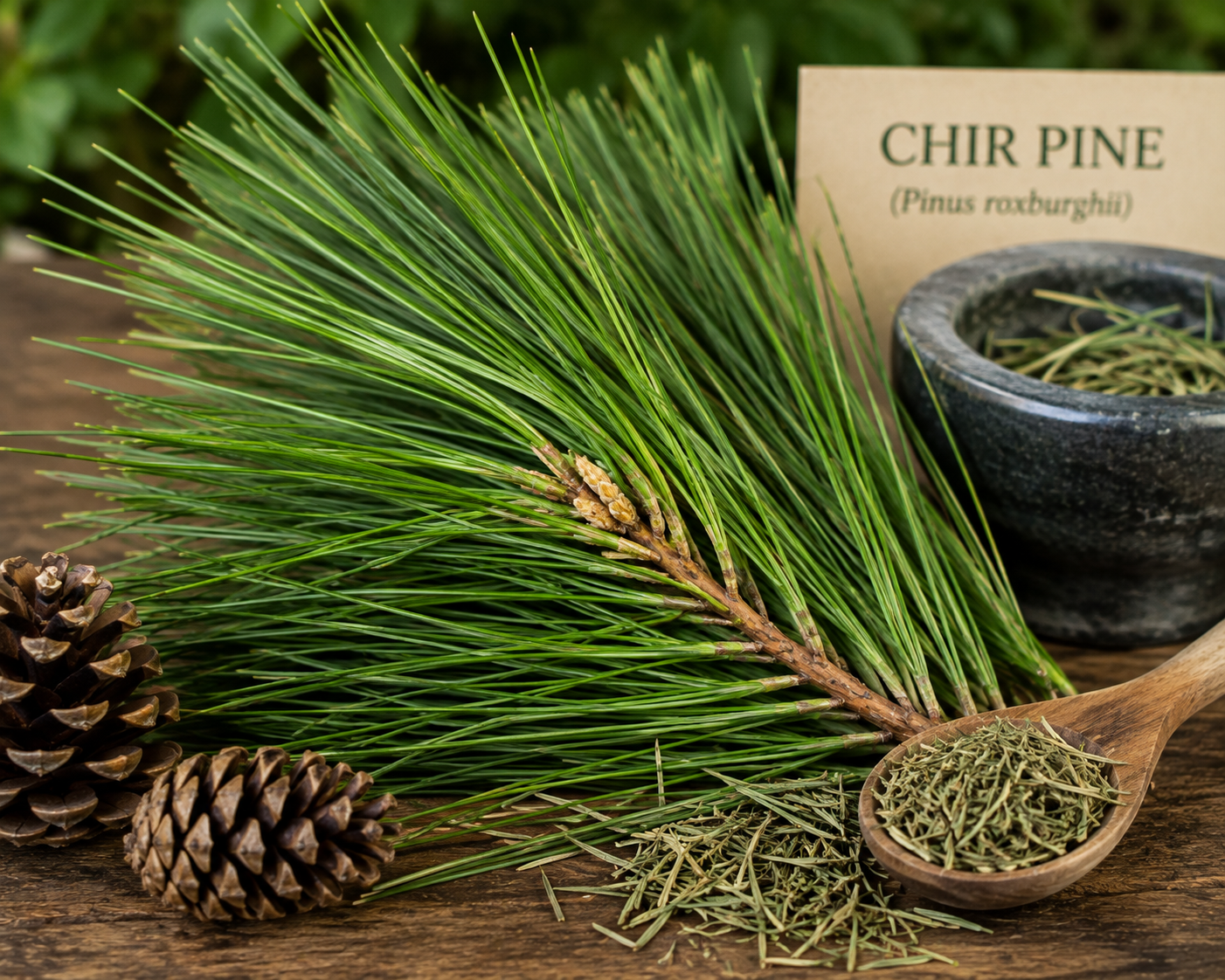
Chir Pine (Introduction, Benefits, and Usages)
Towering over the lower Himalayan slopes, Chir Pine is one of the most recognizable coniferous trees of northern India. Botanically known as Pinus roxburghii Sarg., this evergreen tree is valued not only for timber and resin but also for its long history of use in traditional healing practices.
The Royal Botanic Gardens, Kew recognizes Pinus roxburghii as an accepted species in the Pinaceae family. Its native range extends from Pakistan through the Himalayan region and northwestern India, with populations also recorded across Nepal, Tibet, Bangladesh, and the eastern and western Himalayas.
Chir Pine has traditionally provided mountain communities with timber, fuel, resin, and other useful materials. Its resin is particularly important because it can be processed to obtain products such as turpentine oil and rosin. Traditional medicinal systems have also used different parts of the tree for a variety of purposes, although many of these applications have not yet been confirmed through large human clinical trials.
This article explores what Chir Pine is, its traditional Ayurvedic and folk uses, its potential benefits according to modern research, common applications, and the precautions that should be considered before using pine-derived preparations medicinally.
What Is Chir Pine?
Chir Pine is a tall evergreen conifer belonging to the genus Pinus.
Its scientific name is:
Botanical Name: Pinus roxburghii Sarg.
Family: Pinaceae
Common Name: Chir Pine
Other Name: Indian Longleaf Pine
Older Botanical Synonym: Pinus longifolia
Kew’s Plants of the World Online lists Pinus longifolia Roxb. ex Lamb. as a botanical synonym of Pinus roxburghii.
The tree is especially associated with Himalayan landscapes. It produces long needle-like leaves arranged in bundles and characteristic woody cones containing seeds.
Chir Pine can form extensive forests and is economically important in several Himalayan regions.
The tree yields an aromatic resin when its bark or trunk is tapped. This resin has historically been one of the plant’s most valuable products.
Chir Pine in Traditional Medicine
Different parts of Pinus roxburghii have been used in traditional systems of medicine and local folk practices.
A published review of the ethnobotany and phytopharmacology of the species describes traditional applications involving the resin, wood, bark, leaves, and other parts of the tree. The review records historical uses for conditions involving the skin, throat, respiratory tract, wounds, and inflammatory complaints.
These uses are important from an ethnobotanical perspective, but traditional use should not automatically be interpreted as proof of clinical effectiveness.
Modern scientific research on Chir Pine remains largely at the laboratory, phytochemical, and animal-study level.
For readers interested in learning about other traditional plants and Ayurvedic ingredients, the verified Ayurvedaholic Herbs section contains additional guides to Indian herbs, foods, and botanicals.
Important Constituents of Chir Pine
Researchers have identified numerous naturally occurring plant compounds in Pinus roxburghii.
Its extracts and essential fractions contain various groups of phytochemicals, including compounds belonging to:
- Terpenoids
- Flavonoids
- Phenolic compounds
- Volatile oils
- Resin acids
Pine resin is particularly rich in terpenoid-type compounds, which contribute to its characteristic aroma and many of its industrial properties. Reviews of Pinus roxburghii also describe a range of phytochemicals that have attracted scientific interest for potential biological activity.
However, identifying potentially active compounds in a plant does not mean that the whole plant or its oil has been proven to treat human disease.
Potential Benefits of Chir Pine
1. Traditionally Used for Inflammatory Complaints
One of the most frequently researched properties of Chir Pine is its possible anti-inflammatory activity.
An experimental study published on Pinus roxburghii investigated analgesic and anti-inflammatory activity using animal models. The findings suggested measurable biological activity in the tested extracts.
This supports further investigation into compounds found in the plant, but it does not establish Chir Pine as a clinically proven treatment for arthritis, chronic inflammation, or pain in humans.
People experiencing persistent joint pain or inflammation should seek medical assessment rather than relying solely on traditional pine preparations.
2. May Have Analgesic Activity
Traditional systems have used certain Chir Pine preparations for discomfort and painful conditions.
Animal research has also examined possible analgesic, or pain-modulating, effects of extracts from the plant.
Again, the evidence is preliminary.
There is currently an important difference between showing activity in an experimental model and proving that a standardized product is safe and effective for treating pain in people.
Chir Pine products should therefore not be used as a replacement for prescribed pain treatment without professional advice.
3. Traditional Use for Respiratory Problems
Chir Pine has a strong aromatic character because of the volatile compounds found in its resin and oil.
Traditional medicinal accounts have described the use of the tree in connection with cough, bronchial complaints, and respiratory discomfort.
This traditional reputation is one reason pine-like aromas remain common in balms and inhalation products.
However, concentrated pine or turpentine oils should not be swallowed or inhaled excessively as home treatments. Essential and volatile oils can irritate the respiratory tract and may be harmful if used incorrectly.
Persistent cough, breathing difficulty, wheezing, chest pain, or fever requires appropriate medical evaluation.
4. Antioxidant Potential
Plants naturally produce phenolic and flavonoid compounds that can demonstrate antioxidant activity in laboratory experiments.
Research reviews of Pinus roxburghii have identified phytochemicals that may contribute to antioxidant activity.
Antioxidants can help neutralize reactive molecules in experimental systems, but laboratory antioxidant activity should not be translated into claims that Chir Pine prevents aging, cancer, heart disease, or other illnesses.
Much more research would be required to establish meaningful clinical benefits.
5. Possible Antimicrobial Properties
Researchers have also investigated extracts of Chir Pine for activity against certain microorganisms.
Reviews of the plant describe experimental findings involving antibacterial and antifungal activity.
Such findings are scientifically interesting and may help identify compounds for future research.
However, a plant extract showing antimicrobial activity in a laboratory dish is not equivalent to an approved antibiotic or antifungal medicine.
Serious bacterial or fungal infections require appropriate diagnosis and treatment.
6. Traditional Use for Skin and Wounds
Chir Pine resin has traditionally been applied externally in some communities for wounds and certain skin complaints.
Ethnobotanical reviews document historical use of Pinus roxburghii in connection with ulcers, skin problems, and wound care.
Resin’s sticky texture may have contributed to its traditional topical applications.
However, raw pine resin can also cause skin irritation or allergic contact reactions in susceptible individuals.
It should not be applied to deep wounds, burns, infected skin, or large damaged areas without professional medical guidance.
Chir Pine Resin: One of Its Most Important Products
Resin is perhaps the best-known commercial product obtained from Chir Pine.
The tree can be tapped to release a sticky aromatic substance known as oleoresin.
Industrial processing can separate this material into products such as:
Turpentine Oil
Turpentine is a volatile liquid traditionally used in industries involving:
- Paints
- Varnishes
- Solvents
- Fragrances
- Chemical manufacturing
Although turpentine has a history of medicinal use, concentrated turpentine is potentially toxic and should not be treated as a casual home remedy.
Rosin
The solid portion remaining after volatile turpentine components are separated is known as rosin.
Rosin has many industrial applications and can be found in products related to adhesives, coatings, paper processing, musical instruments, and manufacturing.
Chir Pine resin and timber contribute economically to Himalayan forest communities and industries.
Traditional Uses of Different Parts of Chir Pine
Different parts of the tree have historically been used for different purposes.
Chir Pine Resin
Traditionally, the resin has been used externally in folk practices associated with:
- Minor skin complaints
- Wound applications
- Local discomfort
- Certain inflammatory conditions
Modern self-treatment with raw resin is not advisable because the preparation, concentration, purity, and individual sensitivity can vary.
Bark
Bark extracts have attracted research interest because bark contains various plant polyphenols and other phytochemicals.
Traditional practices have also used bark preparations for different local health applications.
Wood
Chir Pine wood has historically been important for construction, fuel, and other practical purposes.
Traditional medicinal literature and ethnobotanical accounts also describe medicinal applications of the wood, although these should be viewed as historical uses rather than proven treatment recommendations.
Needles
The tree’s long green needles are one of its most recognizable features.
Pine needles contain volatile aromatic compounds and have been investigated for various chemical constituents.
However, people should not assume that all pine needles are edible or appropriate for making tea. Different pine species contain different compounds, and correct botanical identification is essential before ingesting any wild plant.
Chir Pine and Ayurveda
Chir Pine is often discussed alongside traditional Ayurvedic and regional herbal practices.
Historical herbal traditions used pine-derived substances because of their aromatic, resinous, and warming character.
However, modern readers should be cautious when websites assign precise Ayurvedic properties or dosha effects to a plant without citing reliable classical sources.
It is safer to understand Chir Pine primarily as a historically important Himalayan medicinal and economic plant whose resin and other parts have been used in traditional practice and are now being investigated scientifically.
Traditional knowledge can help identify interesting plants for research, but clinical recommendations need stronger evidence.
How Is Chir Pine Used Today?
Chir Pine remains important far beyond herbal medicine.
Its modern uses include:
- Resin production
- Turpentine manufacture
- Rosin production
- Timber
- Fuelwood
- Construction materials
- Industrial raw materials
- Traditional household applications
The Indian forestry literature describes Chir Pine as an important source of resin, timber, and turpentine-related materials in parts of the western Himalayas.
This economic importance is one reason Chir Pine forests have long been closely connected with mountain livelihoods.
Can You Use Chir Pine at Home?
Using Chir Pine as a medicinal ingredient at home requires caution.
There is no universally established home dosage for Chir Pine resin, bark extract, needle extract, or essential oil.
The chemical concentration can differ widely between:
- Raw resin
- Essential oil
- Commercial extracts
- Traditional preparations
- Laboratory extracts
For this reason, a dosage used in a research experiment should never be converted into a home remedy.
If a properly manufactured herbal product contains Pinus roxburghii, follow its labeled directions and obtain professional advice if you have an existing health condition or use prescription medicines.
Safety and Precautions
Do Not Swallow Turpentine Oil
Turpentine oil is not a normal dietary supplement.
Ingestion can be toxic and may cause serious health problems.
Keep turpentine and similar concentrated products away from children and pets.
Avoid Undiluted Concentrated Oils
Concentrated volatile oils can irritate the:
- Skin
- Eyes
- Nose
- Throat
- Airways
Do not apply concentrated oils directly to sensitive skin unless the specific product is designed and properly diluted for topical use.
Patch Test Topical Products
People using a properly formulated topical pine-containing product may consider testing a small amount first.
Stop use if redness, burning, itching, swelling, or rash appears.
Pregnancy and Breastfeeding
There is insufficient high-quality evidence to establish medicinal doses of Chir Pine preparations as safe during pregnancy or breastfeeding.
Medicinal use should therefore be discussed with an appropriate healthcare professional.
Children
Concentrated essential oils, turpentine products, and medicinal pine preparations should not be casually given to children.
Asthma and Respiratory Sensitivity
Strong fragrances and volatile oils may irritate the airways of some sensitive individuals.
Anyone who develops wheezing or difficulty breathing after exposure should discontinue use and seek appropriate medical attention.
Chir Pine Is Not the Same as Pine Nuts
It is useful to distinguish Chir Pine from edible pine nuts.
“Pine” refers to a large group of species within the genus Pinus. Only certain species are commonly harvested for edible pine nuts.
The fact that one pine species produces edible seeds does not mean that every part of every pine species should be eaten.
Correct identification matters whenever wild plants are being used.
Frequently Asked Questions
What is Chir Pine called scientifically?
The accepted scientific name is Pinus roxburghii Sarg., belonging to the family Pinaceae. Kew lists Pinus longifolia as a synonym.
Where is Chir Pine found?
Chir Pine is native to the Himalayan region, including areas of India, Nepal, Pakistan, Tibet, Bangladesh, and the eastern and western Himalayas.
What is Chir Pine mainly used for?
Its major practical uses include timber, resin production, turpentine, rosin, fuel, and various traditional applications.
Does Chir Pine have anti-inflammatory properties?
Laboratory and animal research has reported anti-inflammatory and analgesic activity in certain Pinus roxburghii extracts, but this does not prove effectiveness as a treatment for inflammatory diseases in humans.
Can Chir Pine resin be applied to skin?
Resin has a history of traditional topical use, but raw resin may irritate sensitive skin or trigger contact reactions. It should not be applied to serious wounds or skin diseases without professional guidance.
Can Chir Pine cure cough?
Traditional medicine has used parts of Chir Pine for cough and respiratory complaints, but there is not enough clinical evidence to describe it as a proven cure. Persistent or severe respiratory symptoms require medical evaluation.
Is Chir Pine oil safe to drink?
Concentrated turpentine and pine-derived volatile oils should not be swallowed unless a specific regulated medicinal product has been prescribed or recommended appropriately. Turpentine ingestion can be dangerous.
Final Thoughts
Chir Pine, or Pinus roxburghii, is much more than a familiar Himalayan tree.
For generations, it has supported mountain communities through its timber, fuel, resin, rosin, and turpentine, while its bark, resin, wood, and other parts have also appeared in traditional medicinal practices.
Modern research has begun investigating some of these traditional uses. Experimental studies have reported potentially interesting anti-inflammatory, analgesic, antioxidant, and antimicrobial activities, but much of this evidence remains preliminary.
That distinction matters.
Chir Pine should not be promoted as a proven cure for respiratory disease, arthritis, infections, wounds, or other medical conditions simply because laboratory studies or traditional practices suggest potential activity.
Its strongest story is the combination of traditional knowledge, ecological importance, economic value, and emerging scientific research.
For those interested in Ayurveda and medicinal plants, Chir Pine is a fascinating reminder of how Himalayan forests have supplied people with useful natural materials for centuries.
At the same time, concentrated resin products, essential oils, and especially turpentine require appropriate handling. Natural origin does not automatically guarantee safety.
Used with knowledge and caution, Chir Pine remains an important part of India’s botanical and traditional heritage—and a plant worthy of further scientific study.
External Reference: Royal Botanic Gardens, Kew – Pinus roxburghii
Internal Link: Explore More Ayurvedic Herbs at Ayurvedaholic
Disclaimer: This article is intended for educational and informational purposes only. Traditional uses described here are not necessarily supported by sufficient human clinical evidence. Do not ingest turpentine oil or use concentrated Chir Pine preparations medicinally without appropriate professional guidance. Consult a qualified healthcare professional before using herbal preparations if you are pregnant, breastfeeding, taking medication, or managing a medical condition.
Add comment