
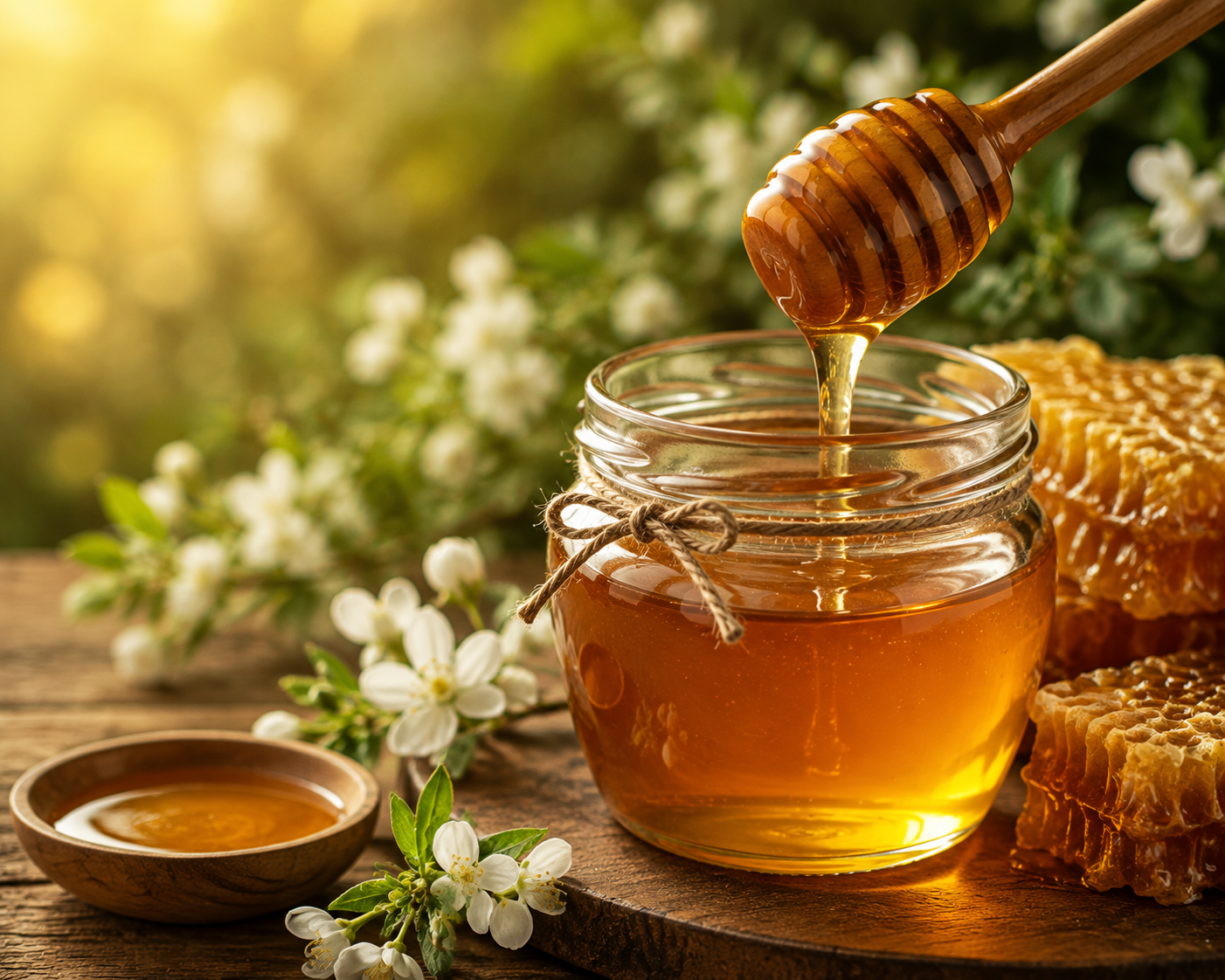
Honey (Introduction, Benefits, and Usages)
Honey benefits have been documented across every major healing tradition on earth — Egyptian papyri from 2700 BCE, the Ayurvedic Charaka Samhita, Hippocratic writings, and now thousands of modern studies all validate honey’s antimicrobial, wound-healing, cough-suppressing, antioxidant, and prebiotic properties. What makes honey remarkable is the combination: natural hydrogen peroxide production, osmotic water-drawing properties, methylglyoxal (in Manuka), bee defensins, and polyphenols together create an antimicrobial environment no single pharmaceutical agent replicates. See Wikipedia: Honey. For related Ayurvedic Anupana medicines, explore Turmeric and Ginger.
What Is Honey? A Complete Introduction
Origin and History of Honey
Honey has been collected by humans for at least 10,000 years — rock paintings in Spain show honey collecting from wild bee hives at that date. Ancient Egyptians used honey extensively as a wound dressing and preservative (honey-preserved foods have been found in pharaoh’s tombs still edible after 3,000 years). In Ayurveda, Madhu (honey) is one of the most important Anupana (medicinal vehicle/adjuvant) — considered capable of carrying medicines deeper into tissues and making them more bioavailable. The Charaka Samhita lists Madhu as one of the eight most important medicinal substances (Ashtavarga). Greek physicians, Hippocrates included, used honey extensively for wound care, burns, and digestive conditions. Virtually every traditional medicine system on earth independently discovered honey’s therapeutic value.
Key Compounds and Nutritional Profile
Honey is primarily fructose (38%) and glucose (31%) with about 17% water and diverse minor components that provide its medicinal properties. Hydrogen peroxide — produced when honey contacts moisture through glucose oxidase enzyme activity — provides broad-spectrum antimicrobial activity. Methylglyoxal (MGO) — particularly high in Manuka honey from Leptospermum scoparium — provides peroxide-independent antimicrobial activity effective against MRSA and other resistant bacteria. Polyphenols including chrysin, caffeic acid, kaempferol, quercetin, and luteolin provide antioxidant and anti-inflammatory effects. Bee defensin-1 (royal jelly protein) provides additional antimicrobial activity. See Wikipedia: Methylglyoxal.
Top Health Benefits of Honey
Honey Benefits for Immunity and Overall Health
Honey’s most robustly evidenced clinical application is cough and upper respiratory tract infections. A Cochrane review and a 2021 BMJ meta-analysis of 14 randomised trials found honey significantly more effective than usual care for upper respiratory tract infections — including cough frequency, cough severity, and duration of symptoms. Honey outperformed antibiotic use (which is inappropriate for viral URTIs) and was comparable to diphenhydramine for cough suppression in children. The WHO now recommends honey as a first-line treatment for cough in children over 1 year old. The antimicrobial mechanism — hydrogen peroxide, MGO, bee defensins, and osmotic stress — makes honey genuinely effective against both bacterial and viral respiratory pathogens.
Honey for Skin, Hair, and Beauty
Honey is one of the most evidence-backed natural wound-healing agents available. Multiple clinical trials confirm Manuka honey wound dressings accelerate healing of surgical wounds, burns, diabetic foot ulcers, and pressure ulcers — significantly reducing infection rates and healing time. The mechanism: osmotic dehydration of wound environment inhibits bacterial growth, hydrogen peroxide and MGO kill surface bacteria, and honey’s anti-inflammatory compounds reduce wound inflammation. For skin care, honey’s humectant properties (drawing moisture from air into skin), antimicrobial activity against acne bacteria, and anti-inflammatory compounds make it an effective face mask for acne-prone, dry, or sensitive skin. For hair, honey conditions and adds shine through its humectant and emollient properties.
Medicinal Properties of Honey
How Honey Works as a Natural Remedy
Honey’s antimicrobial mechanism is multi-layered and uniquely resistance-resistant.
Osmotic dehydration: honey’s high sugar concentration draws water from bacterial cells through osmosis, dehydrating them.
Hydrogen peroxide: glucose oxidase (added by bees) converts glucose to gluconolactone and hydrogen peroxide when diluted — providing slow-release antimicrobial activity.
Methylglyoxal: in Manuka honey, MGO alkylates bacterial DNA and proteins, killing bacteria including MRSA without resistance development.
Bee defensin-1: an antimicrobial peptide that disrupts bacterial membranes.
Low pH: honey’s acidity (pH 3.2–4.5) inhibits bacterial growth. Because honey attacks bacteria through five simultaneous mechanisms, resistance development is essentially impossible — a key advantage over single-target antibiotics.
Honey in Ayurveda and Traditional Medicine
In Ayurveda, Madhu (honey) is considered the best of all Anupanas (medicinal vehicles) — it carries other medicines deeper into Rasa (plasma), Rakta (blood), and Mamsa (muscle) tissues than they would otherwise reach. This is pharmacologically sound: honey’s compounds can interact with intestinal transporters and membrane permeability in ways that genuinely enhance co-administered drug absorption. Ayurveda classifies Madhu as Guru (heavy), Kashaya (astringent), Madhura (sweet), Hridya (cardiac tonic), Chakshushya (eye tonic), Vrana-Shodhana (wound cleanser), and Lekhana (fat-scraping). A critical Ayurvedic rule: honey should never be heated — Ayurveda considered heated honey toxic (Ama-producing). Modern research confirms that heating honey above 40°C generates hydroxymethylfurfural (HMF) — a compound that may be harmful — validating this ancient caution.
How to Use Honey — Practical Usages
Honey in Food, Tea, and Traditional Preparations
Add honey to warm (not hot) drinks — once below 40°C (test with your hand). A classic morning tonic: warm water, honey, and lemon — hydrating, alkalising (despite honey’s acidity, it has an alkaline ash), vitamin C-providing, and antimicrobial. For coughs: a teaspoon of honey directly, or mixed with ginger juice and black pepper, before bed — the Cochrane-evidenced approach. For sore throat: honey dissolved in warm water as a gargle. Combine with Turmeric (golden milk with honey added after cooling slightly) for anti-inflammatory and immune-supporting combination. As an Anupana in Ayurveda: mix herbal powders with honey to enhance their penetration and palatability.
Honey as a Supplement or Topical Application
For wound care: apply medical-grade Manuka honey (UMF 10+ or MGO 100+) directly to minor wounds, burns, and skin infections — cover with a clean dressing. Change dressing daily. For acne skin care: apply raw honey as a face mask for 15–20 minutes, rinse with warm water — the antimicrobial and humectant properties reduce acne and improve skin moisture without the drying effect of conventional acne treatments. For hair conditioning: mix honey with a little warm water or coconut oil and apply to damp hair from mid-length to ends — leave 20 minutes before washing. Choose raw, unprocessed honey for topical applications — commercial honey is often heated and pasteurised, which deactivates the beneficial enzymes.
Side Effects and Precautions of Honey
- Infants under 12 months: honey must never be given to babies under 1 year — it can contain Clostridium botulinum spores that cause infant botulism, which is potentially fatal; the mature gut of older children and adults safely clears these spores
- Blood sugar: honey raises blood sugar — diabetics should use cautiously, substitute Manuka honey for its lower GI (50 vs 65 for table sugar), and monitor glucose response
- Heating honey: don’t heat honey above 40°C — this generates hydroxymethylfurfural (HMF) and destroys beneficial enzymes; add to warm, not hot drinks
- Allergies: people with pollen or bee allergies may react to honey — start with small amounts if you have known pollen sensitivities
Frequently Asked Questions About Honey
What are the main honey benefits for health?
Key honey benefits: cough suppression and URTI symptom reduction (Cochrane review evidence, WHO recommendation), broad-spectrum antimicrobial activity resistant to antibiotic resistance development, wound healing and infection control for minor wounds, burns, and diabetic ulcers (clinical trial evidence), prebiotic effect supporting beneficial gut bacteria, antioxidant protection from polyphenols, anti-inflammatory action, skin moisturising and antimicrobial benefits for topical use, and Anupana function enhancing bioavailability of co-administered Ayurvedic medicines.
Is Manuka honey better than regular honey?
For wound healing and antibiotic-resistant infections specifically — yes. Manuka honey from New Zealand’s Leptospermum scoparium contains methylglyoxal (MGO) at concentrations far higher than regular honey, providing peroxide-independent antimicrobial activity against MRSA, MRSE, and Helicobacter pylori. Look for UMF 10+ (Unique Manuka Factor) or MGO 100+ for wound care. For general health benefits — cough suppression, antioxidant, prebiotic — good quality raw honey of any variety provides similar benefits. The MGO difference matters most for serious antimicrobial applications, less so for general wellness.
Why does Ayurveda say honey shouldn’t be heated?
Ayurveda classifies heated honey as “Ama” — a toxic incompatible substance. Modern food science validates this: heating honey above 40°C generates hydroxymethylfurfural (HMF) through the breakdown of fructose. At lower temperatures, HMF is produced slowly. At high temperatures (boiling), it forms rapidly. HMF is not immediately acutely toxic, but chronic exposure and cumulative intake are of concern — it has shown mutagenic potential in cell studies. More practically, heating above 40°C also deactivates glucose oxidase (eliminating hydrogen peroxide production) and degrades polyphenols, removing the primary therapeutic compounds. The Ayurvedic rule to never heat honey is both pharmacologically sound and biochemically validated.
How much honey should I eat daily?
For health benefits without excessive sugar intake: 1–2 tablespoons (20–40g) daily provides meaningful polyphenol, antimicrobial, and prebiotic benefit while keeping added sugar within reasonable limits. For therapeutic cough suppression: 1 teaspoon (5–10g) before bed has clinical evidence. For wound care, there’s no “internal dose” — Manuka honey is applied topically. For Ayurvedic use as Anupana: mix herbal powders with enough honey (typically ½–1 teaspoon) to form a paste — this is the vehicle dose, not a daily wellness serving. People with diabetes or insulin resistance should limit honey intake and prefer Manuka honey for its lower glycaemic index.
What is the best honey for skin care?
For wound care and serious antimicrobial skin applications: medical-grade Manuka honey (UMF 10+ or MGO 100+) is optimal for its documented MRSA-active compounds. For general face mask, acne treatment, and moisturising applications: raw, unfiltered, unheated honey of any variety provides good antimicrobial, humectant, and anti-inflammatory benefit. Look for raw honey with visible pollen and some cloudiness — signs of minimal processing. Commercial “pure honey” that’s been filtered and pasteurised has significantly fewer beneficial compounds than raw varieties.
Honey benefits are uniquely validated across both the oldest and most recent medical traditions simultaneously. The WHO recommends it for coughs. Clinical trials confirm wound healing. Ancient Egyptians used it for preservation. Ayurveda considers it the finest medicine vehicle. And modern microbiology has explained exactly why it works — five simultaneous antimicrobial mechanisms that no bacterium can become resistant to. Keep raw honey in your kitchen medicine cabinet, reach for it first for coughs and minor wounds, use Manuka for serious skin infections, and never heat it. These are some of the simplest and most evidence-solid practices in natural medicine.



Add comment