
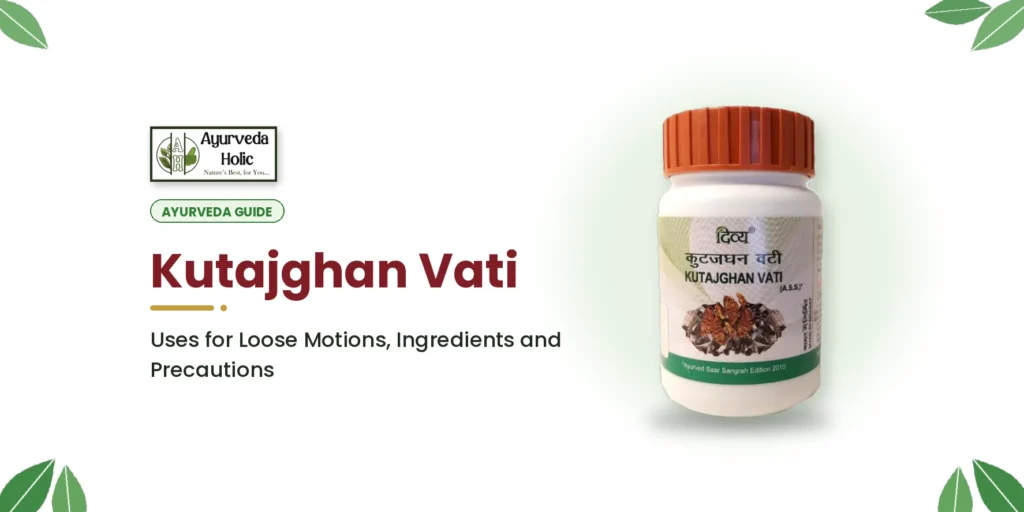
Short answer. Kutajghan vati is a tablet made from a concentrated extract of kutaj bark. Kutaj is Ayurveda’s main herb for loose motions (atisara) and frequent, mucus-filled stools (pravahika). Take it at the pack dose. And keep drinking ORS, because dehydration is the real danger in diarrhoea. See a doctor straight away for blood in the stool, fever or signs of dehydration.
It’s the tablet a lot of families keep in the travel bag. Here’s what kutajghan vati is, how to use it right, and the one thing that matters more than any tablet.
What kutajghan vati is
Kutaj is the bark of a small tree found across India. Ghan means a concentrated extract. A ghanvati is made by boiling the herb, reducing it to a thick paste and pressing it into tablets. Charaka calls kutaj the best herb for loose motions.
Here’s what Patanjali Divya Kutajghan Vati lists on our product page.
| Ingredient | Botanical name | Traditional role |
|---|---|---|
| Kutaj | Holarrhena antidysenterica | The classical herb for loose motions |
| Ativisha | Aconitum heterophyllum | Digestive. Used in bowel complaints |
| Bilva | Aegle marmelos (bael) | Astringent. Firms stools |
| Daru haldi | Berberis aristata | Bitter, cleansing |
| Mustaka | Cyperus rotundus | Digestive |
Check your pack for the full list and amounts.
Kutajghan vati uses (traditional)
- Loose motions (atisara)
- Frequent stools with mucus and cramps (pravahika)
- Weak digestion after a bout of loose motions
It isn’t a substitute for ORS. And it isn’t a substitute for antibiotics when a doctor finds an infection that needs them.
What research says
Lab studies show kutaj extracts work against some microbes and slow diarrhoea. A few small studies have looked at it in dysentery and IBS. Good trials are limited. So it’s traditional support. Fluids and ORS always come first.
The first rule, prevent dehydration
The biggest risk in diarrhoea is losing water and salts. Whatever else you take, do this.
- Drink ORS after every loose stool. Any chemist sells the sachets.
- Keep sipping. Water, coconut water, thin dal water, rice kanji or buttermilk.
- Eat light. Khichdi, curd rice, banana, toast.
For children with diarrhoea, doctors also give zinc tablets along with ORS. Ask your paediatrician.
How to make ORS at home in an emergency
If you can’t get a sachet, the WHO home recipe is simple.
- A litre of clean, boiled and cooled water
- Six level teaspoons of sugar
- Half a level teaspoon of salt
Stir till it dissolves, and sip it through the day. Use packet ORS whenever you can. It has the right balance of salts.
How to take kutajghan vati
- Dose. As printed on the pack, or as your doctor says.
- When. With water, a few times a day while symptoms last.
- How long. A few days. If things don’t settle in two days, see a doctor.
What to eat and avoid
| Eat | Avoid |
|---|---|
| Khichdi, curd rice, plain rice with thin dal | Fried, oily and spicy food |
| Ripe banana, stewed apple | Raw salads and cut fruit from outside |
| Thin buttermilk, coconut water | Milky sweets, ice cream |
| Toast, poha, idli | Cold drinks and sugary juices |
Travel tips
- Drink sealed bottled water or boiled water.
- Eat freshly cooked, hot food.
- Skip ice, cut fruit and street salads.
- Wash your hands or use sanitiser before eating.
- Carry ORS sachets.
Who should avoid it
- Pregnant and breastfeeding women. Only on a doctor’s advice.
- Children. Only at a dose a doctor gives. For babies, see a paediatrician.
- Constipation. Don’t use it to “regulate” normal bowels.
- Regular medicines. Ask your doctor first.
Side effects
Too much, or for too long, can cause constipation or stomach discomfort. Stop once your stools are normal.
Common mistakes
- Taking it for bloody diarrhoea or high fever instead of seeing a doctor.
- Giving adult tablets to children.
- Taking it for weeks when loose motions keep coming back.
When to see a doctor straight away
- Blood or black colour in the stool
- High fever
- Dehydration, like very little urine, dizziness, dry mouth or sunken eyes
- A baby with no tears or a dry nappy for hours
- Diarrhoea in a baby, an older person, or someone with diabetes, heart or kidney disease
- Diarrhoea lasting over two days, or severe stomach pain
- Loose motions after food that made others sick too
Frequently asked questions
What is kutajghan vati used for?
Ayurveda uses it for loose motions and frequent stools with mucus.
How should I take kutajghan vati for loose motions?
At the pack dose, with water, while drinking ORS.
Can children take kutajghan vati?
Only at a dose a doctor gives. For babies, see a paediatrician and give ORS.
Is kutajghan vati an antibiotic?
No. It’s a traditional herbal formula. Some infections need antibiotics, which only a doctor can prescribe.
Can kutajghan vati be taken with ORS?
Yes. ORS matters most. The tablet can go alongside it.
Is kutajghan vati better than kutajarishta?
Both are based on kutaj. The tablet has no alcohol or sugar. Our kutajarishta guide compares them.
Shop: Patanjali Divya Kutajghan Vati · Patanjali Isabgol
This article is for general information and isn’t medical advice. See a doctor for severe or persistent diarrhoea, and always prevent dehydration with ORS.


