
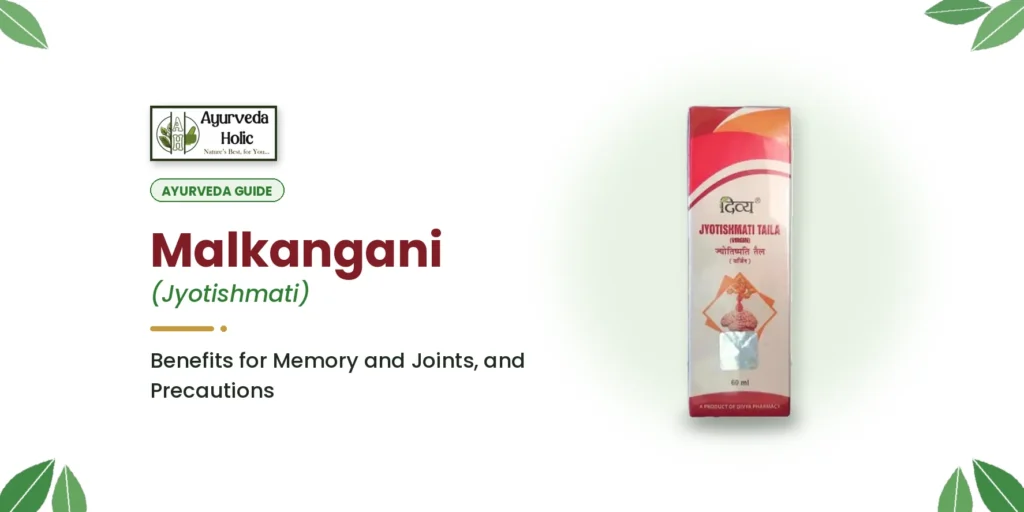
Short answer. Malkangani, or jyotishmati, is a climbing shrub. Ayurveda uses its seeds and seed oil as a strong medhya herb, one for the mind. The traditional malkangani benefits are for memory and mental sharpness. As an oil, it’s used for joint and muscle pain. It’s potent and heating. So it’s used in small amounts, and taken internally only under supervision.
Jyotishmati means “luminous”. The name’s linked to a bright, clear mind. That’s a big promise for a little orange seed. Here’s what it’s really used for, and why it needs respect.
What malkangani is
Malkangani grows in forests across India. Its orange-red seeds are pressed for a dark oil called jyotishmati taila. They’re also used in formulas.
| Feature | Detail |
|---|---|
| Botanical name | Celastrus paniculatus |
| Common names | Malkangani, jyotishmati, intellect tree |
| Part used | Seeds and seed oil |
| Ayurvedic nature | Bitter, pungent, sharp, heating |
| Dosha | Reduces Kapha and Vata. Increases Pitta |
Malkangani in classical texts
Texts like the Bhavaprakasha call it medhya, supporting intellect and memory. It’s often discussed with other mind herbs like brahmi, shankhpushpi and vacha. It’s also described as sharp and heating. That’s why it’s used in small amounts, and why it can stir up Pitta.
Malkangani benefits in Ayurveda
- Memory and mental sharpness. As a medhya herb.
- Joint and muscle pain. The oil, rubbed in.
- Nerve weakness. In classical Vata formulas.
- Skin patches. In some classical external preparations.
What research says
Most of the research is in animals. In those studies, the seed oil or extracts improved learning and memory tasks and showed antioxidant effects in the brain. A few small human studies of formulas containing it exist. There are no good trials of malkangani alone for memory in people. For pain, lab and animal studies suggest anti-inflammatory effects.
Products that contain malkangani
| Product | How it’s used |
|---|---|
| Patanjali Divya Jyotishmati Taila | Pure seed oil |
| Patanjali Divya Medha Vati | Mind-tonic tablet |
| Patanjali Divya Peedanil Taila | Pain-relief oil |
| Patanjali Divya Peedanil Ointment | Pain-relief ointment |
Medha Vati contains other herbs too, so read the full label.
How to massage with jyotishmati oil
- Warm a teaspoon of oil by standing the bottle in warm water.
- Patch test on your inner arm the first time.
- Massage gently around the stiff joint or sore muscle for five to ten minutes.
- Put a warm towel or hot water bag on it.
- Wipe off the extra and wash your hands. Keep it away from your eyes.
It’s strong. Lots of people dilute it with sesame oil.
Internal use
Only inside formulas, at the label dose. Classical texts describe taking a few seeds or drops of oil in a slowly rising pattern. That’s strictly something to do under a vaidya.
Malkangani vs other memory herbs
| Herb | Nature | Traditional use | Good for |
|---|---|---|---|
| Malkangani | Heating, sharp | Memory, nerves | Short-term, supervised |
| Brahmi | Cooling | Memory, calm mind | Daily use for most people |
| Shankhpushpi | Cooling | Calm, sleep, memory | Daily use. Mild |
| Vacha | Heating | Speech, clarity | Small doses, supervised |
For daily memory support, gentler herbs suit most people better. See our brahmi guide.
Who should avoid it
- Pregnancy and breastfeeding. Avoid it.
- Acidity, ulcers or Pitta conditions. It’s heating.
- Children. Only on a doctor’s advice.
- Psychiatric, sedative or epilepsy medicines. Ask your doctor before taking it internally.
Side effects
Too much by mouth can cause nausea, vomiting, sweating and burning. On the skin, it can irritate. Stop and see a doctor if you feel unwell.
Common mistakes
- Taking the seeds or oil by mouth without supervision.
- Giving it to students before exams as a quick memory boost.
- Using the oil on broken or sensitive skin.
Frequently asked questions
What are the main malkangani benefits?
Ayurveda uses it for memory and mental sharpness. The oil’s used for joint and muscle pain.
Is malkangani the same as jyotishmati?
Yes. Jyotishmati is its Sanskrit name. Jyotishmati taila is the oil from its seeds.
How do I use jyotishmati oil?
Mostly on the skin. Massage a little warm oil into stiff joints or sore muscles. Patch test first.
Can students take malkangani for memory?
Only in formulas at the label dose, or on a vaidya’s advice. Gentler herbs like brahmi suit daily use better.
Is malkangani safe in pregnancy?
No. Avoid it.
Does malkangani help with arthritis?
The oil’s used on stiff joints. Arthritis with swelling or redness needs a doctor’s diagnosis.
Can malkangani oil be used on the scalp?
Some people use a little, diluted in coconut or sesame oil. It can irritate. Patch test first.
Shop: Patanjali Divya Jyotishmati Taila · Patanjali Divya Medha Vati
This article is for general information and isn’t medical advice. See an Ayurvedic doctor before using it internally.


