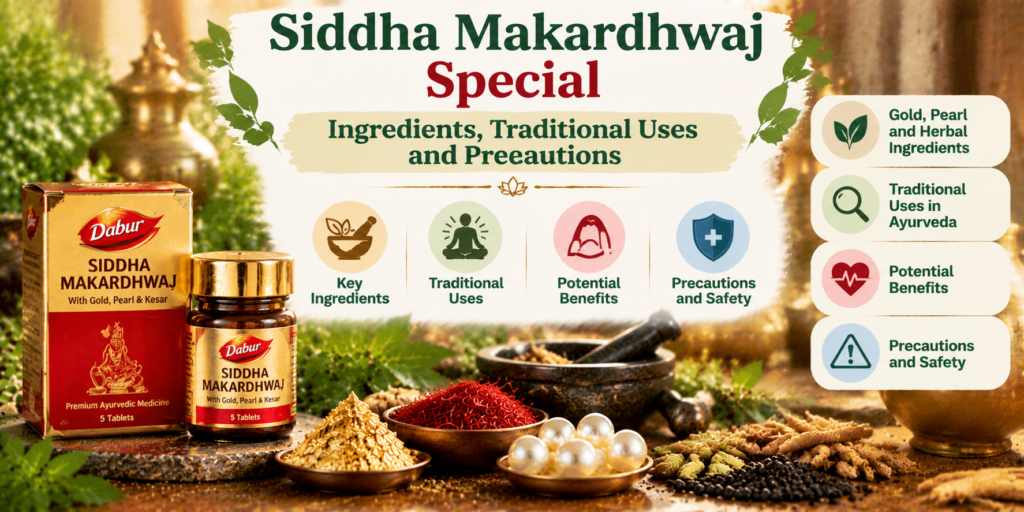
Siddha Makardhwaj Special is a traditional Ayurvedic preparation associated with Rasashastra, the branch of Ayurveda concerned with the processing and use of metals and minerals. It is often discussed in the context of Rasayana, a traditional Ayurvedic concept associated with vitality and wellbeing.
People searching for siddha makardhwaj special benefits may come across descriptions of its traditional uses, ingredients and place in Ayurvedic practice. However, it is important to understand what these descriptions mean, how the preparation differs from ordinary herbal products and why professional guidance matters before considering its use.
Unlike a simple herbal powder, classical Makardhwaj formulations may involve processed gold, mercury and sulphur. Their preparation requires specialised procedures, and the quality of the finished product is an important consideration. Scientific literature has examined the composition and safety of these formulations, but laboratory findings and animal studies should not be interpreted as proof of safety or effectiveness in humans.
This guide explains Siddha Makardhwaj Special from a traditional Ayurvedic perspective, explores its commonly discussed ingredients, and outlines the precautions readers should understand before purchasing or using such a preparation.
What Is Siddha Makardhwaj (Rasa Aushadhi)?
Siddha Makardhwaj, also written as Makaradhwaja or Makardhwaja, is a traditional Ayurvedic herbo-mineral or metal-based preparation described in the literature of Rasashastra. It is associated with a specialised pharmaceutical process known as Kupipakwa Rasayana, which involves controlled heating of ingredients using traditional methods.
The word Rasa Aushadhi refers broadly to medicines associated with the Ayurvedic tradition of processing metals, minerals and related substances. These preparations are distinct from products made exclusively from common culinary herbs.
How does it differ from an ordinary herbal preparation?
An ordinary herbal preparation may use plant parts such as leaves, roots, seeds or bark. Classical Makardhwaj formulations, by contrast, are associated with specialised processing of metallic and mineral ingredients.
The preparation method matters because the starting materials undergo chemical and physical changes during processing. Researchers have used analytical techniques to examine the composition and structure of Makardhwaj samples, demonstrating why manufacturing methods and batch-level quality assessment are important.
However, traditional processing should not be taken as automatic proof that a product is free from toxicological risk. The final composition, manufacturing consistency and quality-control procedures need to be considered.
What does the word Special mean?
The word Special appears in the names of certain commercial formulations, but it should not be interpreted as proof of greater potency, superior quality or better clinical outcomes.
Different manufacturers may offer products with similar names but different formulations. Therefore, consumers should check the exact product label rather than assume that every Siddha Makardhwaj Special product contains identical ingredients or proportions.
For the product discussed in this article, readers can review the Dabur Siddha Makardhwaj Special 10-tablet listing on Ayurvedaholic. The label and manufacturer information should be used to verify the exact formulation.
Ingredients: Swarna Bhasma, Parada and Gandhaka
Three ingredients commonly discussed in classical Makardhwaj formulations are Swarna Bhasma, Parada and Gandhaka. Understanding their traditional names helps readers recognise the nature of this preparation.
The exact composition and proportions can vary across formulations, so the following descriptions explain the ingredients in the broader traditional context rather than confirm the composition of every product sold under this name.
Swarna Bhasma: Processed gold
Swarna means gold, while Bhasma refers to a specially processed preparation in the Ayurvedic pharmaceutical tradition.
Swarna Bhasma has a place in classical Ayurvedic discussions of Rasayana. Its traditional associations with vitality and wellbeing are part of the historical context in which certain gold-containing formulations are described.
These traditional associations do not establish that Swarna Bhasma prevents ageing, improves immunity or treats a particular condition. Such claims require reliable evidence from appropriate human studies.
Parada: Mercury
Parada is the traditional Ayurvedic term for mercury. In Rasashastra, mercury has an important historical role in the preparation of certain metal-based formulations.
Classical methods describe specialised processing of Parada before it is incorporated into particular preparations. Nevertheless, mercury is a toxic element, and exposure can harm the nervous system, kidneys and other organs depending on its chemical form, dose and exposure circumstances.
The presence of mercury makes it especially important to distinguish traditional descriptions of processing from independently established safety. A product should not be assumed harmless simply because its ingredients have undergone traditional purification procedures.
Research on Makardhwaj has investigated mercury content and chemical composition, reinforcing the importance of careful manufacturing and analytical quality control.
Gandhaka: Sulphur
Gandhaka is the Ayurvedic term for sulphur. It is used in various traditional Rasashastra preparations, including formulations involving mercury.
In classical Makardhwaj preparation, sulphur is processed with other ingredients under specified conditions. Scientific investigations have examined the chemical phases formed during manufacturing, including mercury-sulphur compounds.
However, the presence of sulphur does not mean that the product neutralises every potential risk associated with mercury. Safety depends on the finished preparation and its actual properties, not simply on a list of traditional ingredients.
Why do the ingredients matter?
Understanding these ingredients helps explain why Siddha Makardhwaj Special should not be treated as an ordinary herbal supplement.
- The traditional formulation may involve metals and minerals.
- Manufacturing procedures can influence the finished product’s composition.
- The quality and consistency of individual batches matter.
- Product suitability and potential risks require professional assessment.
Important: The presence of Swarna Bhasma, Parada and Gandhaka in classical descriptions does not confirm that every commercial variant contains them in the same proportions. Check the actual product label and available manufacturer documentation before making ingredient-specific assumptions.
Traditional Uses of Siddha Makardhwaj as Described in Ayurvedic Literature
Classical Ayurvedic literature and later discussions of Rasashastra describe Makardhwaj within traditional frameworks concerned with vitality, strength and Rasayana practices. Historical sources have also discussed its use in specific therapeutic contexts.
For readers researching siddha makardhwaj special benefits, the important distinction is between understanding these historical descriptions and treating them as proof of a medical benefit.
Rasayana and traditional wellbeing
Rasayana is a broad Ayurvedic concept associated traditionally with maintaining vitality and wellbeing. Certain metal-based preparations, including Makardhwaj, have been discussed within this framework.
This historical association explains the preparation’s place in traditional Ayurvedic practice. It does not prove that taking the product increases lifespan, reverses ageing or prevents chronic disease.
Traditional discussions of strength and vitality
Some traditional accounts associate Makardhwaj with strength, vigour and recovery in particular contexts. These descriptions belong to the historical and theoretical framework of Ayurveda.
They should not be turned into promises of increased stamina, improved physical performance or faster recovery without adequate clinical evidence.
What does modern research say?
Scientific research on Makardhwaj includes analytical studies of its composition and preclinical investigations of its safety.
For example, a study published in the Indian Journal of Medical Research examined a mercury-based Sidh Makardhwaj formulation in rats. Although the researchers did not observe certain toxicological changes at some tested doses over 28 days, mercury levels in the brain, liver and kidneys increased with dose. The study cannot establish that commercial products are safe for humans or that long-term use is harmless.
A separate analytical investigation examined the chemical composition of Makardhwaj samples and highlighted the importance of understanding the finished preparation rather than relying solely on traditional ingredient descriptions.
These findings illustrate why further research is necessary. Animal studies, chemical analyses and historical references answer different questions; none alone establishes a product’s clinical effectiveness in humans.
A responsible discussion of traditional uses should therefore acknowledge the Ayurvedic context without promising specific health outcomes.
Precautions: Who Should Consult a Physician?
Siddha Makardhwaj Special should not be treated as a routine wellness supplement. Because Makardhwaj formulations may contain mercury and other processed metallic ingredients, their use requires particular attention to product quality, individual circumstances and professional supervision.
A systematic review of reported heavy-metal toxicity associated with traditional Indian medicines identified cases involving mercury, lead and other metals. The review also highlighted problems associated with contamination, manufacturing quality and inappropriate prescribing. These findings do not mean that every product is contaminated, but they demonstrate why quality assurance matters.
Children and adolescents
Do not give this preparation to children based on online advice or another person’s experience. Children may be particularly vulnerable to harmful metal exposure, and any consideration of such a product requires careful professional assessment.
Pregnant or breastfeeding individuals
Anyone who is pregnant, planning pregnancy or breastfeeding should avoid self-prescribing this preparation and seek advice from an appropriate healthcare professional. Do not assume that traditional use establishes safety during pregnancy or breastfeeding.
People with kidney or liver conditions
The kidneys and liver perform important functions in processing and eliminating substances from the body. People with existing kidney or liver conditions should discuss the exact product with their treating clinician before considering its use.
People taking medicines or managing chronic conditions
If you take prescription medicines or are managing a long-term condition, inform your healthcare professional about any Ayurvedic preparation you are considering. Potential interactions may be insufficiently studied, so combining products without professional advice is not advisable.
Anyone considering self-medication
Avoid starting Siddha Makardhwaj Special simply because a website describes benefits relating to vitality, strength or general wellbeing.
A qualified Ayurvedic physician can assess whether the specific preparation is appropriate and explain its limitations. Where necessary, your conventional healthcare provider can help evaluate potential risks and interactions.
Do not independently increase the amount, extend the duration of use or substitute this product for prescribed treatment.
A key safety distinction: Traditional purification and processing are not substitutes for reliable manufacturing controls, appropriate testing and an individual assessment of risk.
If you suspect an adverse reaction after taking a metal-containing preparation, stop using it and seek medical advice. Severe or rapidly worsening symptoms require urgent medical attention.
How to Choose a Genuine Siddha Makardhwaj Special Brand
Selecting a product involves more than recognising a brand name or comparing discounts. Because formulations can differ, check the specific product information and available quality documentation before purchasing.
Here are five practical checks.
1. Verify the exact product name. Confirm that the listing is for Siddha Makardhwaj Special and not a similarly named preparation with a different formulation.
2. Read the ingredient label. Check the declared ingredients, manufacturer information and applicable licence details. Do not assume that a formulation contains a particular ingredient or proportion unless the label or manufacturer documentation confirms it.
3. Inspect the packaging. Look for intact packaging, a readable batch number, manufacturing details and expiry information. Do not use a product if the seal appears tampered with or important information is missing.
4. Look for quality-control information. Where available, review relevant testing documentation and ask the manufacturer about its quality-assurance procedures. A general statement about traditional preparation is not equivalent to batch-specific analytical evidence.
5. Buy from a retailer you can contact. Review the seller’s contact information, invoice policy, return terms and process for handling product-quality concerns. Retain the invoice and packaging details after delivery.
No single check guarantees authenticity or safety. A familiar brand name, attractive packaging or large discount is not conclusive proof that a product is genuine or appropriate for use.
Where to find Dabur Siddha Makardhwaj Special
If you are researching this product, you can review the listing on Ayurvedaholic.

Dabur Siddha Makardhwaj Special — 10 tablets
Ayurvedaholic product listing
Review the available product details, packaging information and current availability before ordering.
View Dabur Siddha Makardhwaj Special
The product page is a starting point for reviewing the listing, not independent confirmation of authenticity or clinical effectiveness. Check the actual packaging and seek clarification from the retailer or manufacturer if any details are unclear.
Frequently Asked Questions
What are the traditional Siddha Makardhwaj Special benefits?
Classical Ayurvedic discussions associate Makardhwaj with Rasayana and traditional concepts of vitality and strength. These descriptions should not be interpreted as proof of specific medical benefits or guaranteed results.
What are the main ingredients of Siddha Makardhwaj?
Classical Makardhwaj formulations commonly involve Swarna (gold), Parada (mercury) and Gandhaka (sulphur). The exact ingredients and proportions of a commercial product should be confirmed from its own label and manufacturer documentation.
Is Siddha Makardhwaj safe for daily use?
Its safety cannot be assumed for everyone or every product. The formulation, manufacturing quality, potential metal exposure and individual health circumstances all matter. Do not begin daily use without appropriate professional guidance.
Does scientific research prove its benefits?
Available research includes laboratory analyses and animal studies, but these do not establish that commercial formulations provide specific benefits or are safe for long-term human use. More reliable human evidence is needed.
How can I check whether a product is genuine?
Inspect the packaging, batch number, expiry information and manufacturer details. Review available quality-control documentation, buy from a retailer you can contact and request verification if anything appears questionable.
Conclusion
Siddha Makardhwaj Special has a place in the traditional Ayurvedic literature associated with Rasashastra and Rasayana. Understanding this history means looking beyond promotional descriptions to examine its ingredients, specialised preparation and important safety considerations.
For anyone researching siddha makardhwaj special benefits, the most responsible approach is to distinguish traditional uses from scientifically established outcomes. It is equally important to recognise the significance of mercury-containing formulations, verify product information and seek professional guidance before considering use.
If you want to review the product details, visit the Dabur Siddha Makardhwaj Special listing on Ayurvedaholic. Check the label and quality information carefully, and do not treat a traditional reputation or brand name as a guarantee of safety or effectiveness.