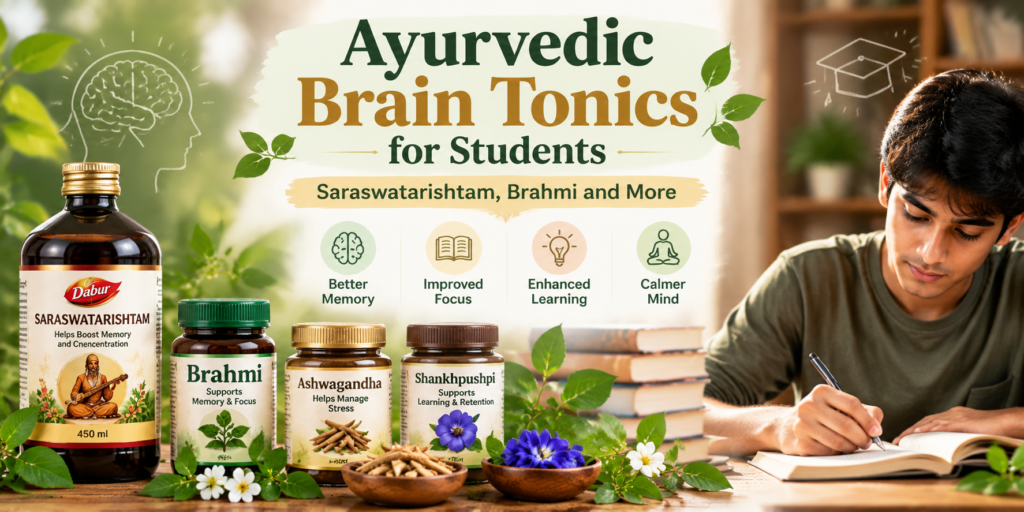
Exams, assignments, competitive tests and long study sessions can make student life demanding. Along with regular revision, students often look for ways to maintain concentration, manage stress and feel mentally prepared for studying. This is one reason people search for an Ayurvedic brain tonic or explore traditional herbs such as Brahmi and Shankhpushpi.
Ayurveda has a long history of using herbs and multi-ingredient preparations in different traditional contexts. Saraswatarishtam and Manasamitra Vatakam are two formulations that people may encounter when exploring this subject. However, it is important to distinguish traditional Ayurvedic use from scientifically established benefits, especially when discussing memory, attention and academic performance.
No herbal product can replace effective study habits, adequate sleep, balanced nutrition or professional support when a student experiences persistent concentration difficulties.
In this guide, we explore the traditional background of Ayurvedic preparations associated with mental and intellectual functions, discuss Brahmi and Shankhpushpi, explain Saraswatarishtam and outline practical habits that support a healthy study routine.
What Is an Ayurvedic Brain Tonic?
The term Ayurvedic brain tonic is commonly used to describe herbs and formulations traditionally associated with memory, learning, mental alertness or intellectual functions.
It is important to understand that this is a broad descriptive term, not a standardised medical category. Products marketed or discussed under this label may have very different ingredients, preparation methods and safety considerations.
How does Ayurveda approach mental wellbeing?
Traditional Ayurveda discusses mental and intellectual functions through concepts that include Medhya Rasayana. This term is associated with certain traditional approaches to supporting intellectual functions and mental wellbeing.
Several herbs, including Brahmi and Shankhpushpi, are discussed in this context. Some classical formulations also combine multiple ingredients rather than relying on a single plant.
These traditional descriptions help explain the historical use of such preparations. They do not, by themselves, establish that a particular product improves examination results, treats attention difficulties or prevents memory-related conditions.
Are Ayurvedic brain tonics necessary for students?
Not necessarily. Many common study difficulties are related to insufficient sleep, stress, distractions, irregular meals or ineffective study methods.
Before considering a supplement or traditional formulation, students should review their daily routine and identify practical changes that might help. Persistent or worsening concentration difficulties may also warrant an assessment by a qualified healthcare professional.
An Ayurvedic preparation should not be treated as a shortcut to academic performance or a replacement for appropriate medical care.
Brahmi and Shankhpushpi: Two Well-Known Ayurvedic Herbs
Brahmi and Shankhpushpi are among the herbs commonly discussed when people explore Ayurvedic preparations associated with learning, memory and mental wellbeing. Although both have a place in traditional Ayurvedic practice, they are different plants and should not be treated as interchangeable.
Brahmi: Traditional use and current research
Brahmi is commonly identified as Bacopa monnieri, although the common name can sometimes be applied differently in regional contexts. It is used in traditional Ayurvedic formulations and is frequently discussed in research on cognitive functions.
Some clinical studies of standardised Brahmi extracts have examined memory-related outcomes. However, the findings cannot automatically be applied to every Brahmi product, a multi-herb formulation or a student taking a supplement for examination preparation. Research varies in product composition, study design, dosage and duration.
For students, the practical takeaway is that Brahmi is an herb of research interest, not a guaranteed way to improve concentration or examination performance.
Shankhpushpi: A traditional Ayurvedic ingredient
Shankhpushpi is another herb traditionally associated with mental wellbeing in Ayurveda. The name is used in herbal products and formulations, but the botanical identity may differ between regional traditions and commercial preparations.
If you are considering a Shankhpushpi product, check its botanical identification, complete ingredient list and manufacturer instructions. A product’s traditional reputation does not establish that it will improve academic performance or suit every student.
Should students combine Brahmi and Shankhpushpi?
Combining herbs does not automatically make a formulation more effective. The suitability of a combination depends on the ingredients, quantities, product quality, age and individual health circumstances.
Students who take prescription medicines, have an existing health condition or are considering a product for a child should consult a qualified healthcare professional before use. Avoid combining multiple supplements simply because each is marketed for memory or concentration.
Saraswatarishtam: Traditional Background and Important Considerations
Saraswatarishtam is a classical Ayurvedic liquid preparation traditionally associated with mental and intellectual functions. It belongs to the Arishta category, which involves a fermentation-based preparation method.
Depending on the specific formulation, ingredients may include Brahmi, Shatavari, Abhaya, Usira, ginger and other traditional components. Sugar-containing ingredients and honey may also be part of the preparation. The complete composition should always be checked against the manufacturer’s label.
Why is Saraswatarishtam discussed in Ayurveda?
Its traditional background is linked to Ayurvedic approaches involving intellectual functions and mental wellbeing. However, these traditional uses should not be interpreted as proof that the preparation treats memory disorders, anxiety, depression or attention-related conditions.
Evidence about an individual herb cannot establish the effectiveness of the complete Saraswatarishtam formulation. The product’s ingredients, manufacturing process and individual suitability all matter.
What should you know before considering it?
Saraswatarishtam is a fermented liquid preparation and may contain self-generated alcohol. Some formulations also include sugar and honey. These factors are particularly relevant for people who need to avoid alcohol, monitor sugar intake or manage certain health conditions.
Do not assume that the preparation is appropriate for every student or that it must be taken during examination periods. A qualified practitioner can help assess whether it is suitable for an individual’s circumstances.
Kottakkal Saraswatarishtam on Ayurvedaholic

Kottakkal Saraswatarishtam
Pack size: 450 ml
Review the product description, ingredient information and current price before ordering.
View Kottakkal Saraswatarishtam on Ayurvedaholic
The product listing is a starting point for reviewing the formulation. Confirm the complete ingredient declaration and directions on the actual packaging, and consult a qualified healthcare professional before use.
Manasamitra Vatakam and Other Traditional Ayurvedic Formulations
Manasamitra Vatakam is another classical Ayurvedic preparation that people may encounter when researching traditional formulations associated with mental wellbeing.
Unlike Saraswatarishtam, which is a fermented liquid, Manasamitra Vatakam is generally available in tablet or pill form. Its ingredients and preparation differ, so its directions and precautions should not be assumed to be the same as those of Saraswatarishtam.
How should you evaluate Manasamitra Vatakam?
Before considering this formulation, review the exact manufacturer’s ingredient list and directions. The composition of a multi-ingredient Ayurvedic preparation matters, particularly if it contains processed mineral ingredients.
Do not assume that a product is suitable for students simply because it is discussed in connection with mental wellbeing. Traditional use does not establish that it improves academic performance or treats a diagnosed health condition.
Saraswatarishtam vs Manasamitra Vatakam
| Feature | Saraswatarishtam | Manasamitra Vatakam |
|---|---|---|
| Form | Fermented liquid | Tablet or pill formulation |
| Composition | Herbs and other ingredients, depending on the product | Multiple ingredients, depending on the formulation |
| Important consideration | May contain self-generated alcohol and sugar | Requires careful review of its complete ingredient list |
| How to use | Follow product directions and professional advice | Follow product directions and professional advice |
Neither formulation should be selected solely on the basis of its traditional reputation. The appropriate choice, if either is suitable, depends on the individual’s circumstances and professional assessment.
Explore Manasamitra Vatakam on Ayurvedaholic

Kottakkal Manasamitra Vatakam
Review the formulation, packaging and product directions.
View Manasamitra Vatakam on Ayurvedaholic
Check the actual product label and consult a qualified healthcare professional before considering this preparation, especially if it is intended for a child or someone who takes regular medication.
Study Habits That Matter: Sleep, Routine and Nutrition
Whether or not someone chooses to explore traditional Ayurvedic products, everyday habits remain an important part of a student’s routine. Building a realistic study schedule and maintaining good sleep habits can help create better conditions for learning.
Maintain a consistent sleep schedule
Sleep plays an important role in attention, learning and memory. Regularly staying up late to study can make it harder to concentrate the following day.
Try to maintain a consistent bedtime and wake-up time. Teenagers generally need around 8–10 hours of sleep, while most adults need at least 7 hours regularly.
Instead of sacrificing sleep before an examination, plan revision sessions earlier and leave time for rest.
Build a realistic study routine
Long study sessions without breaks can become difficult to sustain. Break larger topics into smaller tasks and set a clear objective for each session.
For example, a student preparing for an examination might plan to revise one chapter, practise a set of questions and review mistakes before moving to the next subject.
Short breaks between focused sessions can also make a demanding study schedule more manageable.
Eat balanced meals and stay hydrated
Regular meals that include a variety of foods help support general health. Include suitable sources of protein, vegetables, fruit and other nutrient-rich foods according to your dietary needs.
Keep water available during study sessions and avoid relying excessively on energy drinks or large amounts of caffeine to compensate for inadequate sleep.
No single food or supplement can replace a balanced diet.
Reduce distractions
Put unnecessary notifications on silent, keep frequently used study materials within reach and choose a workspace where you can concentrate.
If you find yourself repeatedly checking your phone, try placing it outside your immediate reach during a focused study session.
Manage examination stress
Some nervousness before an examination is common. Planning revision in advance, practising questions under timed conditions and discussing concerns with someone you trust may help make preparation more manageable.
If persistent anxiety, low mood, sleep disruption or concentration problems interfere with daily life, seek appropriate professional support rather than relying exclusively on an herbal preparation.
Precautions: When Should You Consult a Physician?
Before considering any Ayurvedic formulation for a student, take the individual’s age, health history, current medicines and the product’s complete composition into account.
- For children and teenagers: Do not give an Ayurvedic supplement or medicine without appropriate professional guidance. Adult product directions should not be applied to children.
- During pregnancy or breastfeeding: Seek advice from a qualified healthcare professional before using any such preparation.
- For people taking medicines: Inform the healthcare professional about all prescription medicines, supplements and herbal products to help assess possible interactions.
- For Saraswatarishtam: Consider its possible alcohol content and sugar-containing ingredients, especially if alcohol must be avoided or blood sugar needs to be managed.
- For complex formulations: Verify the full ingredient list, particularly if the product contains mineral-based ingredients or you have known allergies.
- For persistent symptoms: Seek assessment for ongoing memory difficulties, concentration problems, sleep disturbances or changes in mood.
Do not stop prescribed medication or delay an appropriate medical assessment in favour of a traditional product.
Frequently Asked Questions
1. What is an Ayurvedic brain tonic?
It is an informal term used for Ayurvedic herbs and formulations traditionally associated with mental wellbeing, learning or intellectual functions. It is not a standardised medical category, and products marketed under this term can differ significantly.
2. Is Brahmi useful for students?
Brahmi has been studied for certain cognitive outcomes, but the evidence varies by extract, study design and population. Research on specific preparations does not establish that every Brahmi product improves examination performance.
3. What is Saraswatarishtam traditionally used for?
Saraswatarishtam is traditionally associated with mental and intellectual functions in Ayurveda. These traditional uses should not be treated as proof that the finished product treats a particular medical condition.
4. Can students take Saraswatarishtam every day?
Whether regular use is appropriate depends on the individual and the specific formulation. Consult a qualified healthcare professional and follow the current product directions rather than adopting a dosage from another source.
5. What is the difference between Saraswatarishtam and Manasamitra Vatakam?
Saraswatarishtam is a fermented liquid preparation, while Manasamitra Vatakam is generally available in tablet or pill form. Their compositions and precautions differ, so they should not be treated as interchangeable.
6. Can an Ayurvedic brain tonic replace proper sleep and studying?
No. A supplement cannot replace sufficient sleep, effective revision, balanced nutrition or professional support when needed. These habits should remain central to a student’s routine.
7. Where can I find Kottakkal Saraswatarishtam?
You can review Kottakkal Saraswatarishtam 450 ml on Ayurvedaholic and check its product details before ordering.
Conclusion
Ayurveda has a long tradition of using herbs and compound formulations associated with mental and intellectual functions. Brahmi, Shankhpushpi, Saraswatarishtam and Manasamitra Vatakam are among the names people may encounter while researching this subject.
However, traditional use should not be confused with guaranteed improvements in memory, concentration or academic performance. The evidence for individual herbs cannot automatically be applied to every commercial formulation, and product ingredients, quality and individual circumstances all matter.
For students, consistent sleep, balanced nutrition, structured revision and a manageable daily routine remain sensible foundations for learning. Anyone considering an Ayurvedic formulation should verify the product details and consult a qualified healthcare professional, particularly when the product is intended for a child or someone taking regular medicines.
To review the relevant products, visit Kottakkal Saraswatarishtam on Ayurvedaholic or Kottakkal Manasamitra Vatakam on Ayurvedaholic