Parents often explore traditional Ayurvedic products as part of their children’s wellbeing routines. One name that frequently comes up is Swarna Prashan, a traditional Ayurvedic practice associated with administering a preparation containing Swarna Bhasma (processed gold) alongside other ingredients.
When exploring Swarna Prashan, parents may encounter tablets, drops and other liquid preparations. Although these products may share a similar name, they can differ in composition, concentration, serving instructions and suitability for different age groups.
Choosing between Swarna Prashan tablets and drops should not be based on convenience alone. The product’s ingredient declaration, age-specific directions, manufacturing information and advice from a qualified healthcare professional all matter, particularly because the intended users are children.
This guide explains the traditional background of Swarna Prashan, compares tablets and drops, outlines what to check on the label and discusses important precautions before purchasing a product.
What Is Swarna Prashan?
Swarna Prashan is a traditional Ayurvedic practice described in classical Ayurvedic literature. The term combines Swarna, meaning gold, and Prashan, referring broadly to administration or consumption.
In traditional descriptions, Swarna Prashan involves administering a preparation containing Swarna Bhasma alongside other ingredients. The composition and method of administration can vary between traditional practices and commercially available products.
What is its traditional significance?
Swarna Prashan is discussed in Ayurveda in the context of children’s traditional care and development. However, traditional descriptions should not be interpreted as proof that a commercial product improves immunity, intelligence, memory or growth.
Scientific evidence for a particular preparation must be evaluated independently. Evidence about one ingredient or formulation cannot automatically be applied to every product sold under the Swarna Prashan name.
Are all Swarna Prashan products the same?
No. Products may differ in:
- Whether they are supplied as tablets, drops or another dosage form.
- The declared quantity and form of Swarna Bhasma.
- Other herbal or supporting ingredients.
- Serving instructions and intended age group.
- Manufacturing standards and product-specific precautions.
For this reason, parents should review the exact product label rather than assuming that all Swarna Prashan products are interchangeable.
Swarna Prashan Tablets vs Drops: What Is the Difference?
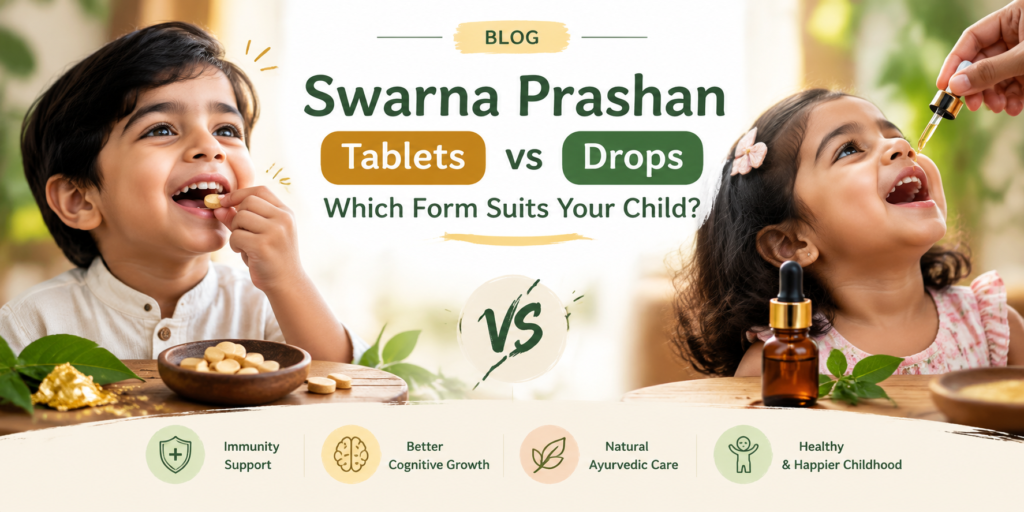
The main difference between tablets and liquid preparations is the dosage form. Both may be marketed under the Swarna Prashan name, but their ingredients, concentrations, serving instructions and suitability for different ages can vary.
| Feature | Swarna Prashan tablets | Swarna Prashan drops or liquid |
|---|---|---|
| Form | Solid tablets | Liquid preparation |
| Measurement | Number of tablets or a specified tablet portion | A measured quantity as stated on the label |
| Convenience | May be convenient for children who can safely swallow tablets | May be easier to administer when the label permits |
| Ingredients | Must be checked on the tablet pack | Must be checked on the liquid pack |
| Age suitability | Depends on the specific product and its instructions | Depends on the specific product and its instructions |
| Storage | Follow the tablet packaging instructions | Follow the liquid product’s storage instructions |
Which form is more convenient?
Tablets may be convenient for older children who can swallow them safely and whose practitioner has confirmed that the formulation is appropriate. However, a tablet should not automatically be crushed, split or mixed with food unless the product instructions or a qualified professional permit it.
Liquid preparations can allow the serving to be measured in a different way, but drops are not automatically safer or more suitable for younger children. The concentration and measuring instructions matter.
Can tablets and drops be used interchangeably?
No. Do not assume that one tablet equals a particular number of drops or that the same quantity of Swarna Bhasma is present in both products.
Even products from the same brand can have different compositions and directions. If you are considering changing from tablets to a liquid preparation, consult a qualified healthcare professional and confirm the exact formulation.
What if a child cannot swallow tablets?
Do not crush the tablet or dissolve it in a drink without checking the instructions for that product. Instead, ask the child’s healthcare professional whether the formulation is suitable for the child’s age and whether another option is appropriate.
The decision should be based on safety and the product’s specific directions, not simply on which form is easier to administer.
Ingredients to Check on the Label: Swarna Bhasma and Other Components
Swarna Prashan products may contain Swarna Bhasma, traditionally described as processed gold, along with herbs and other ingredients. However, the complete formulation differs by product.
Swarna Bhasma
Swarna Bhasma is a traditional Ayurvedic preparation made from gold using specialised processing methods. It is an important ingredient to look for when reviewing a product marketed as gold-containing Swarna Prashan.
The presence of Swarna Bhasma does not, by itself, prove that a product improves immunity, memory, intelligence or physical development. Nor does the traditional description establish the purity or safety of a particular commercial batch.
Brahmi and Shankhpushpi
Brahmi and Shankhpushpi appear in some Swarna Prashan formulations. They have histories of traditional use in Ayurveda, including in preparations associated with intellectual functions.
Their inclusion does not guarantee a particular result in children. The identity, quantity and quality of the ingredients should be checked on the specific product label.
Honey and ghee
Some Swarna Prashan preparations contain honey and ghee. These ingredients are relevant when reviewing the product’s composition and suitability.
Important for infants: Honey should not be given to children younger than 12 months because of the risk of infant botulism. Do not give a honey-containing Swarna Prashan product to a child under 12 months. Consult a paediatric healthcare professional about age-appropriate alternatives.
Why the complete ingredient list matters
When comparing two products, check:
- The complete list of declared ingredients.
- The stated amount of Swarna Bhasma, if provided.
- Other herbal, mineral or supporting ingredients.
- The manufacturer’s directions and age-related warnings.
- Batch details, expiry information and applicable manufacturing or licence details.
If the label does not clearly identify the ingredients or serving instructions, seek clarification before considering the product for a child.
Safety and Precautions: When Should Parents Consult a Practitioner?
Because Swarna Prashan products are intended for children, parents should be particularly careful about the formulation, age suitability and directions for use. A traditional product should not automatically be considered safe for every child simply because it is marketed as Ayurvedic.
Consult a qualified healthcare professional
Before considering a Swarna Prashan product, discuss the child’s age, medical history, allergies and current medicines with a qualified healthcare professional. This is especially important for infants, children with ongoing medical conditions and children receiving prescribed treatment.
Do not guess the serving size
The correct serving cannot be determined simply from a child’s age or the form of the product. Follow the directions for the exact formulation and obtain professional guidance when necessary.
Do not copy a dosage from another brand’s label or an online article. Tablets and liquid preparations may have different compositions and concentrations.
Be careful with metal-containing ingredients
Some products contain Swarna Bhasma or other specialised ingredients. Traditional processing does not automatically establish the safety of every finished product.
Review the ingredient declaration and available quality information. If the composition is unclear, seek clarification before considering the product.
Check for allergies and other ingredients
Read the entire label, not just the product name. Ingredients such as honey, ghee and herbs may be relevant to a child’s dietary restrictions or sensitivities.
If a child develops an unexpected reaction after taking a product, stop its use and seek appropriate medical advice.
Do not use Swarna Prashan as a substitute for medical care
Swarna Prashan should not replace routine childhood vaccinations, balanced nutrition, adequate sleep, developmental assessments or treatment recommended by a paediatrician.
Claims that a product prevents infections, guarantees better memory or improves intelligence should not be treated as established medical facts.
Dabur Swarna Prashan Tablets vs Krishna Ayurveda Swarna Prashan
If you are comparing these products, start with their listed forms, pack details and ingredient declarations rather than assuming that the products are equivalent.

Dabur Swarna Prashan Tablets
Pack size: 30 tablets
₹1,750
Listed MRP: ₹2,464
The listing identifies this product as a tablet formulation. Check the current pack for its full composition and directions. View on Ayurvedaholic

Krishna Ayurveda Swarna Prashan
Listed pack size: 10 g
₹1,589
Listed MRP: ₹1,875
This listing describes a liquid or juice preparation. Confirm its precise dosage form and directions on the packaging. View on Ayurvedaholic
Prices shown are those displayed on Ayurvedaholic when checked and may change. Verify the current price, availability and product details before ordering.
Which one should you choose?
There is no universally best option for every child. Consider the following factors:
- Age suitability: Check whether the exact product is appropriate for the child’s age.
- Dosage form: Confirm whether the product is a tablet or a liquid preparation and how it is intended to be administered.
- Ingredients: Compare the complete declared composition, including the stated quantity of Swarna Bhasma where available.
- Instructions: Follow the specific product label and professional advice.
- Quality information: Review the manufacturer, batch details and packaging.
- Price: Compare the current selling price and pack size without assuming that a lower price means better value or equivalent composition.
The Dabur product is listed as 30 tablets, while the Krishna Ayurveda product is listed as a 10 g liquid or juice preparation. Their prices should not be compared as though the packs contain equivalent servings.
If a practitioner has recommended a particular formulation, confirm the exact product before purchasing. Do not switch between products or calculate equivalent quantities yourself.
Where to Buy Original Swarna Prashan Products Online
Before ordering, review the product listing and check the details printed on the pack when it arrives.
What to check before purchasing
- Product identity: Confirm the brand and exact product name.
- Dosage form: Make sure the listing matches the intended tablet or liquid formulation.
- Pack size: Check the number of tablets or net quantity.
- Ingredients: Review the complete ingredient declaration.
- Batch and expiry: Ensure the information is readable and the product is within its stated shelf life.
- Packaging: Avoid products with damaged seals, altered labels or signs of tampering.
- Invoice: Retain your purchase receipt and order confirmation.
You can review the two products on Ayurvedaholic:
The product listings help you review the available details, but a listing alone does not independently establish a product’s safety or clinical effectiveness. Always check the actual packaging and consult an appropriate healthcare professional before use.
Frequently Asked Questions
1. What is the difference between Swarna Prashan tablets and drops?
Tablets are solid dosage forms, while drops are liquid preparations measured according to their specific instructions. Their compositions and concentrations can differ, so they should not be treated as interchangeable.
2. Are Swarna Prashan tablets suitable for every child?
No. Suitability depends on the exact formulation, the child’s age and health circumstances. Check the product directions and consult a qualified healthcare professional before considering use.
3. Does Swarna Prashan contain Swarna Bhasma?
Some products contain Swarna Bhasma, traditionally described as processed gold. Check the specific product’s ingredient declaration to confirm its composition and any stated quantity.
4. Can I give Swarna Prashan to a baby?
Do not assume that a product is suitable for infants. In particular, honey-containing products must not be given to children under 12 months because of the risk of infant botulism. Consult a paediatric healthcare professional about appropriate care for infants.
5. Can I switch from tablets to drops?
Do not switch or calculate equivalent quantities without professional guidance. The formulations and concentrations may differ, even when the products share the same traditional name.
6. Does Swarna Prashan guarantee better immunity or intelligence?
No such guarantee should be assumed. Traditional use is not the same as established clinical evidence, and product-specific claims need appropriate scientific support.
7. Where can I buy Swarna Prashan products?
You can review Dabur Swarna Prashan Tablets and Krishna Ayurveda Swarna Prashan on Ayurvedaholic. Check the current product details before ordering.
Conclusion
Swarna Prashan is a traditional Ayurvedic practice, and commercial products are available in different dosage forms. Tablets may be convenient for some older children, while liquid preparations have different measuring and administration requirements. Neither form is automatically more effective or suitable for every child.
When comparing Swarna Prashan tablets vs drops, focus on the actual ingredients, age suitability, label directions and manufacturing information. Never assume that products with similar names contain equivalent quantities of Swarna Bhasma or can be substituted dose for dose.
If you are considering a product for your child, consult a qualified healthcare professional and do not use Swarna Prashan as a substitute for routine paediatric care. Remember that honey-containing preparations must not be given to children under 12 months.