Yogendra Ras is a specialised formulation in the classical Ayurvedic tradition. It is discussed in relation to preparations containing processed metals and minerals, and it is different from the simple herbal powders and supplements that many people encounter today.
If you are searching for Yogendra Ras, you may want to understand its traditional background, the ingredients used in the formulation, its reference in Ayurvedic literature and why professional guidance is important before considering a product.
Dabur Yogendra Ras with Gold is one commercially available product in this category. Its gold-containing formulation makes it particularly important to review the manufacturer’s ingredient declaration, directions and safety information rather than relying only on traditional descriptions.
This guide explains Yogendra Ras in its Ayurvedic context, discusses its classical reference and ingredient considerations, and outlines practical steps for evaluating a genuine product. Traditional uses are described as traditional uses, not as guaranteed medical benefits or a substitute for modern medical care.
What Is Yogendra Ras?
Yogendra Ras is a classical Ayurvedic Rasaushadhi formulation. The term Rasaushadhi refers broadly to a category of Ayurvedic preparations that may contain processed metals, minerals and other ingredients prepared according to traditional methods.
Unlike a formulation made only from herbs, Yogendra Ras is associated with specialised processing and combinations of ingredients. Some commercial versions include Swarna Bhasma, traditionally described as processed gold.
What does the name Yogendra Ras mean?
In Ayurvedic terminology, Ras appears in the names of many traditional formulations. The word alone does not identify a medicine’s complete composition, intended use or appropriate dosage.
Yogendra Ras should therefore be understood as the name of a specific traditional formulation, not as a general category of supplements that can be used interchangeably.
What is the traditional context of Yogendra Ras?
Classical Ayurvedic practitioners have used specialised formulations in individualised treatment approaches. Their selection may depend on the practitioner’s assessment of the person, the condition being addressed and the preparation being prescribed.
However, a formulation’s presence in traditional practice does not establish that it is effective for every condition mentioned in historical descriptions. Modern clinical evidence, manufacturing quality and individual safety considerations must be assessed separately.
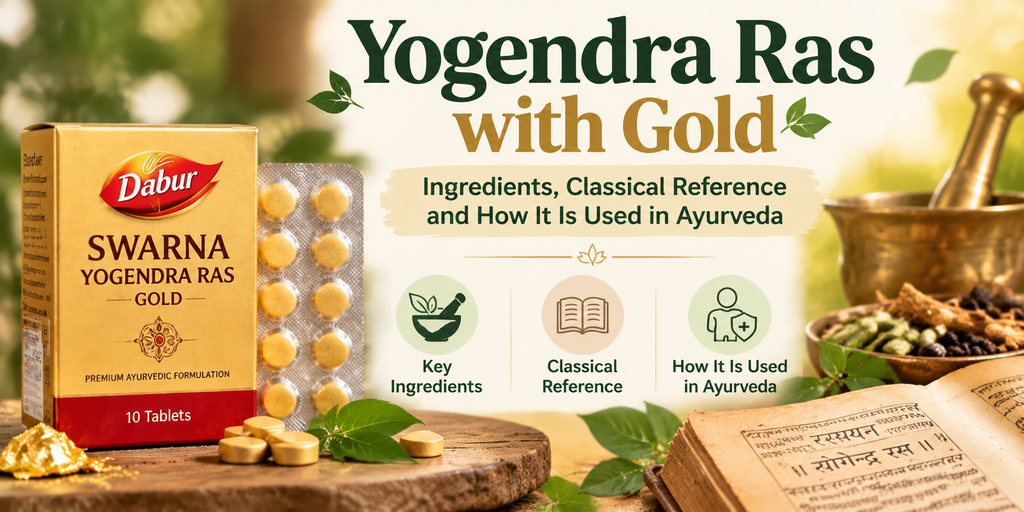
What is Dabur Yogendra Ras with Gold?
Dabur Yogendra Ras with Gold is a commercial product listed by Ayurvedaholic in a 10-tablet pack. The product name indicates that the formulation is marketed as gold-containing.
Before considering it, verify the full ingredient declaration and current directions on the actual packaging. Do not infer the quantity of gold, the complete composition or the product’s effectiveness from the name alone.
Classical Reference: Is Yogendra Ras Mentioned in Bhaishajya Ratnavali?
Yogendra Ras is commonly attributed to Bhaishajya Ratnavali, a classical Ayurvedic text that describes numerous formulations and their traditional applications.
Some modern Ayurvedic references place Yogendra Ras in the section on Vatavyadhi Chikitsa, which discusses conditions traditionally associated with Vata disorders. However, chapter and verse references vary between secondary sources. The exact reference should be checked against a specified edition of the original text before publishing a precise verse citation.
What does the classical reference tell us?
Classical texts provide historical context for how a formulation was understood and used within traditional Ayurveda. They can describe ingredients, preparation methods, traditional indications and directions for administration.
However, a classical reference is not equivalent to a modern clinical trial. It does not independently establish that the formulation is effective for a particular disease, nor does it confirm the safety or quality of every commercially available product.
Understanding Rasashastra
Rasashastra is a specialised branch of Ayurveda concerned with the processing and use of metals, minerals and other substances in traditional formulations.
The preparation of such medicines involves specific traditional procedures. Nevertheless, traditional processing should not be assumed to eliminate all toxicological risks. The finished product’s composition, manufacturing quality and appropriate clinical supervision remain important.
For this reason, Yogendra Ras should be approached differently from a general herbal supplement that someone might choose to take without professional advice.
Yogendra Ras Ingredients: What Is in the Formulation?
Yogendra Ras formulations commonly described in Ayurvedic references include a combination of processed metal and mineral preparations. The exact composition can differ between formulations and manufacturers.
Patanjali’s published ingredient information, for example, lists Ras Sindoor, Swarna Bhasma, Kantlauh Bhasma, Abhraka Bhasma, Mukta Bhasma, Vanga Bhasma and Aloe vera juice.
The Dabur product is specifically marketed as Yogendra Ras with Gold. Its complete ingredient declaration should be verified from the actual pack rather than inferred from another manufacturer’s formulation.
Key ingredients and their traditional descriptions
| Ingredient | Traditional description |
|---|---|
| Ras Sindoor | A processed mercury-and-sulphur preparation |
| Swarna Bhasma | A processed gold preparation |
| Kantlauh Bhasma | A processed iron-based preparation |
| Abhraka Bhasma | A processed mica-based preparation |
| Mukta Bhasma | A processed pearl-derived preparation |
| Vanga Bhasma | A processed tin-based preparation |
| Ghritkumari Svarasa | Aloe vera juice, used in some formulations during processing |
These descriptions explain the ingredient names in traditional terminology. They do not establish the exact chemical composition, purity or safety of a finished commercial product.
Why does the ingredient list matter?
Several of these ingredients are metal- or mineral-based. Ras Sindoor, in particular, is associated with mercury compounds. The presence of such ingredients makes verification of product quality especially important.
Consumers should not attempt to prepare this formulation themselves, alter the dosage or assume that a product is safe simply because its ingredients are described as purified or traditionally processed.
Before considering any brand, check:
- The complete ingredient list printed on the pack.
- The manufacturer’s identity and applicable manufacturing details.
- The batch number and expiry information.
- Any available quality-control documentation.
- The product’s warnings and directions for use.
Important: The ingredient list of one brand should not be used as a substitute for the label of another. Traditional formulations with similar names may differ in their declared composition.
Why Physician Guidance Matters Before Using Yogendra Ras
Yogendra Ras is a specialised herbo-mineral formulation, not an ordinary daily wellness supplement. Its traditional ingredients and potential toxicological risks make self-medication inappropriate.
Why should you avoid choosing a dose online?
Dosage information published for one brand may not apply to another formulation. The appropriate directions, if a practitioner recommends the product, depend on the exact preparation and the individual’s circumstances.
Do not copy a dosage from a blog, increase the quantity because symptoms persist, or continue using the product for an extended period without professional review.
The product’s own label and the prescribing practitioner’s instructions should be consulted before use.
Who should seek particular caution?
- People with kidney or liver conditions: Seek advice from your treating clinician before considering a metal- or mineral-containing formulation.
- People taking prescription medicines: Provide a complete list of your medicines and supplements so potential interactions can be assessed.
- Pregnant or breastfeeding individuals: Do not assume that this type of formulation is suitable; obtain specialist advice before considering use.
- Children and older adults: Do not apply adult directions to children. Older adults, especially those taking several medicines, require individual assessment.
- People with unexplained symptoms: Obtain an appropriate medical assessment instead of relying on a traditional product to diagnose or treat the underlying cause.
Can traditional processing guarantee safety?
No. Traditional processing methods are part of the formulation’s manufacturing history, but they do not automatically prove that every finished product is free from harmful contaminants or that it is safe at every dose.
Quality assessment may require suitable analytical testing and reliable manufacturing controls. A brand name or traditional reputation alone cannot establish these things.
What if you experience an unexpected reaction?
Stop using the product and seek medical advice if you experience unexpected symptoms after taking it. If symptoms are severe or rapidly worsening, seek urgent medical care.
Do not use Yogendra Ras as a replacement for prescribed treatment for heart conditions, neurological disorders, diabetes or any other diagnosed disease.
Dabur Yogendra Ras with Gold vs Patanjali Yogendra Ras
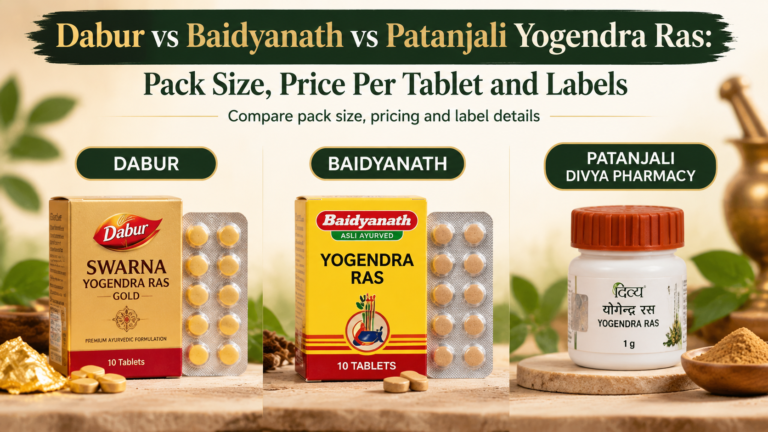
Dabur and Patanjali both offer products marketed under the Yogendra Ras name. Ayurvedaholic lists the Dabur gold-containing formulation in a 10-tablet pack and Patanjali Yogendra Ras in a 1 g pack.
Although the names are similar, these products should not automatically be considered identical or interchangeable.
| Feature | Dabur Yogendra Ras with Gold | Patanjali Yogendra Ras |
|---|---|---|
| Brand | Dabur | Patanjali / Divya Pharmacy |
| Listed pack | 10 tablets | 1 g |
| Form | Tablets | Fine powder, according to the listing |
| Gold-containing ingredient | Confirm the complete label | Swarna Bhasma is listed |
| Directions | Follow the specific product label and qualified practitioner’s advice | Manufacturer states use under medical supervision, as directed by a physician |
| Important consideration | Verify the complete composition and pack details | Verify the composition and directions for this specific formulation |
Which brand should you choose?
There is no responsible basis for declaring one brand universally better from the product name alone. Compare the actual ingredient declaration, manufacturing details, quality information and suitability for the intended use.
A lower price, a familiar brand or the inclusion of gold does not independently establish superior effectiveness or safety.
If a qualified Ayurvedic physician recommends a particular formulation, confirm the exact brand and product before purchasing. Do not substitute another brand or dosage form without discussing it with the practitioner.
Where to Buy Genuine Yogendra Ras Online
When purchasing Yogendra Ras, focus on product verification rather than relying only on the brand name or promotional claims.
Dabur Yogendra Ras with Gold on Ayurvedaholic

Dabur Yogendra Ras with Gold
Pack size: 10 tablets
₹1,990
Listed MRP: ₹2,820
Price displayed on Ayurvedaholic when checked. Confirm the current price and availability before ordering.
View Dabur Yogendra Ras with Gold on Ayurvedaholic
Patanjali Yogendra Ras on Ayurvedaholic

Patanjali Yogendra Ras
Listed pack size: 1 g
The listing identifies Swarna Bhasma among its ingredients.
View Patanjali Yogendra Ras on Ayurvedaholic
How to check a genuine pack
Before placing an order or using the product:
- Confirm the exact product name. Check whether the prescribed product is Dabur Yogendra Ras with Gold or Patanjali Yogendra Ras.
- Inspect the packaging. Look for intact packaging, clear labels and readable manufacturing details.
- Check the batch and expiry information. Do not use a product that has expired or shows signs of tampering.
- Review the ingredient declaration. Confirm the formulation rather than relying on a generic description of Yogendra Ras.
- Retain the invoice. Keep your order confirmation and purchase receipt.
- Follow professional guidance. Verify that the product received matches the formulation recommended by your qualified practitioner.
A retailer’s listing can help you review product details, but it is not independent proof of authenticity, quality or clinical effectiveness.
Frequently Asked Questions
1. What is Yogendra Ras used for in Ayurveda?
Yogendra Ras is a traditional herbo-mineral formulation used in selected Ayurvedic treatment contexts. Its traditional indications should not be interpreted as proof that it cures neurological, cardiac or other medical conditions.
2. Is Yogendra Ras mentioned in Bhaishajya Ratnavali?
Modern Ayurvedic references attribute Yogendra Ras to Bhaishajya Ratnavali, including discussions associated with Vatavyadhi Chikitsa. The exact chapter and verse should be verified against the specific classical edition being cited.
3. Does Yogendra Ras contain gold?
Some formulations, including the products discussed here, are marketed with Swarna Bhasma. Check the ingredient declaration on the specific product because compositions can differ between manufacturers.
4. Can Yogendra Ras be taken daily?
Do not assume that daily use is appropriate for everyone. The product should be considered only under qualified professional supervision, with the quantity and duration determined for the individual’s circumstances.
5. Are Dabur and Patanjali Yogendra Ras the same?
They are products marketed under the same classical formulation name, but their packaging, dosage form and declared composition may differ. Do not substitute one for the other without consulting the prescribing practitioner.
6. Are there precautions associated with Yogendra Ras?
Yes. Some formulations contain processed mercury and other metal- or mineral-based ingredients. Product quality, possible toxicological risks, individual health conditions and other medicines must be considered before use.
7. Where can I buy Yogendra Ras online?
You can review Dabur Yogendra Ras with Gold, 10 tablets and Patanjali Yogendra Ras, 1 g on Ayurvedaholic. Verify the exact product and current listing details before ordering.
Conclusion
Yogendra Ras is a specialised formulation within the classical Ayurvedic tradition. Its association with Bhaishajya Ratnavali and its combination of processed ingredients provide historical context, but traditional use alone does not establish clinical effectiveness or guarantee safety.
If you are researching Yogendra Ras, pay particular attention to the complete ingredient list, manufacturing quality and the need for qualified professional guidance. Products containing processed metals and minerals should never be treated as casual wellness supplements or used through self-prescription.
Dabur Yogendra Ras with Gold and Patanjali Yogendra Ras are available to review on Ayurvedaholic. Compare their declared formulations and pack details, but do not choose between them on price or brand reputation alone.
For product information, visit Dabur Yogendra Ras with Gold on Ayurvedaholic or Patanjali Yogendra Ras on Ayurvedaholic.
Above all, consult a qualified Ayurvedic physician before considering Yogendra Ras, and continue to obtain appropriate medical assessment and treatment for any diagnosed health condition.