
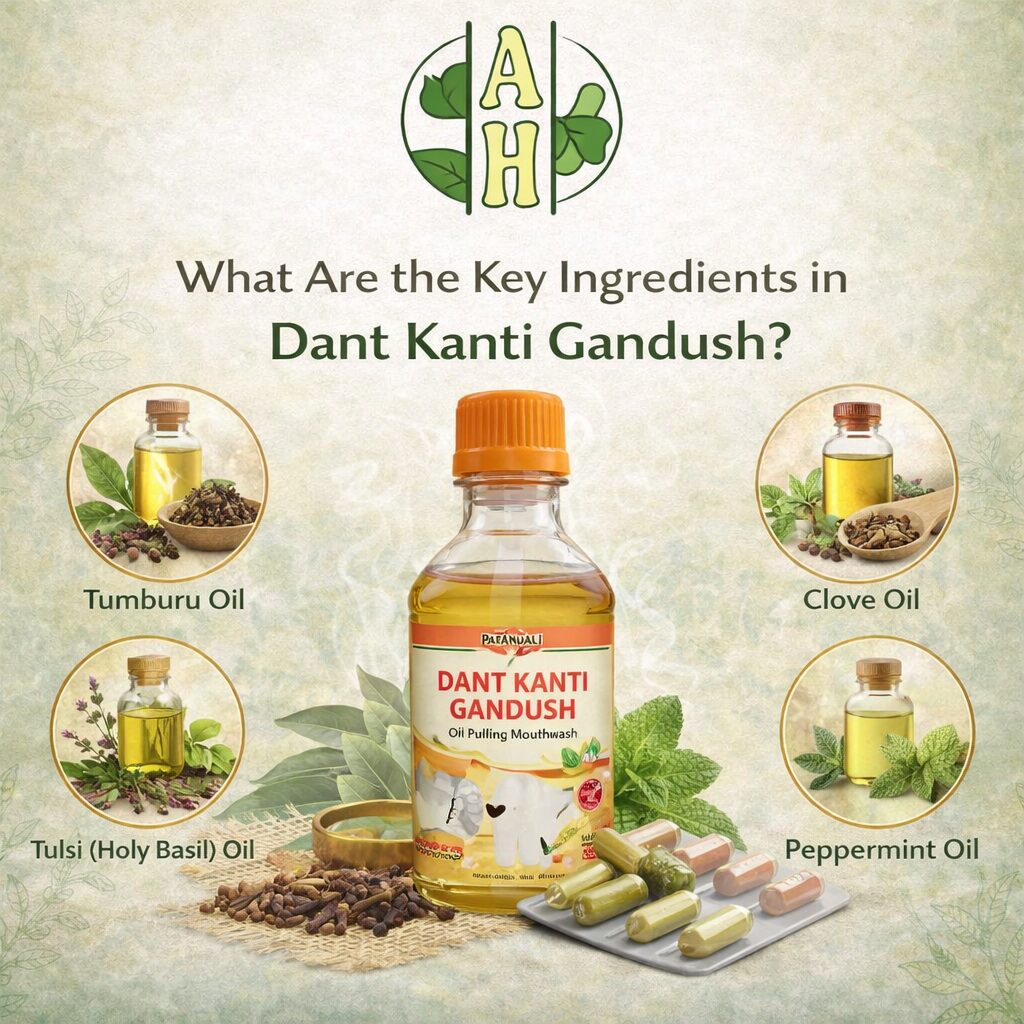
What Are the Key Ingredients in Dant Kanti Gandush?
Ayurveda places significant importance on oral hygiene, not as a cosmetic routine but as an essential daily practice that affects overall health. Among its classical rituals, Gandush—holding medicinal oils or herbal liquids in the mouth—is considered one of the most effective methods to cleanse, moisturize, and strengthen the oral cavity. In modern times, Patanjali’s Dant Kanti Gandush brings this ancient concept into an easy-to-use bottle. But what makes this formulation effective? The answer lies in its herbal ingredients, each chosen for a clear purpose.
This article explores all key ingredients present in Dant Kanti Gandush, their traditional relevance, their individual properties, and why they are blended in a specific way to make this product suitable for everyday use.
Understanding the Purpose of Gandush
Before breaking down the ingredients, it is important to understand why certain herbs are used for Gandush instead of for a simple mouthwash.
Gandush is not about rinsing; it is about retaining a herbal liquid in the mouth long enough for the herbs and oils to work on the gums, tongue, inner cheeks, and oral tissues.
Ayurveda describes Gandush as beneficial for:
- Oral dryness
- Impurities around gums and tongue
- Bad breath
- Weak or sensitive gums
- Roughness or heat in the oral cavity
A Gandush formulation has to meet three criteria:
- It should be stable inside the mouth
- It should have herbs that cleanse without irritating soft tissues
- It should offer natural lubrication
Dant Kanti Gandush achieves these outcomes through a thoughtful mix of oils, herbs, and aromatic substances.
Key Ingredients in Dant Kanti Gandush
Below is a detailed look at the main ingredients traditionally found in this product and the classical purpose behind each one.
1. Sesame Oil (Til Taila)
Sesame oil is the backbone of Ayurvedic oral-care preparations. It is rich, smooth, and naturally warming, making it ideal for holding inside the mouth.
Why Sesame Oil Is Used
- Helps maintain moisture in the mouth
- Supports gum tolerance and firmness
- Binds impurities due to its oil-soluble nature
- Penetrates deeper tissues
- Traditionally used for strengthening gum base
Sesame oil remains stable for the entire duration of Gandush, which is why Ayurveda recommends it more than any other oil.
2. Pudina Extract & Menthol
Mint-based ingredients appear in two forms: mint extract and menthol crystals. Together, they create the refreshing element people immediately notice.
Role of Mint in Oral Care
- Helps reduce stale breath
- Adds coolness and freshness
- Lightens the mouthfeel after oil retention
- Supports natural oral clarity
- Creates balance for warm oils like sesame and clove
Mint does not overpower the formulation but provides a clean aftereffect.
3. Clove Oil (Lavang Taila)
Clove is one of the most valued herbs in oral care. Ayurveda has used clove for centuries in formulations for gum strength and breath freshness.
Why It’s Included
- Supports natural cleansing
- Traditionally used for gum firmness
- Offers warmth that complements sesame oil
- Provides a distinctive aromatic depth
Clove oil is powerful, so only a small quantity is needed to influence the overall profile of the formulation.
4. Cinnamon Oil (Dalchini)
Cinnamon adds both aroma and warmth. Its traditional use in oral hygiene makes it a natural addition.
Purpose of Cinnamon
- Enhances the taste of the formulation
- Helps maintain oral freshness
- Supports oral comfort
- Adds a sweet-warm herbal aroma
Ayurveda describes cinnamon as invigorating for oral tissues, especially when used in controlled amounts.
5. Camphor (Kapoor)
Camphor is cooling, aromatic, and deeply penetrating. It is found in many classical Ayurvedic oral-care recipes.
What Camphor Contributes
- Helps reduce oral heat
- Promotes a cool, clean feeling
- Supports natural salivation
- Provides a strong cleansing aroma
Because camphor is potent, it works synergistically with softer herbs.
6. Ajwain Oil (Carom Seed Oil)
Ajwain oil has a sharp, penetrating profile that makes it suitable for oral cleansing.
Traditional Benefits
- Supports oral comfort
- Helps maintain gum cleanliness
- Promotes movement of saliva
- Adds warmth to offset cooling herbs
Ajwain balances mint and camphor effectively.
7. Mulethi (Licorice Root Extract)
Mulethi brings natural sweetness and soothing properties to the blend.
Why Mulethi Is Important
- Helps soothe gum tissues
- Provides mild sweetness
- Reduces the intensity of strong aromatic oils
- Supports oral moisture retention
It stabilizes the formulation by reducing the sharpness of clove and cinnamon.
8. Triphala (Harad, Baheda, and Amla)
Triphala—an iconic Ayurvedic blend—is included in many formulations designed to cleanse and strengthen.
Role of Triphala in Oral Care
- Supports gum health
- Helps reduce tongue coating
- Maintains overall oral cleanliness
- Provides a balanced cleansing action
Its mild astringent qualities help tone the mouth without causing dryness.
9. Neem Extract
Neem has been a cornerstone of Indian oral-health tradition for generations.
Why Neem Is Included
- Known for its strong cleansing nature
- Helps purify the oral cavity
- Supports gum cleanliness
- Traditionally used to maintain teeth hygiene
It adds a slightly bitter, earthy tone that contributes to the herbal character of the product.
How These Ingredients Work Together
A Gandush formulation works only when the ingredients complement each other. Dant Kanti Gandush appears to follow this principle.
1. Strong Cleansing Action
Neem, clove, ajwain, and cinnamon form the core cleansing group. They support the removal of impurities from the gums, tongue, and inner lining of the mouth.
2. Natural Freshness
Mint, menthol, camphor, and cinnamon give a lasting fresh breath effect.
3. Gum Strengthening
Sesame oil, clove oil, and triphala help strengthen the gum base while maintaining tissue comfort.
4. Lubrication and Moisture
Mulethi and sesame oil prevent oral dryness and maintain smoothness during Gandush.
5. Balanced Taste and Aroma
The combination ensures that no single herb dominates.
Mint cools, cinnamon sweetens, clove warms, neem purifies, and sesame stabilizes the entire blend.
Why These Herbs Are Suitable for Gandush Specifically
A Gandush oil must:
- Stay in the mouth without breaking down
- Spread evenly
- Not irritate the sensitive lining
- Support natural salivation
- Retain freshness after use
Sesame oil acts as the base, while herbs like mint, clove, camphor, and triphala make the experience suitable for daily oral care.
How the Ingredients Support Daily Oral Hygiene
Based on traditional Ayurvedic uses, the herbs in Dant Kanti Gandush may offer:
1. Fresh Breath Maintenance
Mint, menthol, cinnamon, and camphor refresh the mouth and reduce stale breath sensations.
2. Oral Moisture Support
Sesame oil and mulethi help reduce dryness, which is important for people who experience mouth roughness.
3. Gum Strength and Comfort
Triphala, clove, sesame oil, and neem are commonly used in Ayurveda for supporting gums.
4. Maintaining Cleanliness in the Oral Cavity
Neem, clove, ajwain, and camphor support overall hygiene by removing impurities from the mouth.
5. Better Saliva Flow
Camphor and ajwain stimulate salivation, which is considered essential for natural cleansing.
A Step-by-Step Guide to Using Dant Kanti Gandush
To get the best out of this formulation:
- Take the recommended amount of Gandush in your mouth.
- Do not gargle; simply hold it.
- Move it gently inside your mouth if required.
- Hold until your mouth feels full or warm.
- Spit it out.
- Rinse with warm water if desired.
Daily use, especially in the morning, aligns with Ayurvedic routine recommendations.
Conclusion
Dant Kanti Gandush is built on a classical Ayurvedic foundation that blends sesame oil, mint extract, menthol, clove oil, cinnamon, camphor, ajwain oil, mulethi, triphala, and neem. Each of these ingredients serves a specific function—some cleanse, some freshen, some lubricate, and some strengthen the gums. Together, they create a balanced formulation suitable for those who wish to include Gandush in their daily lifestyle.

Add comment