
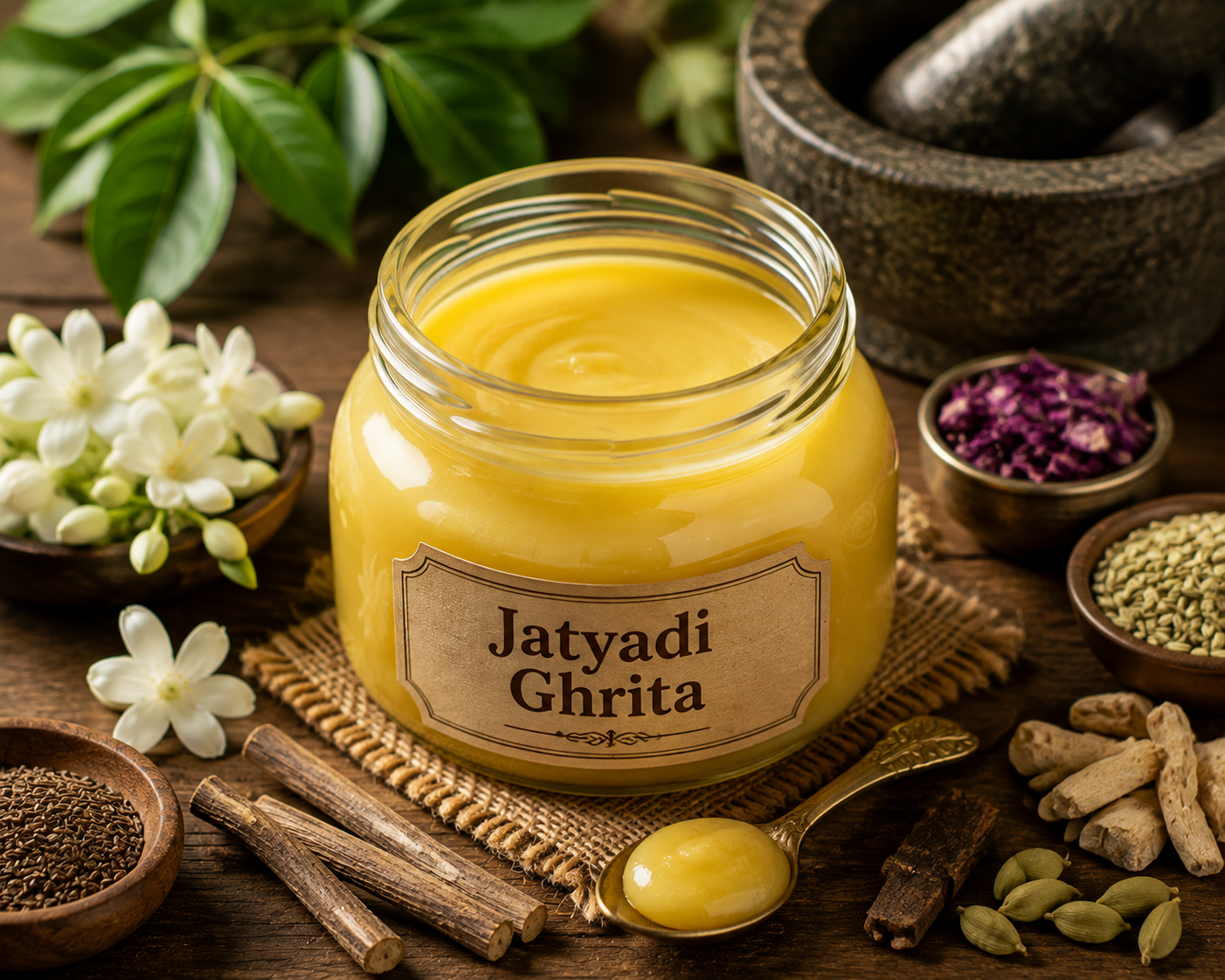
Jatyadi Ghrita (Introduction, Benefits, and Usages)
Jatyadi Ghrita benefits centre on wound healing, skin disease, and anal and rectal disorders — this classical Ayurvedic medicated ghee formulation is one of the most widely used topical wound-healing preparations in Ayurvedic clinical practice. The primary ingredient Jati (Jasmine) is combined with potent wound-healing herbs in a ghee base that enhances tissue penetration and creates a sustained-release topical environment. See Wikipedia: Ghee. For related Ayurvedic wound formulations, explore Jatyadi Oil and Triphala.
What Is Jatyadi Ghrita? A Complete Introduction
Origin and History of Jatyadi Ghrita
Jatyadi Ghrita is a classical Ayurvedic formulation described in the Ashtanga Hridayam and Sushruta Samhita — the primary classical surgical and wound-care text of Ayurveda. The “Jatyadi” prefix indicates that Jati (Jasmine — Jasminum officinale or J. sambac) is the principal herb. “Ghrita” refers to medicated ghee — cow’s ghee processed with herbal decoctions and pastes. The preparation involves cooking ghee with multiple wound-healing herb decoctions until the water is fully evaporated and the ghee has absorbed the medicinal compounds. This fat-based extraction produces high bioavailability of fat-soluble phytochemicals and creates a base that stays on wounds longer than water-based preparations. Jatyadi Ghrita has been continuously used in Ayurvedic surgery (Shalya Tantra) for wound management, ulcer treatment, fistula care, and haemorrhoid management for over 2,000 years.
Key Ingredients and Active Compounds
Jatyadi Ghrita’s classical formulation includes multiple wound-healing herbs processed into ghee. Key ingredients: Jati (Jasmine) — antimicrobial, wound-healing, anti-inflammatory; Nimba (Neem — Azadirachta indica) — powerful antimicrobial, antibacterial, anti-inflammatory; Patola (Trichosanthes dioica) — anti-inflammatory and skin-healing; Tuttha (copper sulphate) — antimicrobial, astringent; Kushtha (Saussurea lappa) — anti-inflammatory; Manjistha (Rubia cordifolia) — skin pigmentation normalisation and lymphatic support; Haridra (Turmeric) — curcumin antimicrobial and anti-inflammatory; Daru Haridra (Tree Turmeric/Berberine) — potent antimicrobial; and Ghee base — lipid vehicle enhancing penetration and providing its own wound-healing properties. See Wikipedia: Neem.
Top Health Benefits of Jatyadi Ghrita
Jatyadi Ghrita Benefits for Wound Healing and Overall Health
Jatyadi Ghrita’s primary benefits are for Vrana (wounds) — the text Sushruta Samhita, which describes the world’s oldest systematic surgical manual, uses Jatyadi Ghrita extensively for post-surgical wound care, chronic ulcers, burns, and infected wounds. The multi-herb formulation addresses every aspect of wound healing: broad-spectrum antimicrobial action (Neem, Turmeric, Daru Haridra, Tuttha) eliminates infection; anti-inflammatory compounds (Jasmine, Patola, Kustha) reduce wound oedema and pain; Manjistha promotes lymphatic drainage of inflammatory exudate; and the ghee base itself promotes granulation tissue formation and epithelialisation. Clinical studies on Jatyadi preparations confirm accelerated wound healing and reduced infection rates compared to conventional dressings in some contexts.
Jatyadi Ghrita for Anorectal Conditions and Skin
Jatyadi Ghrita’s second major application is anorectal disorders — haemorrhoids (Arsha), fistula-in-ano (Bhagandara), fissure, and anal ulcers. The ghee base creates a soothing, lubricating, antimicrobial environment in the perianal area that reduces pain, swelling, and infection while promoting healing. Clinical Ayurvedic practice uses Jatyadi Ghrita for local application after Kshar Sutra (medicated thread) treatment for fistula-in-ano — a combination that has shown excellent healing rates in published studies. For skin diseases: chronic skin ulcers, eczema, psoriatic plaques, and infected dermatoses benefit from Jatyadi Ghrita’s combined antimicrobial, anti-inflammatory, and skin-regenerating actions applied topically.
Medicinal Properties of Jatyadi Ghrita
How Jatyadi Ghrita Works as a Natural Remedy
The wound-healing mechanism operates through several pathways simultaneously.
Antimicrobial: Neem’s nimbidin and nimbolide, Turmeric’s curcumin, Daru Haridra’s berberine, and copper sulphate (Tuttha) together provide broad-spectrum antibacterial and antifungal coverage that prevents secondary infection in open wounds.
Anti-inflammatory: curcumin inhibits COX-2 and NF-kB inflammatory pathways; Jasmine and Patola flavonoids reduce inflammatory cytokine production; these together reduce the excessive inflammation that delays wound closure.
Regenerative: ghee’s butyrate stimulates fibroblast activity and collagen synthesis; Manjistha promotes lymphatic flow clearing wound debris; collectively these accelerate granulation tissue formation.
Moisture balance: the ghee base creates a moist wound environment proven to accelerate epithelialisation compared to dry wound management.
Jatyadi Ghrita in Ayurveda and Traditional Medicine
In Ayurveda, Jatyadi Ghrita belongs to the Vrana Chikitsa (wound management) category of Shalya Tantra (surgery). The Sushruta Samhita classifies wound healing into six stages (Shodha, Ropana, etc.) and prescribes specific formulations for each stage. Jatyadi Ghrita is particularly indicated for the Ropana (healing/granulation) stage and for infected wounds requiring Shodhana (purification/cleansing) simultaneously. The formulation principle — combining Tikta (bitter, antimicrobial) herbs with Snigdha (unctuous, regenerative) ghee base — reflects Ayurvedic understanding that wound healing requires both pathogen elimination and tissue nourishment. Modern wound care science validates this dual approach: antimicrobial and nutritive environments together outperform either alone.
How to Use Jatyadi Ghrita — Practical Usages
Jatyadi Ghrita Application and Dosage
For wounds and skin ulcers: cleanse the wound first with antiseptic or Triphala decoction. Apply a thin layer of Jatyadi Ghrita directly to the wound surface. Cover with a clean dressing. Change dressing once or twice daily. For chronic ulcers, continue for several weeks under physician guidance.
For haemorrhoids and fissures: apply a small amount of Jatyadi Ghrita to clean fingertip and apply gently to the affected perianal area after each bowel movement and at bedtime — soothing, lubricating, and healing.
For skin diseases: apply to affected skin areas twice daily after cleansing — for eczema, psoriasis, or chronic skin ulcers.
For burns: apply immediately after cooling the burn with cold water — the ghee base creates a protective moisture barrier while the antimicrobial compounds prevent infection.
Jatyadi Ghrita as a Supplement
Jatyadi Ghrita is available from major Ayurvedic manufacturers including Baidyanath, Dabur, Arya Vaidya Sala, and Kottakkal. It’s available in both Ghrita (ghee-based, for warmer environments) and Taila (oil-based — Jatyadi Taila) versions — the oil version is more liquid and often preferred for wound application. Prepare at home if ingredients are available: the classical preparation involves processing ghee with herb decoctions and pastes over low heat until the decoction’s water evaporates completely — the final ghee should pass the characteristic tests (no crackling on hot tawa, paste formation on fingernails). For home first-aid use, a tube of Jatyadi Ghrita in your medicine cabinet provides a versatile wound and skin care preparation.
Side Effects and Precautions of Jatyadi Ghrita
- Copper sulphate (Tuttha): some formulations contain Tuttha (copper sulphate) which can cause irritation on sensitive or broken skin — if burning increases on application, wash off and consult a physician
- Infected wounds: while Jatyadi Ghrita has antimicrobial properties, deep infections, necrotising wounds, or wounds showing red streaking (cellulitis) require immediate medical evaluation — do not rely solely on Ayurvedic preparations for serious infections
- Dairy allergy: the ghee base contains milk proteins — use with caution in people with dairy allergies
- Internal use: Jatyadi Ghrita is primarily a topical preparation; internal use should only be as directed by a qualified Ayurvedic physician for specific anorectal conditions
Frequently Asked Questions About Jatyadi Ghrita
What are the main Jatyadi Ghrita benefits?
Key Jatyadi Ghrita benefits: accelerated wound healing through combined antimicrobial, anti-inflammatory, and regenerative mechanisms, broad-spectrum antimicrobial action preventing secondary infection, moist wound environment supporting faster epithelialisation, haemorrhoid and anal fissure soothing and healing, chronic skin ulcer management, burn wound care, post-surgical wound application in Ayurvedic Shalya Tantra, and skin disease (eczema, psoriasis) topical management.
What is the difference between Jatyadi Ghrita and Jatyadi Taila?
Both Jatyadi Ghrita (ghee-based) and Jatyadi Taila (sesame oil-based) contain the same or similar herb combinations, but the lipid base differs. Ghee base (Ghrita) is preferred in Ayurveda for conditions with Vata and Pitta involvement — it’s more nourishing, penetrating, and cooling. Oil base (Taila) is more appropriate in humid climates, for oily skin types, and where a more liquid consistency is needed for wound application. Sesame oil base has its own antimicrobial and anti-inflammatory properties complementing the herbs. In practice, Jatyadi Taila is often preferred for wounds because its more liquid consistency spreads more easily; Jatyadi Ghrita is preferred for anorectal conditions and as a nourishing skin treatment.
Is Jatyadi Ghrita good for haemorrhoids?
Yes — Jatyadi Ghrita is a standard Ayurvedic topical treatment for haemorrhoids. The ghee base lubricates and soothes inflamed haemorrhoidal tissue, reducing friction and pain. The antimicrobial compounds prevent secondary infection. The anti-inflammatory herbs reduce oedema and pain. Applied gently to the perianal area after bowel movements and at bedtime, it provides symptomatic relief and supports healing. For internal (grade 2–3) haemorrhoids, Jatyadi Ghrita can be administered as a Pichu (medicated pad) or Basti (enema) under Ayurvedic physician guidance alongside oral medications and dietary modifications.
Can Jatyadi Ghrita be used for burns?
Jatyadi Ghrita has a long traditional use for minor burns — the ghee base creates immediate soothing, the antimicrobial compounds prevent infection, and the anti-inflammatory herbs reduce pain and oedema. For minor first and second-degree burns: after cooling the burn thoroughly with cold running water for 10–20 minutes, apply Jatyadi Ghrita and cover with a clean dressing. However: third-degree burns, large burns (>5% body surface), burns on the face, hands, feet, or genitals, and electrical or chemical burns all require emergency medical treatment — do not attempt to manage these with Ayurvedic preparations alone.
Jatyadi Ghrita benefits represent Ayurvedic surgery’s most refined wound management system — a multi-herb formulation in a penetrating ghee base that addresses infection, inflammation, and regeneration simultaneously. Keep it in your first-aid kit for wounds, burns, and skin conditions. Use it consistently for haemorrhoids and anal fissures. Trust the 2,000-year clinical track record of Sushruta’s surgical tradition — and know that modern wound care science increasingly validates why medicated ghee-based wound dressings work as well as they do.



Add comment