
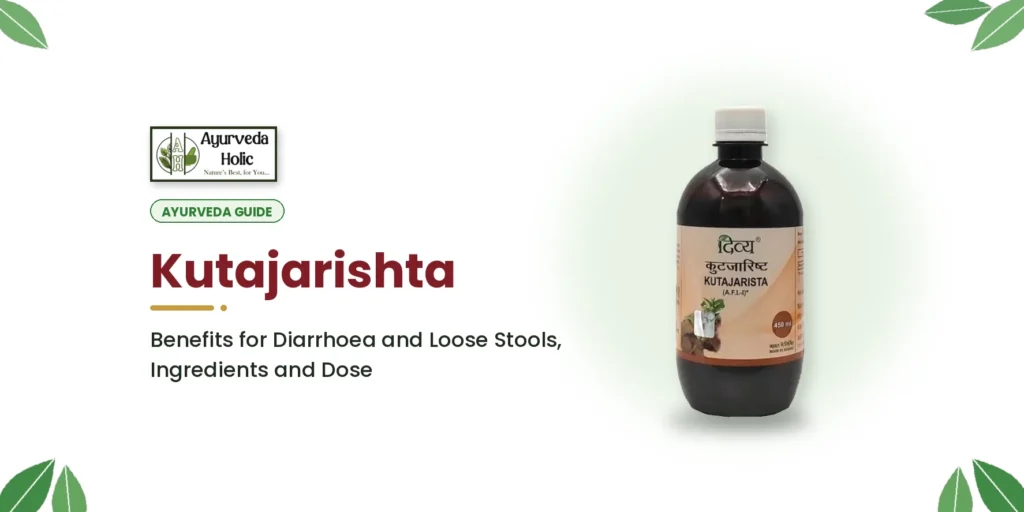
Short answer. Kutajarishta is a classical fermented tonic. It’s made mainly from kutaja bark, Ayurveda’s top herb for diarrhoea. The traditional kutajarishta benefits are for loose stools, diarrhoea, dysentery, IBS-type upsets and bleeding piles. You take it after meals, mixed with water. It doesn’t replace ORS. With diarrhoea, fluids always come first.
Loose motions are one of the most common reasons people reach for an Ayurvedic bottle. Kutajarishta is the classic one. Here’s what’s in it, how to take it, and when to skip it and see a doctor.
What’s in it
Here’s what Patanjali Divya Kutjarishta lists on our product page.
| Ingredient | Traditional role |
|---|---|
| Kutaja bark | The main herb for diarrhoea and dysentery |
| Draksha (raisins) | Sweetness. Helps fermentation |
| Madhuka (licorice) | Soothes the gut |
| Kusuma (safflower) | Supporting herb |
| Gambhari | Supporting herb |
| Dhataki flowers | Starts natural fermentation |
Like all arishtas, it contains a little natural alcohol.
How kutajarishta is made
It’s described in classical texts like Bhaishajya Ratnavali. Kutaja bark, raisins, licorice and gambhari are boiled into a decoction. It’s strained and cooled. Jaggery and dhataki flowers go in. Then it’s sealed and left to ferment for about a month. Dhataki flowers carry natural yeasts that kick off the fermentation.
Kutajarishta benefits (traditional)
- Diarrhoea and loose stools (atisara)
- Dysentery (pravahika). With mucus or blood, alongside medical treatment.
- IBS-type upsets (grahani). Alternating or loose stools.
- Bleeding piles
- Fever with loose stools
What research says about kutaja
Kutaja has a long history for dysentery, in Ayurveda and in older Western medicine. Conessine, an alkaloid from the bark, was once used against amoebic dysentery. Lab studies show the bark works against amoeba and some diarrhoea-causing bacteria. Animal studies show less gut movement and fluid loss. Good human trials are scarce.
How to take it
- At the pack dose, mixed with an equal amount of water, after meals.
- For a sudden bout of loose motions, usually for a few days.
- For longer use, like in IBS, take it with a practitioner’s guidance.
With diarrhoea, fluids come first
- ORS. Drink oral rehydration solution after every loose stool.
- Light food. Khichdi, curd rice, banana, buttermilk.
- Avoid oily, spicy and very sweet food, and raw salads, till you’re better.
- Wash your hands and use safe drinking water.
A sample day during loose stools
- Morning. ORS or rice water, then a ripe banana.
- After breakfast and lunch. Your dose of kutajarishta with water.
- Lunch. Khichdi or curd rice.
- Through the day. Sips of ORS, buttermilk with roasted jeera, or coconut water.
- Dinner. Light moong dal soup or khichdi.
Go back to normal food slowly as things firm up.
Kutajarishta vs kutajghan vati
| Kutajarishta | Kutajghan vati | |
|---|---|---|
| Form | Fermented liquid | Tablet of concentrated kutaja |
| Alcohol | A little, natural | None |
| Sugar | Yes, from jaggery and raisins | Little or none |
| Good for | Adults fine with arishtas. Long-running loose stools | Travel. People avoiding alcohol or sugar |
Who should be careful
- Pregnant and breastfeeding women. Avoid it, because of the alcohol, unless a doctor advises.
- Children. Only on a doctor’s advice.
- Diabetes. Arishtas contain sugar.
- If you avoid alcohol or take medicines that react with it, like metronidazole. The tablet form is a better pick.
- Constipation. It’s binding.
Common mistakes
- Taking kutajarishta and skipping fluids. Dehydration is the real danger.
- Using it to stop diarrhoea in a young child.
- Taking it for weeks without finding out why the loose stools keep coming.
- Taking it with metronidazole.
When diarrhoea needs a doctor
- Signs of dehydration, like very little urine, dizziness, dry mouth or sunken eyes
- Blood in the stool, or high fever
- Diarrhoea over two days in adults
- Any diarrhoea in a baby who isn’t drinking
- Severe stomach pain, or vomiting that won’t stop
- Diarrhoea in older adults or people with weak immunity
Frequently asked questions
What are the main kutajarishta benefits?
It’s traditionally used for diarrhoea, loose stools, dysentery, IBS-type upsets and bleeding piles.
How do I take kutajarishta?
Mix the label dose with an equal amount of water. Take it after meals.
Does kutajarishta contain alcohol?
Yes, a little, formed naturally, like all arishtas.
How quickly does kutajarishta work?
For mild loose stools, many people feel better within a day or two, with fluids and light food. See a doctor if there’s no change after two days.
Can kutajarishta be taken for IBS?
It’s used for IBS-type loose stools. For longer use, take it with a practitioner’s guidance.
Can kutajarishta be taken for bleeding piles?
It’s traditionally used for that. Any bleeding from the back passage should be checked by a doctor first.
Can I give kutajarishta to my child?
Not without a doctor’s advice. For children, ORS and medical advice come first.
Shop: Patanjali Divya Kutjarishta · Patanjali Divya Kutajghan Vati
This article is for general information and isn’t medical advice. See a doctor for severe or persistent diarrhoea.


