
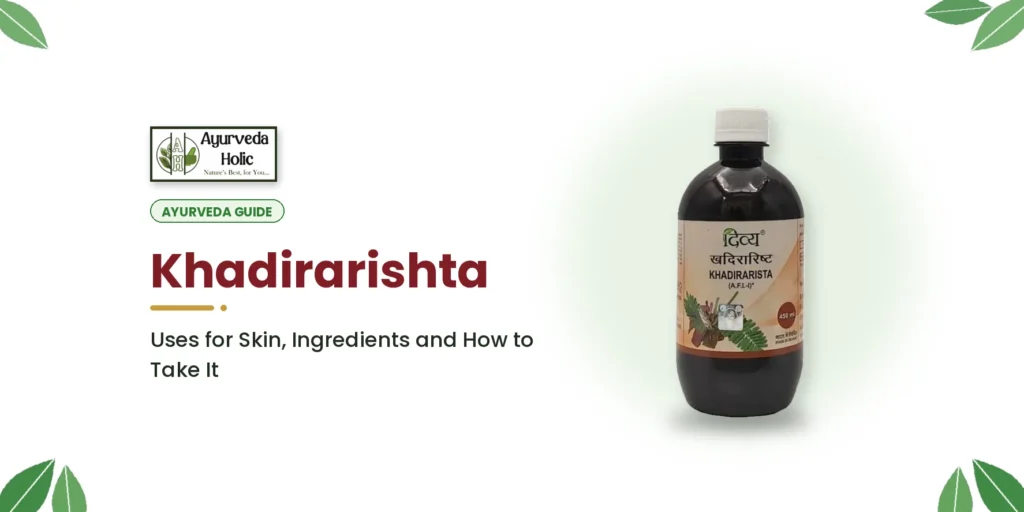
Short answer. Khadirarishta is a classical arishta, a naturally fermented herbal liquid. Its main herb is khadira, or catechu. Ayurveda uses it from the inside for skin, especially itchy, rash-prone or blemished skin. You take it with an equal amount of water after meals, at the bottle dose. It contains a little natural alcohol and some sugar. If you have diabetes or liver disease, or you avoid alcohol, ask your doctor first.
Most skin products go on the skin. Khadirarishta goes in. Ayurveda believes a lot of skin trouble starts inside. Here’s how this old tonic fits in, and what it can’t do.
What khadirarishta is
Khadira is the catechu tree, the source of kattha. An arishta is made by boiling herbs into a strong decoction, then letting it ferment with jaggery or sugar and dhataki flowers. That fermentation makes a little alcohol. It preserves the liquid. Traditionally, it’s also said to help carry the herbs into the body.
Here’s what Patanjali Divya Khadirarishta lists on our product page.
| Group | Ingredients |
|---|---|
| Main herb | Khadira (catechu) |
| Skin herbs | Devadaru, bakuchi, daruharidra |
| Triphala | Haritaki, bibhitaka, amalaki |
| Fermentation | Water, madhu, dhataki |
| Spices | Kankola, nagkesara, jatiphala, lavanga, ela, tvak, tejpatra, pippali |
Check your bottle for the full list.
How an arishta is made
- Herbs are boiled into a strong decoction (kwath).
- It’s cooled and mixed with jaggery or sugar, and honey.
- Dhataki flowers go in to start fermenting.
- It’s sealed and left for weeks.
- Then it’s filtered and bottled.
That’s why arishtas keep so long without added preservatives.
Khadirarishta uses (traditional)
Ayurveda links many skin problems to impure blood (rakta), plus excess Pitta and Kapha. Khadira is the classic herb for that pattern. So khadirarishta is used for these.
- Itchy, rash-prone skin
- Pimples and blemishes
- Skin that flares with heat, spicy food or season changes
- General skin health, as part of a wider routine
These are traditional uses. It isn’t a treatment for eczema, psoriasis, fungal infections or any skin disease. A rash that won’t go needs a dermatologist.
What research says
There’s very little research on khadirarishta itself. Catechu and some other ingredients show antimicrobial and anti-inflammatory effects in the lab. Arishtas have been studied mostly for their alcohol content and how they’re made. So its skin uses are traditional.
How to take khadirarishta
- Dose. As printed on the bottle, or as your doctor says.
- With water. Mix it with an equal amount of water.
- When. After meals, usually twice a day.
- How long. Skin changes slowly. Vaidyas usually review it after a month or two.
Shake the bottle first. A bit of sediment is normal.
Khadirarishta vs other skin formulas
| Product | Form | Traditional use |
|---|---|---|
| Khadirarishta | Fermented liquid | Skin health from inside |
| Khadiradi Vati | Tablet to suck | Mouth, gums and throat |
| Neem Ghan Vati | Tablet | Skin health. Very bitter |
| Neem or Kayakalp oils | Oil | Applied on the skin |
Khadirarishta and Khadiradi Vati share their main herb. They’re used completely differently, though. Don’t swap one for the other.
Habits that help your skin
- Cut back on very spicy, fried and fermented food, and sugar.
- Drink enough water. Eat cooling foods like cucumber, pomegranate and greens.
- Sleep on time. Late nights stir up Pitta.
- Use a gentle cleanser like Patanjali Saundarya Neem Tulsi Face Wash.
Our neem guide covers another classic skin herb.
Who should avoid it
- Diabetes. It contains sugar from the fermentation base.
- Liver disease, or if you avoid alcohol. It contains a little natural alcohol.
- Pregnant and breastfeeding women, and children. Only on a doctor’s advice.
- Medicines that don’t mix with alcohol, like metronidazole. Ask your doctor.
- Acidity. Some people find it warming.
Bakuchi, one of its herbs, is linked with sun sensitivity when used on the skin. If you also use bakuchi oils, protect your skin from strong sun.
Common mistakes
- Taking it for months with no review.
- Taking more than the label dose to clear skin faster.
- Forgetting it contains alcohol and sugar.
- Stopping prescribed skin treatment.
- Expecting results in days.
When to see a dermatologist
See a doctor if a rash spreads fast, oozes, blisters, comes with fever, or doesn’t improve after a few weeks.
Frequently asked questions
What is khadirarishta used for?
Ayurveda uses it from the inside for skin, especially itchy, rash-prone or blemished skin.
How should I take khadirarishta?
At the bottle dose, mixed with an equal amount of water, after meals.
Does khadirarishta contain alcohol?
A little, formed naturally by fermentation, like all arishtas.
Can diabetics take khadirarishta?
It contains sugar, so ask your doctor first.
How long does khadirarishta take to work?
Skin changes slowly. Vaidyas usually review it after a month or two.
Can khadirarishta help with itching?
It’s traditionally used for itchy skin. Itching without a rash can have other causes, like liver, kidney or thyroid problems. See a doctor if it keeps up.
Shop: Patanjali Divya Khadirarishta · Patanjali Divya Khadiradi Vati · Patanjali Neem Ghan Vati
This article is for general information and isn’t medical advice. See a dermatologist for ongoing skin problems.


