
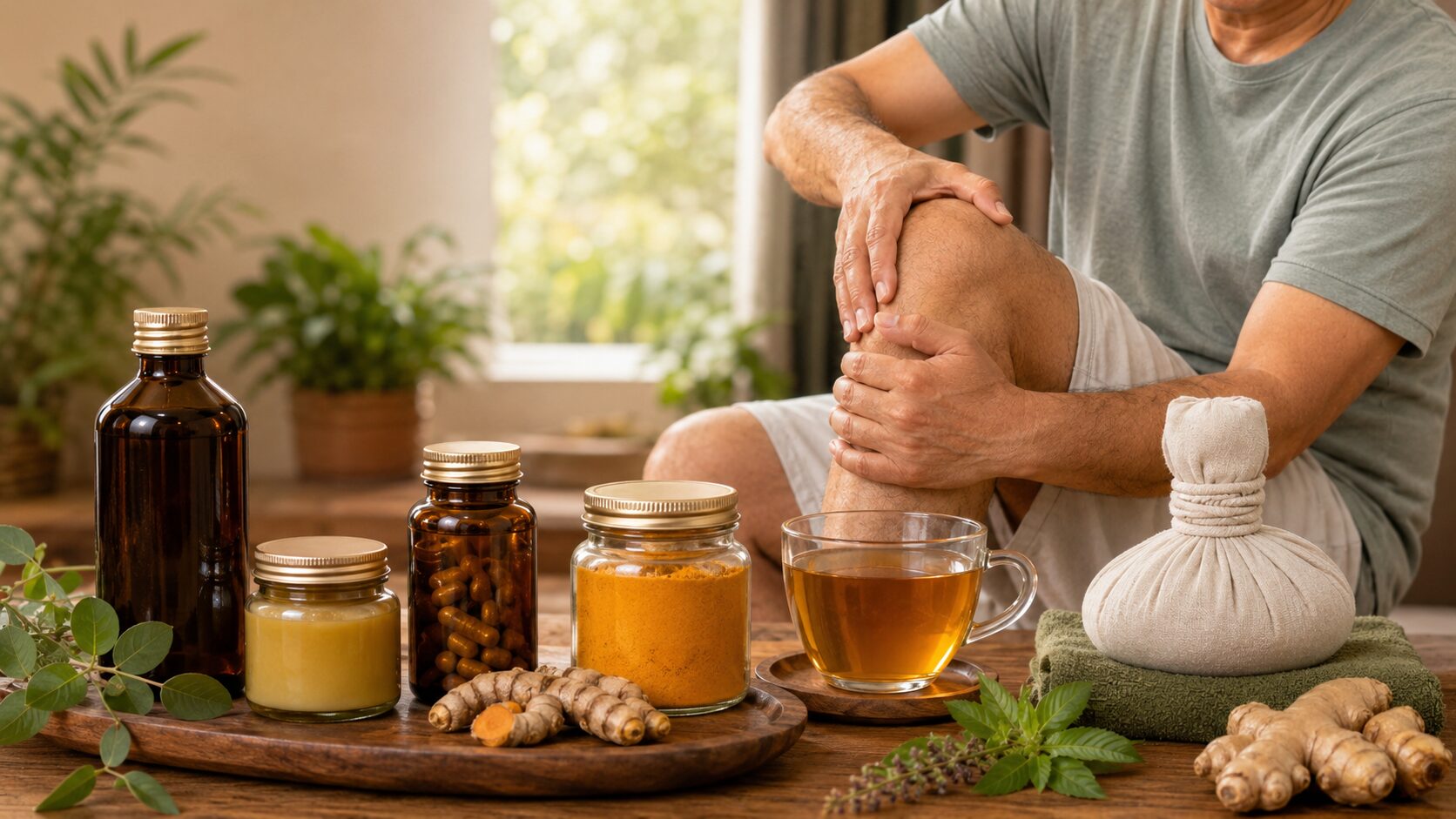
Ayurvedic Joint Care Routine: 6 Products for Daily Use
The routine matters more than the supplement — this is the part Ayurveda gets most right and people skip most often.
Stiff, aching joints quietly shrink your life — the stairs you avoid, the walk you cut short, the sleep broken by a throbbing knee. Ayurveda treats this not as wear-and-tear to be endured but as an imbalance to be corrected.
Below, we walk through how Ayurveda actually understands joint pain and arthritis, the specific herbs worth knowing with their real doses and cautions, the food and daily habits that do at least half the work, and an honest look at what the research does and does not show. The aim is a plan you can genuinely follow — not vague advice to ‘stay balanced’.
Building the Routine That Does the Work
Ayurveda’s real strength is Dinacharya, the daily rhythm, and it is free. The essentials are unremarkable and effective: wake and sleep at consistent times, drink warm water on rising, make lunch the largest meal when Agni peaks, keep dinner light and early, and move for thirty minutes a day. Add oil massage a few times a week for Vata. What makes this powerful is regularity rather than intensity — the body predicts and prepares for a rhythm it recognises. Most people would get more from fixing meal timing and sleep for a month than from any product they could buy.
How Ayurveda Reads This
Classically this falls under Sandhivata (osteoarthritis) or Amavata (rheumatoid arthritis), and the underlying pattern is Vata-dominant with dryness and degeneration in Sandhivata; Ama plus Vata in Amavata, where toxins lodge in the joint. That reading is practical, not decorative: it tells you which herbs to use and — just as importantly — which will make things worse, the mistake people make when they copy a remedy that suited someone with the opposite pattern.
Best Herbs for Daily Routine
These are the herbs with the strongest case here, each doing a different job:
Triphala (Amalaki + Haritaki + Bibhitaki)
Haritaki stimulates peristalsis, Amalaki cools excess Pitta and supplies antioxidants, and Bibhitaki clears excess Kapha and mucus. Together they regulate bowel function rather than forcing it. Triphala is taken at 1 tsp (3–5 g) of churna in warm water, or 500–1,000 mg in tablet form, at bedtime for constipation and overnight regulation; on an empty stomach in the morning for detoxification. Reduce the dose if stools become too loose.
Ashwagandha (Withania somnifera)
It blunts the HPA-axis stress response, lowering circulating cortisol, and has a mild GABA-mimetic action that quietens an over-firing nervous system without sedating it. Ashwagandha is taken at 300–600 mg of a standardised root extract (KSM-66 or Sensoril), or 3–6 g of raw root churna, at night with warm milk for sleep and anxiety; in the morning for energy and stamina. Avoid in pregnancy.
Diet That Supports Daily Routine
Foods to Favour
- Warm, moist, well-cooked food
- Ghee and healthy fats to lubricate the joints
- Ginger, turmeric and garlic daily
- Warm soups and cooked vegetables
Foods to Limit or Avoid
- Cold, dry and raw food, which aggravates Vata
- Curd at night and excess sour food in Amavata
- Sitting still for long stretches
- Potatoes and nightshades if you notice a flare
A Practical Daily Routine
- Morning: Triphala at 1 tsp (3–5 g) of churna in warm water
- Midday: make lunch the largest meal, when Agni is strongest
- Evening: thirty minutes of movement, and a light, early dinner
- Night: a calming or regulating herb as appropriate, with warm milk
- Weekly: log morning stiffness duration, pain score, and range of movement
Precautions and When to See a Doctor
- Tell your doctor about every herb you take — most interactions are caught this way
- Herbs complement conventional treatment for serious disease; they do not replace it
- Pregnancy, breastfeeding and childhood all need professional guidance first
- Buy only certified brands — unregulated products carry a real heavy-metal risk
What the Evidence Shows
Trials show improved bowel regularity without dependency, and microbiome studies report increases in Lactobacillus and Bifidobacterium. The independent NIH review covers the lead herb, and the NIH overview covers the wider condition.
Common Mistakes With Daily Routine
- Expecting results in days — this works over weeks, and quitting at two weeks guarantees failure
- Taking herbs but ignoring the diet, which usually does more of the work
- Copying a remedy that suited someone with the opposite dosha pattern
- Switching herbs constantly instead of giving one combination a fair eight-week trial
What the Research Really Says About Joint Pain
The evidence for Shallaki (Boswellia) is worth understanding honestly rather than through marketing. Randomised trials in knee osteoarthritis report reduced pain and improved function within 8 weeks, with cartilage-protective signals. Its measurable action comes from boswellic acids (AKBA), and it inhibits 5-lipoxygenase — a different inflammatory pathway from NSAIDs, which block COX. That is why it eases joint pain without damaging the stomach lining, and it also slows cartilage-degrading enzymes.
That said, three caveats apply to almost all Ayurvedic research on joint pain and arthritis. First, many studies are small and run in India, so they need larger independent replication before the results are considered settled. Second, herbal trials struggle to blind properly — the taste and smell of a churna are hard to disguise with a placebo, which can inflate the apparent benefit. Third, whole-herb preparations vary batch to batch, so a result from a standardised extract does not automatically transfer to the powder on your shelf. None of this means the herbs do not work; it means the honest position is ‘promising and traditionally supported’, not ‘clinically proven cure’.
It also helps to know how the classical and modern pictures line up. Ayurveda described Sandhivata (osteoarthritis) or Amavata (rheumatoid arthritis) and its pattern of vata-dominant with dryness and degeneration in sandhivata centuries before anyone could measure a cytokine or a hormone, and much of what modern pharmacology now documents maps onto those older observations rather than contradicting them. The gap is in the standard of proof, not usually in the direction of the effect — traditional texts recorded what practitioners saw repeatedly, while modern trials are still catching up on measuring it rigorously.
The practical takeaway is to treat the research as a reason to try a well-made product carefully, alongside the diet and lifestyle changes that carry the strongest evidence of all — and to track morning stiffness duration, pain score, and range of movement so you have your own data rather than relying on a study done on someone else. If eight to twelve consistent weeks show no change in your own measurements, that is a genuine signal to reassess rather than to keep spending.
Frequently Asked Questions
Which single habit should I start with?
Fixed meal times, with lunch as the largest meal. It costs nothing and does more for digestion, energy and weight than any supplement. Add consistent sleep and wake times next.
Is my arthritis Sandhivata or Amavata?
Sandhivata (osteoarthritis) is dry, worse with movement, mainly in knees and hips, and improves with warm oil. Amavata (rheumatoid) brings migrating pain, swelling, morning stiffness over an hour, and a heavy, toxic feeling. Crucially, oil massage helps Sandhivata but can worsen active Amavata — clear the Ama first.
Should I use hot or cold on the joint?
Hot for chronic, stiff, Vata-type pain — warm oil and a hot pack. Cold for acute, red, swollen, hot joints. Applying heat to an actively inflamed joint makes it worse.
How long before I see results?
Two to four weeks for the first signs, four to eight for a clear change, three to six months for full benefit. Track morning stiffness duration, pain score, and range of movement weekly — steady, gradual improvement is the expected shape.
The Bottom Line
The routine matters more than the supplement — this is the part Ayurveda gets most right and people skip most often. Get the pattern right, use the herbs above at their real doses, fix the diet, and give it eight to twelve weeks. Track morning stiffness duration, pain score, and range of movement, keep your doctor informed, and judge it on the data rather than on how you feel on day three.
Related Reading
- How to use herbal guggulu for joint pain relief?
- Krishna Gopal Kaleda Chyawanprash
- Which Ayurvedic hair care products are recommended for dandruff treatment?
- Which Ayurvedic Products are Best for Enhancing Energy and Vitality?
- What Are the Health Benefits of Using Mukta Bhasma for Skin Care?
Disclaimer
This article is for general information and educational purposes only. It is not medical advice, a diagnosis, or a prescription, and it does not claim to cure, treat, or prevent any disease. Ayurvedic herbs can interact with medicines and are not suitable for everyone — responses vary from person to person. Always consult a qualified doctor or registered Ayurvedic practitioner before starting any herb, supplement, or remedy, especially if you are pregnant, breastfeeding, taking medication, or managing a health condition. Never stop prescribed treatment without professional guidance.

Add comment