Guggulu buying guide
Which Guggulu Tablet Is Which?
Swarna, Kanchnar, Yograj and Mahayograj Guggulu compared side by side.

Walk into any Ayurvedic pharmacy and ask for “Guggulu” and the pharmacist will ask you a question back: which one? There are dozens of Guggulu formulations, and the names sound similar enough to cause real confusion. People regularly buy Kanchnar Guggulu for knee pain or Mahayograj Guggulu when their doctor wrote Yograj.
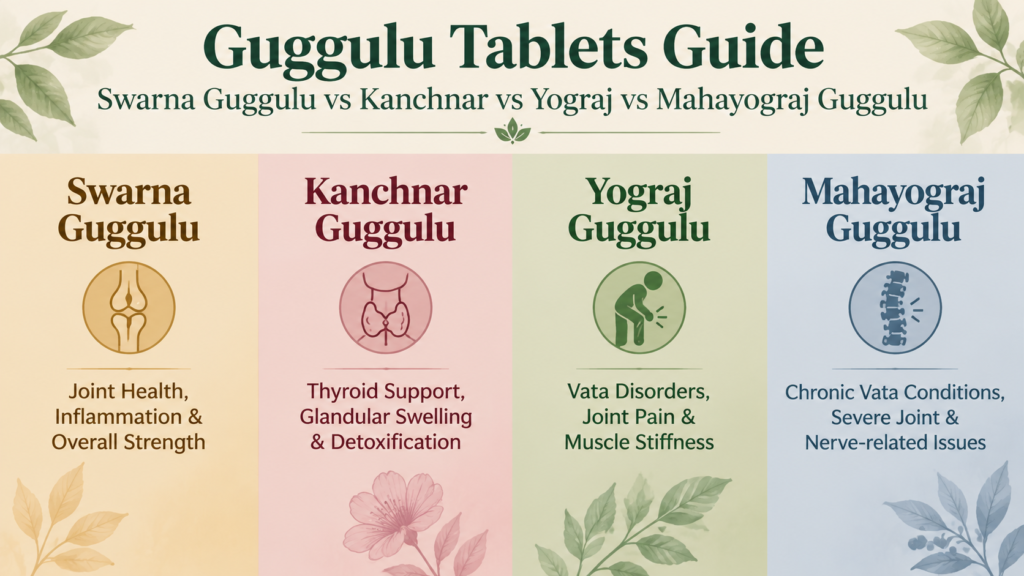
This guide covers the four you are most likely to be prescribed or recommended, and explains what actually separates them.
What Guggulu is
Guggulu is the resin of Commiphora mukul, a thorny shrub that grows in the dry regions of Rajasthan and Gujarat. Before it is used in medicine, the raw resin is purified (shodhana), traditionally by boiling it in Triphala decoction or milk and straining it.
Purified Guggulu has two jobs in a formula. It is an active ingredient in its own right, described in Ayurveda as reducing Vata and Kapha, and it acts as a binder that holds the other powders together as a tablet. That is why so many classical tablets end in “Guggulu”. Our Guggul introduction covers the resin in more detail.
The four compared
| Yograj Guggulu | Mahayograj Guggulu | Kanchnar Guggulu | Swarna Guggulu | |
|---|---|---|---|---|
| Base | Guggulu with about 25 to 30 herbs | Yograj formula plus metal Bhasmas | Guggulu with Kanchnar bark | Guggulu with Swarna Bhasma |
| Contains Bhasmas | No | Yes (Abhrak, Vang, Naag, Rajat, Lauh, Mandur, Ras Sindoor) | No | Yes (gold) |
| Traditional focus | Joint and muscle stiffness, Vata disorders | Long-standing, more severe Vata conditions of joints | Glandular swellings and lumps (Granthi), lymph and thyroid support | Joint comfort with added Rasayana support |
| Typical user | Adults with stiffness, older adults | Chronic cases, under close supervision | Not a joint medicine in the first place | Older adults, physician-guided |
| Prescription needed | Advisable | Yes | Advisable | Yes (contains gold) |
Yograj Guggulu
Yograj Guggulu is the workhorse. It appears in Sharangadhara Samhita and combines purified Guggulu with a long list of herbs including Chitrak, Pippali, Triphala, Ajwain and others. Traditionally it is used for Vata disorders of the joints and muscles: morning stiffness, aching, reduced movement.
We stock Dabur Yograj Guggulu and Kerala Ayurveda Yogaraja Guggulu. Our Dabur Yograj Guggulu guide has more.
Mahayograj Guggulu
Maha means great. Mahayograj Guggulu takes the Yograj formula and adds a set of metal and mineral Bhasmas: Abhrak, Vang, Naag, Rajat (silver), Lauh, Mandur and Ras Sindoor. This makes it more potent in the traditional view, and it is generally kept for older, long-standing cases rather than as a first choice.
Because of the mineral content, it should be taken only on a doctor’s advice. Options include Dabur Maha Yograj Guggulu and Patanjali Divya Mahayograj Guggul. We have also written about Mahayograj Guggul for cholesterol, joint and heart health.
Kanchnar Guggulu
This is the one most often bought by mistake. Kanchnar Guggulu is built around the bark of Kanchnar (Bauhinia variegata) with Triphala, Trikatu, Varuna and a few spices. Its classical use is for Granthi and Gandamala, meaning lumps, swellings and glandular enlargements. In modern practice it is commonly prescribed in thyroid and lymph-related conditions, always alongside proper medical care.
It is not a joint-pain medicine. If you have arthritis, Kanchnar Guggulu is not the tablet to start with. A related option in our store is Patanjali Divya Kanchnar Ghanvati.
Swarna Guggulu
Swarna Guggulu combines purified Guggulu with Swarna Bhasma (processed gold) and supporting herbs such as Ashwagandha and Kesar. The gold is there as a Rasayana, a rejuvenative, on top of Guggulu’s traditional joint support. It is aimed at older adults whose joint stiffness comes with general weakness.
Dabur Swarn Guggulu comes in packs of 30 tablets. The usual pack guidance is 1 tablet twice a day after meals with lukewarm water or milk, or as your physician directs. Our Dabur Swarn Guggulu guide has the full ingredient breakdown.
When to ask your Vaidya
Guggulu tablets are widely sold over the counter, but you should speak to an Ayurvedic doctor if:
- you are not sure which type of joint problem you have (osteoarthritis, rheumatoid arthritis and gout need very different care)
- your doctor has prescribed Mahayograj or Swarna Guggulu, which both contain Bhasmas
- you have liver, kidney or thyroid conditions
- you take blood thinners, thyroid medicine, or medicines for blood pressure or diabetes
- you are pregnant or breastfeeding (Guggulu is traditionally avoided in pregnancy)
Also see a regular doctor for joint pain that comes with fever, a red hot swollen joint, sudden severe pain, or weight loss.
Practical tips for taking Guggulu
- Guggulu is usually taken after meals to avoid stomach upset.
- Warm water is the traditional anupana. Some doctors suggest a Rasna or Dashmool decoction instead.
- Classical advice is to go easy on very sour, heavy and fried food during a Guggulu course.
- Give it time. Most practitioners review progress after a few weeks rather than days.
Our article on how to use herbal Guggulu for joint pain relief has more practical advice.
How Guggulu is purified and made into tablets
Raw Guggulu straight from the tree is not used as medicine. The classical texts insist on shodhana first. In the common method, the resin is broken into pieces, tied in a cloth and suspended in a pot of boiling Triphala decoction, cow’s milk or Dashmool decoction. The resin softens and passes through the cloth while sand, bark and other impurities stay behind. The purified Guggulu is then dried in the sun until it can be worked.
To make a tablet, the herbal powders of the formula are mixed with the purified Guggulu, often with a little ghee, and pounded until the mass is smooth and sticky. It is then rolled into pills or pressed into tablets. In Bhasma-containing formulas such as Mahayograj and Swarna Guggulu, the Bhasmas are ground in at this stage.
This is one reason quality varies between makers. Properly purified Guggulu is gentler on the stomach, and the amount of Guggulu relative to the herbs changes how the tablet behaves. A licensed manufacturer following the classical recipe and listing the composition is your best guarantee.
The dosha view: who each Guggulu suits
Ayurveda groups joint problems by dosha, and that shapes which Guggulu a Vaidya chooses.
- Vata-type joint pain is dry, cracking, worse in cold weather and in the morning, and better with warmth and oil massage. Yograj Guggulu is the classic choice, and Mahayograj Guggulu is kept for long-standing, more severe Vata cases.
- Ama-related joint pain, which Ayurveda links with poor digestion, shows as heaviness, stiffness and swelling, sometimes moving from joint to joint. Doctors often address digestion first, and may use Yograj Guggulu alongside other formulas.
- Pitta-type joint pain has redness, heat and burning. Guggulu formulas are warming, so they are used carefully here, often with cooling formulas such as Kaishore Guggulu instead, which is outside this guide.
- Swellings, lumps and glandular enlargement are not joint problems at all in this system. That is Kanchnar Guggulu territory.
- Weakness with stiffness in older adults is where Swarna Guggulu, with its gold Rasayana support, is usually considered.
You do not need to diagnose your own dosha to use this guide, but it explains why two people with “knee pain” may be given different tablets.
Diet and routine during a Guggulu course
The classical texts give quite specific advice to people taking Guggulu. Most practitioners still pass on a version of it:
- Eat warm, freshly cooked, easily digested food.
- Go easy on very sour foods (pickles, tamarind, curd at night), heavy fried food and excess alcohol.
- Avoid very cold drinks and sleeping during the day.
- Keep moving. Gentle walking, joint-friendly yoga and regular warm oil massage are part of Ayurvedic joint care, not optional extras.
- Drink warm water through the day.
Guggulu also pairs with external care. Many people use a joint oil such as Mahanarayan Tail or Peedanil Taila alongside the tablets, as advised by their doctor.
Guggulu tablets we stock
| Tablet | Brand and pack | Contains Bhasmas |
|---|---|---|
| Yograj Guggulu | Dabur Yograj Guggulu 60 tablets | No |
| Yogaraja Guggulu | Kerala Ayurveda 50 tablets | No |
| Mahayograj Guggulu | Dabur Maha Yograj Guggulu 40 tablets | Yes |
| Mahayograj Guggul | Patanjali Divya 60 tablets | Yes |
| Swarna Guggulu | Dabur Swarn Guggulu 30 tablets | Yes (gold) |
| Gokshuradi Guggul | Patanjali 80 tablets | No (traditionally used for urinary health, not joints) |
Frequently asked questions
Can Guggulu be taken long term?
Most practitioners prescribe it in courses with breaks and reviews, rather than continuously for years. Formulas with Bhasmas in particular should be reviewed regularly by your doctor.
Does Guggulu cause stomach upset?
Some people get mild acidity or loose stools, especially on an empty stomach. Taking it after meals with warm water usually helps. Tell your doctor if it continues.
Which Guggulu is best for knee pain?
Yograj Guggulu is the most common starting point for joint stiffness in Ayurveda. Mahayograj and Swarna Guggulu are usually kept for older or long-standing cases on a doctor’s advice. Kanchnar Guggulu is not a joint medicine.
What is the difference between Yograj and Mahayograj Guggulu?
Mahayograj Guggulu contains the Yograj formula plus several metal and mineral Bhasmas, which makes it more potent and means it should be taken under supervision.
Does Swarna Guggulu contain real gold?
Yes. It contains Swarna Bhasma (processed gold) along with purified Guggulu and herbs.
Can I take two Guggulu tablets together?
Only if your doctor advises it. Combining formulas can double up ingredients.
This guide describes the traditional use of Ayurvedic formulations for general information. It is not medical advice. Consult a qualified doctor for any joint condition.