
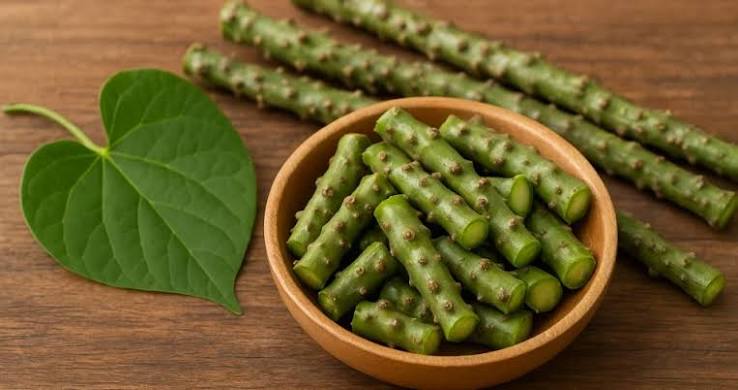
Giloy (Introduction, Benefits, and Usages)
Giloy benefits make Tinospora cordifolia one of Ayurveda’s most important and scientifically validated immunomodulatory herbs – known as Guduchi in Sanskrit and “Amrita” (divine nectar of immortality), this climbing shrub has documented effects on immune function, fever management, diabetes, liver protection, and anti-inflammatory applications backed by substantial modern research. What makes Giloy particularly remarkable is its status as one of Ayurveda’s genuine tridosha-balancing Rasayana herbs – rare medicines that can be used safely long-term by people of all constitutions. See Wikipedia: Tinospora cordifolia. For related immunomodulatory herbs, explore Ashwagandha and Tulsi.
What Is Giloy? A Complete Introduction
Origin and History of Giloy
Giloy (Tinospora cordifolia), called Guduchi or Amrita in Sanskrit, is a large deciduous climbing shrub native to tropical India, Myanmar, and Sri Lanka. It grows on other trees and has distinctive heart-shaped leaves. In Ayurvedic mythology, Giloy/Amrita was the nectar of immortality dripped from heaven – a mythology that reflects its status as one of the most universally applicable and potent Rasayana (rejuvenating) herbs. The Charaka Samhita classifies Guduchi among the most important Rasayana, Jwaragna (fever-reducing), Medhya (cognitive-enhancing), and Vayasthapana (anti-ageing) herbs. The plant is particularly valued when it grows on a neem tree – the Neem Giloy (Giloy that has climbed a neem tree) is considered to absorb additional medicinal properties from the host tree.
Key Compounds and Active Profile
Giloy’s pharmacologically active compounds span several chemical classes. Tinosporin, tinosporide, and cordifolide are clerodane diterpenes with anti-malarial, hepatoprotective, and immunomodulatory activity. Berberine (the same alkaloid found in Daruharidra/Berberis) provides antimicrobial, antidiabetic, and anti-inflammatory effects. Arabinogalactan polysaccharides are the primary immunomodulatory compounds – activating macrophages, NK cells, and T-lymphocytes. Tinosporaside has analgesic and antipyretic properties. Magnoflorine and choline contribute to cognitive and neuromuscular effects. See Wikipedia: Berberine.
Top Health Benefits of Giloy
Giloy Benefits for Immunity and Overall Health
Giloy’s immunomodulatory properties are its most distinctive and well-researched benefit. Multiple studies confirm that Giloy extracts significantly increase white blood cell counts (particularly macrophages and neutrophils), enhance NK cell activity, increase T-lymphocyte proliferation, and modulate cytokine production. This is “immune modulation” – not just stimulation – meaning Giloy appropriately enhances immune function when it’s low and potentially moderates it when it’s excessive (autoimmune conditions), which is pharmacologically sophisticated. For fever – particularly chronic low-grade fever, recurrent fevers, and post-infectious fatigue – Giloy is one of Ayurveda’s most consistently recommended herbs, with clinical study support for reducing dengue fever symptoms and platelet recovery.
Giloy for Skin, Hair, and Beauty
Giloy’s potent antioxidant and anti-inflammatory properties contribute to skin health through multiple mechanisms. The arabinogalactan polysaccharides modulate skin immune responses, relevant for inflammatory skin conditions like psoriasis and eczema. Blood purification (Rakta Shodhana) – the Ayurvedic concept that many skin conditions originate from blood toxins – is Giloy’s classical skin indication: clinical reports support improvement in chronic inflammatory skin conditions following Giloy treatment. The berberine component provides direct antimicrobial activity against skin pathogens. Giloy’s anti-diabetic effects are relevant for skin health because poor blood sugar control worsens many skin conditions.
Medicinal Properties of Giloy
How Giloy Works as a Natural Remedy
Giloy’s immunomodulatory mechanism is multi-layered. The arabinogalactan polysaccharides directly stimulate macrophage phagocytosis and cytokine production (IL-12, TNF-alpha) that activate both innate and adaptive immunity. The diterpenes have documented anti-inflammatory effects through prostaglandin pathway inhibition. For antipyretic effects, Giloy extracts inhibit fever-generating prostaglandin E2 production – explaining the classical fever-reducing application. For blood sugar management, berberine and the diterpenes improve insulin sensitivity and glucose uptake through AMPK activation. The hepatoprotective effects are documented: Giloy extracts protect liver cells from hepatotoxin damage, reducing liver enzyme elevation comparably to silymarin.
Giloy in Ayurveda and Traditional Medicine
In Ayurveda, Giloy (Guduchi/Amrita) is classified as bitter and astringent in taste, hot in potency, and uniquely Tridosha-balancing – it reduces all three doshas simultaneously, a very rare quality among medicinal herbs. Ayurvedic indications include Jvara (all types of fever), Prameha (diabetes), Raktapitta (bleeding disorders), Kamala (liver conditions), Kushtha (skin diseases), Vatarakta (gout), and as a universal Rasayana (rejuvenating tonic) for all constitutions. The classical formulation Guduchi Ghanavati and Guduchyadi Kwatha are widely prescribed for fever and immune support. Giloy is one of the three herbs in the classical Trikatu-like combination with Ashwagandha and Shatavari for comprehensive Rasayana therapy. Pairs with Tulsi for respiratory immunity and with Ashwagandha for adaptogenic-immune combined therapy.
How to Use Giloy – Practical Usages
Giloy in Juice, Tea, and Cooking
Fresh Giloy juice: crush fresh Giloy stem (2-3 inches), extract juice with minimal water, strain and drink 10-20 ml daily – the most potent preparation with maximum immunomodulatory polysaccharides. Giloy Kwatha (decoction): boil 10g of dried Giloy stem in 400ml water, reduce to 100ml, strain, and drink twice daily for fever, chronic fatigue, or blood sugar management. Guduchi powder (churna): 1-3g twice daily with honey or warm water for long-term Rasayana use. Ready-to-drink Giloy juice is now widely available from Patanjali, Dabur, and other Ayurvedic brands – convenient though less potent than fresh preparation.
Giloy as a Supplement or Topical Application
Giloy is available as standardised aqueous extracts, tablets, and capsules – standardised products provide more consistent dosing of the immunomodulatory polysaccharides. Doses of 300-500 mg of standardised extract twice daily are used in clinical studies for immune support. The classical Guduchi Satwa (starch extracted from Giloy stem) is the purest preparation – it dissolves in water, has minimal bitter taste, and is used for children, elderly, and convalescent patients. Giloy doesn’t have significant topical applications – its primary therapeutic use is internal for systemic immune and metabolic conditions.
Side Effects and Precautions of Giloy
- Autoimmune conditions: Giloy stimulates immune function – theoretically this could exacerbate autoimmune conditions (lupus, rheumatoid arthritis, MS). However, Ayurveda traditionally uses Giloy FOR some autoimmune conditions (Vatarakta) because of its modulating rather than purely stimulating effects; discuss with a physician if you have an autoimmune condition
- Blood sugar medication: Giloy’s anti-diabetic effects can potentiate antidiabetic drugs – monitor blood sugar carefully
- Pregnancy: insufficient human safety data – use with caution during pregnancy and only under Ayurvedic physician supervision
- Liver health: rare case reports of liver injury associated with Giloy products have been published (possibly related to misidentification with Tinospora crispa) – choose products from reputable authenticated sources
Frequently Asked Questions About Giloy
What are the main Giloy benefits for health?
Key Giloy benefits: immunomodulation through arabinogalactan polysaccharides activating macrophages, NK cells, and T-lymphocytes; fever reduction through prostaglandin E2 inhibition; blood sugar management through berberine and AMPK activation; liver protection from hepatotoxins; anti-inflammatory activity for arthritis and inflammatory conditions; blood purification for chronic skin diseases; cognitive support through Medhya classification; and long-term Rasayana (anti-ageing) tonic properties safe for all constitutions.
How to use Giloy for immunity?
For daily immune maintenance: 10-20 ml of fresh Giloy juice or 1-3g of Giloy powder with honey daily. During acute infections or post-infection recovery: double the dose and consider combining with Tulsi and Ginger for synergistic respiratory-immune support. For long-term Rasayana use: consistent low-dose (1-2g churna or 300 mg extract) use for 3-6 months provides cumulative immunomodulatory benefits. Consult an Ayurvedic physician for personalised dosage and formulation recommendations.
What is Giloy called in English and what plant is it?
Giloy is called “heart-leaved moonseed” in English, referring to its distinctive heart-shaped leaves and climbing growth habit. The botanical name is Tinospora cordifolia (“Tinospora” from the Greek for “thread seed,” “cordifolia” from Latin for “heart-leaved”). It belongs to the Menispermaceae family. Common names include Guduchi (Sanskrit), Giloy (Hindi), Amruth (Telugu), Seenthil (Tamil), and Amrit (Bengali) – the multiple names referencing immortality across Indian languages reflect its universally exalted medicinal status.
Giloy benefits represent some of Ayurveda’s most sophisticated immune medicine – an herb that modulates rather than simply stimulates immunity, balances all three doshas, and serves as a foundational Rasayana for long-term health maintenance. Its research profile supports every major classical Ayurvedic application: fever management, blood sugar control, liver protection, and immune enhancement. This is an herb worth knowing well and including regularly in your Ayurvedic health practice.
Add comment