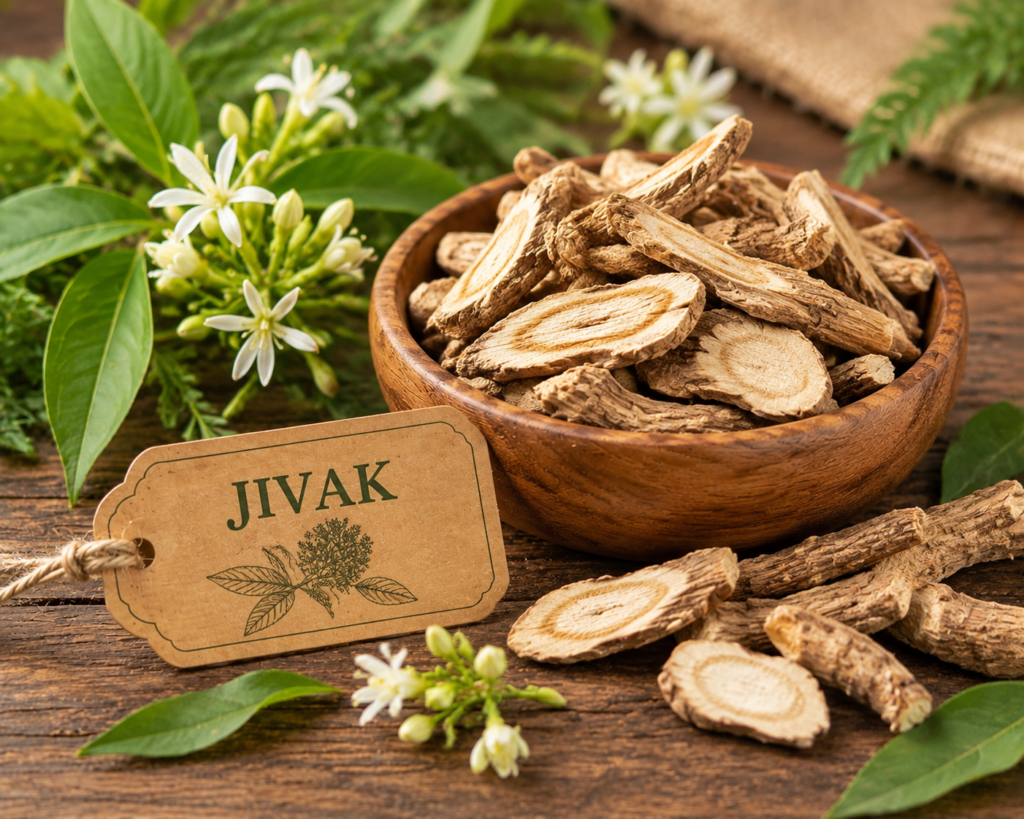
Jivak benefits for vitality, immunity, and reproductive health establish it as one of Ayurveda’s most revered Rasayana (rejuvenative) herbs — part of the classical Ashtavarga (eight sacred herbs) group used in the most potent Ayurvedic tonics including Chyawanprash. Jivak (Microstylis muscifera or related orchid species) is a rare Himalayan medicinal orchid whose tubers are used as an aphrodisiac, general tonic, and adaptogen in classical Ayurvedic formulations. See Wikipedia: Malaxis muscifera. For related Rasayana tonics, explore Ashwagandha.
What Is Jivak? A Complete Introduction
Origin and History of Jivak
Jivak (Microstylis muscifera, also classified as Malaxis muscifera) is a small terrestrial orchid growing in the Himalayan alpine meadows at 2,500–4,000 metres altitude. It’s one of the eight herbs of the Ashtavarga group — a collection of rare Himalayan herbs collectively called “Jeevaka” or “life-giving herbs” — central to the most powerful classical Ayurvedic rejuvenative preparations. The bulbous tubers are the medicinal part, resembling small onions and harvested in autumn. The Charaka Samhita and Sushruta Samhita both describe the Ashtavarga group for Jivaniya (life-supporting), Shukrala (semen-promoting), Balya (strength-giving), and Rasayana (rejuvenative) properties. The extreme rarity and difficult growing conditions of Himalayan orchids in this group have made genuine Jivak almost unobtainable in commercial supply — most commercial “Ashtavarga” preparations substitute readily available herbs. Conservation is a critical issue.
Key Compounds in Jivak
Comprehensive phytochemical analysis of authentic Jivak (Microstylis muscifera) is limited due to the species’ rarity and conservation-protected status. Available analyses document: mucilage polysaccharides — the primary nutritive component of the orchid tuber, providing the thick, demulcent, mucous-membrane-soothing properties; alkaloids — including small amounts of orchid-specific alkaloids; flavonoids — quercetin and related compounds providing antioxidant activity; sterols — beta-sitosterol and related phytosterols with anti-inflammatory and hormonal modulating properties; phenolic acids — antioxidant and anti-inflammatory compounds. The mucilage content is particularly high and is likely central to Jivak’s classical Snigdha (unctuous), Guru (heavy), and Jivaniya (vitalising) properties. See Wikipedia: Mucilage.
Top Health Benefits of Jivak
Jivak Benefits for Vitality and Overall Health
Jivak’s classical Ayurvedic benefits reflect its Jivaniya (life-supporting) category: general vitality restoration, immune system support, physical strength enhancement, and nutritive tonic function. The mucilage-rich orchid tuber provides sustained energy, supports anabolism (tissue building), and has demulcent effects on respiratory and urinary mucous membranes. As part of the Ashtavarga group in Chyawanprash and Ashtavarga Kwath formulations, Jivak contributes to the overall adaptogenic, Ojas (vital essence)-building action. For reproductive health: classical texts specifically describe Jivak as Shukrala (semen-enhancing) and Vajikara (aphrodisiac) — increasing sperm quality and sexual vitality — applications supported by the phytosterol and nutritive mucilage content, which support healthy hormonal function and reproductive tissue nutrition.
Jivak for Respiratory Health and Immunity
The mucilage content of Jivak tubers makes it an excellent demulcent for the respiratory tract — soothing irritated bronchial and throat mucous membranes in cough, bronchitis, and asthma. This is consistent with its Kasa-Shwasa Hara (cough and asthma-relieving) traditional application. The immune-modulating properties attributed to Jivak in the Ashtavarga context relate to the polysaccharides’ ability to stimulate immune cell activity — mucilage polysaccharides from medicinal plants generally have well-documented immunomodulatory properties (beta-glucan type activity). As a Rasayana herb used in formulations like Chyawanprash, Jivak contributes to the overall immune-protective and rejuvenative effect of these complex preparations.
Medicinal Properties of Jivak
How Jivak Works as a Natural Remedy
Jivak’s mechanism of action aligns with its nutritive, mucilage-rich composition. The polysaccharide mucilage directly coats and soothes irritated mucous membranes throughout the respiratory and urinary tracts — reducing cough reflex and urinary tract irritation. The immunomodulatory polysaccharides stimulate macrophage and NK cell activity, enhancing innate immunity. The phytosterols modulate inflammatory eicosanoid pathways and support steroid hormone precursor availability — relevant to the aphrodisiac and reproductive tonic effects. The overall anabolic, Ojas-building effect attributed in Ayurveda corresponds to the nutritive high-polysaccharide, demulcent quality of the tuber that supports tissue building in deficiency states. This is Ayurvedic “Brinhana” (nourishing therapy) in practice.
Jivak in Ayurveda and Traditional Medicine
In Ayurveda, Jivak is classified as Madhura (sweet), Sheeta (cool), Snigdha (unctuous), and Guru (heavy) — properties characteristic of nutritive, anabolic, Vata and Pitta-reducing herbs. It balances all three Doshas and is specifically Tridosha Shamaka (all three Dosha-balancing) — a rare and highly valued quality. Classical indications include Kshaya (wasting disease, tuberculosis-like depletion), Kasa (cough), Shwasa (asthma), Shukradosha (semen disorders), Akala Jaraa (premature ageing), and as part of Rasayana (rejuvenation) protocols. The Ashtavarga group including Jivak is specified in the Chyawanprash formulation in Charaka Samhita — historically the complete group was used, though today commercial Chyawanprash almost universally substitutes with related orchids or other herbs due to Ashtavarga rarity.
How to Use Jivak — Practical Usages
Jivak as Part of Classical Formulations
Authentic Jivak is extremely rare and should not be self-prescribed as a standalone herb. Its most practical use is as part of classical compound formulations including: Ashtavarga Kwath — a decoction of all eight Ashtavarga herbs used in chronic wasting disease, respiratory conditions, and general debility; Chyawanprash (ideally authentic preparations including Ashtavarga herbs); Vajikara preparations for male reproductive health under Ayurvedic physician guidance. If you have access to authentic Jivak tuber (rare, from licensed sources), the classical dose is 3–6g powder with milk and honey twice daily for general Rasayana use.
Jivak Conservation and Sustainable Sourcing
Jivak and the other Ashtavarga orchids are critically threatened by overharvesting and habitat loss. Most species in this group are listed as endangered or vulnerable. Conservation imperative: if purchasing products claiming to contain Ashtavarga herbs, ask suppliers to provide documentation of sustainable cultivation sourcing — wild harvesting of these rare Himalayan orchids is ecologically devastating and in many cases illegal under Indian wildlife laws. The Forest Research Institute and several Ayurvedic institutions are working on cultivation protocols for Ashtavarga species. Demand for authentic Ashtavarga must be balanced against conservation need — consider quality Chyawanprash formulations from manufacturers with documented sustainable sourcing.
Side Effects and Precautions of Jivak
- Kapha excess: the heavy, unctuous Snigdha-Guru nature of Jivak can increase Kapha in people with existing Kapha excess — those with obesity, sluggish digestion, or excess mucus should use cautiously
- Blood sugar: the high mucilage and starchy polysaccharide content may affect blood sugar — people with diabetes should monitor glucose response
- Authenticity: most commercial “Jivak” products are adulterated or substituted — the genuine herb is extremely rare; purchase only from verified, conservation-compliant suppliers
- Pregnancy: while classified as Tridosha Shamaka and generally nourishing, use medicinal preparations under physician guidance during pregnancy
Frequently Asked Questions About Jivak
What are the main Jivak benefits for health?
Key Jivak benefits: general vitality and strength restoration as part of Ashtavarga Rasayana group, immune modulation through polysaccharide immunostimulatory activity, respiratory demulcent soothing cough and asthma symptoms, reproductive tonic and Shukrala (semen-enhancing) function, anti-ageing Ojas-building action in Rasayana formulations, anabolic and nutritive support for wasting disease and debility, urinary tract demulcent soothing irritated mucous membranes, and Tridosha-balancing adaptogenic properties.
What is the Ashtavarga group in Ayurveda?
The Ashtavarga is a group of eight rare Himalayan herbs central to Ayurvedic Rasayana (rejuvenation) therapy: Jivak (Microstylis muscifera), Rishabhak (Microstylis wallichii), Meda (Polygonatum cirrhifolium), Mahameda (Polygonatum verticillatum), Kakoli (Fritillaria roylei), Ksheer Kakoli (Lilium polyphyllum), Ridhi (Habenaria intermedia), and Vridhi (Habenaria edgeworthii). All are Himalayan alpine species, all are rare or endangered, and all share similar sweet, mucilaginous, nourishing, Jivaniya properties. They’re used collectively in Ashtavarga Kwath and in traditional Chyawanprash preparations for their combined Ojas-building, immune-supporting, and rejuvenative effects.
Can Jivak improve sperm quality?
Classical Ayurvedic texts consistently describe Jivak as Shukrala (semen-producing) and Vajikara (aphrodisiac) — applications that align with its nutritive, phytosterol-containing, and anabolic properties that support reproductive tissue health. The phytosterols in orchid tubers provide precursors for steroid hormone synthesis relevant to testosterone and sperm production. While direct modern clinical trials on Jivak alone for sperm quality are lacking (due to rarity), the Ashtavarga group as a whole in formulations like Ashtavarga Kwath has traditional clinical evidence for male reproductive conditions including Oligospermia (low sperm count), Asthenospermia (poor motility), and general Shukrakshaya (semen deficiency).
Is Chyawanprash still made with authentic Ashtavarga herbs?
Genuine classical Chyawanprash should include the Ashtavarga group, but commercial reality means most products do not contain authentic Ashtavarga due to their rarity and expense. Most commercial Chyawanprash uses Amla as the primary ingredient (present in all formulations) with various substitutes for the rare Ashtavarga herbs. A few traditional manufacturers (Arya Vaidya Sala Kottakkal, Arya Vaidya Pharmacy Coimbatore, and some smaller classical manufacturers) maintain efforts to source authentic Ashtavarga herbs through cultivation. When choosing Chyawanprash, prioritise manufacturers with transparent ingredient sourcing and classical formulation adherence over marketing claims alone.
Jivak benefits remind us that Ayurveda’s most sacred medicines were chosen from the rarest, most vital ecological spaces — Himalayan alpine orchids surviving at 4,000 metres elevation. The value of these herbs comes precisely from their rarity, their potency, and their ecological context. Access them through authentic formulations from responsible manufacturers. Support conservation efforts for Himalayan medicinal orchids. And understand that when Ayurveda says “life-giving herb” for Jivak, it means it in the most literal sense — a nutritive, immune-modulating, reproductive-supporting medicine from one of the world’s most challenging and pristine environments.