
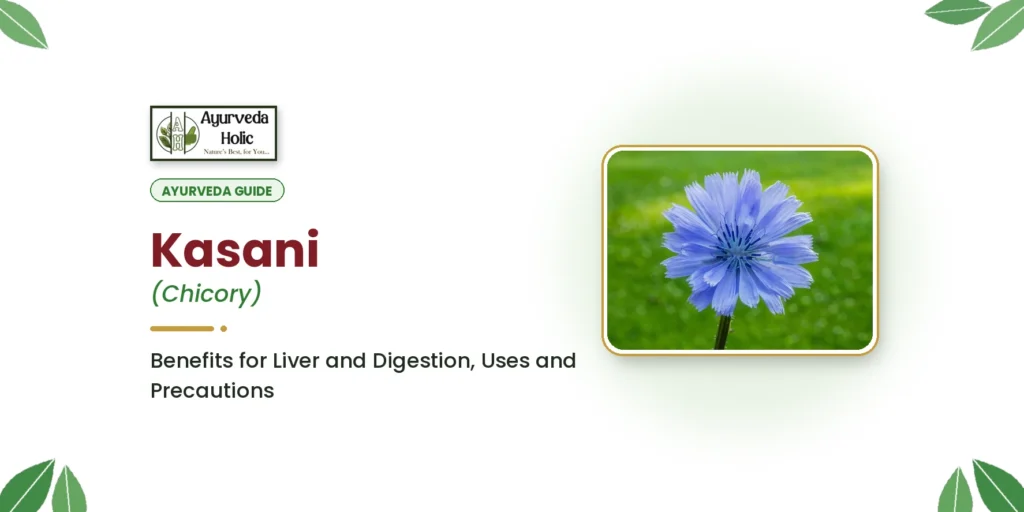
Short answer. Kasani is chicory. It’s a bitter herb used in both Ayurveda and Unani medicine. The traditional kasani benefits are for the liver, digestion and appetite, with a gentle cooling effect. It’s in well-known liver formulas like Liv.52 and Livamrit. And yes, it’s the chicory in your South Indian filter coffee. In food amounts it’s safe for most people. If you have liver disease, use liver formulas only with your doctor’s okay.
Chances are you’ve had kasani this week without knowing it. It’s hiding in a lot of Indian coffee powder. Here’s what else it does.
What kasani is
Chicory is a tall plant with bright blue flowers. Its leaves are eaten as a bitter green in many countries. Its roasted root goes into coffee.
| Feature | Detail |
|---|---|
| Botanical name | Cichorium intybus |
| Common names | Kasani, chicory |
| Part used | Root, seeds and leaves |
| Ayurvedic and Unani view | Bitter, cooling |
| Dosha | Mainly reduces Pitta and Kapha |
Kasani in Unani and Ayurveda
Kasani is a big herb in Unani medicine. Its seeds and root go into cooling preparations for the liver, fevers with heat, and thirst. It’s less prominent in the classical Ayurvedic texts. But it’s everywhere in modern liver formulas. Both systems value its bitterness. It’s thought to stir appetite and bile flow, and cool excess Pitta.
Kasani benefits
- Liver support. In many classical and proprietary liver formulas.
- Digestion and appetite. Thanks to the bitter taste.
- Cooling. In heat and Pitta conditions.
- Gut health. Chicory root is rich in inulin. That’s a fibre that feeds good gut bacteria.
What research says
Most research is on inulin. It makes up a big share of the dried root. Human studies show chicory inulin can help with mild constipation. It also raises levels of good bifidobacteria in the gut. Europe’s food safety authority has even approved a health claim linking chicory inulin to normal bowel function.
Chicory extracts have been tested in animals for liver protection and blood sugar. Promising, but early. Studies of Liv.52 test a whole mix of herbs. So they can’t tell you what kasani does alone.
Liver formulas that contain kasani
| Product | Form |
|---|---|
| Himalaya Liv.52 DS | Tablets |
| Patanjali Divya Livamrit Advance | Tablets |
| Patanjali Livamrit Syrup | Syrup |
For another bitter liver herb, see Kalmegh.
Chicory in coffee
Lots of Indian coffee powders contain chicory. It adds body and a slightly bitter, caramel taste. It also means less caffeine per cup, since chicory has none. The label will say “coffee-chicory blend” with a percentage.
How to use chicory at home
- Chicory coffee. A blend with a quarter or so of chicory gives a milder cup.
- Chicory greens. Sauté the leaves with garlic. Blanch them first if they’re too bitter.
- Caffeine-free drink. Brew roasted chicory root on its own. Start with a small cup.
- Seeds. Used in Unani cooling drinks, but only on a practitioner’s advice.
Kasani vs other liver herbs
| Herb | Traditional strength |
|---|---|
| Kasani | Gentle, bitter, cooling. Digestion and liver |
| Bhumi amla | Liver protection. Traditionally used in jaundice |
| Kutki | Strongly bitter. Liver, in small doses |
| Kalmegh | Bitter. Liver and fever |
| Punarnava | Swelling, water retention, liver support |
Most liver formulas mix several of these.
Who should be careful
- Liver disease. Use liver formulas only with your doctor’s okay. Keep up your liver tests.
- Gallstones. Chicory may increase bile flow. Ask your doctor.
- Allergy to ragweed, marigold or daisies. Chicory’s in the same family.
- Pregnancy. Food amounts are fine. Skip medicinal doses.
- A sensitive stomach. Inulin can cause gas and bloating.
Common mistakes
- Treating jaundice or bad liver tests at home without a diagnosis.
- Taking several liver formulas at once.
- Adding lots of chicory or inulin all at once. Hello, gas.
Frequently asked questions
What are the main kasani benefits?
Liver support, better digestion and a cooling effect, in traditional use.
Is kasani the same as chicory?
Yes. Kasani is the Hindi and Unani name.
Is chicory in coffee good for you?
In normal amounts, yes. It adds fibre and cuts caffeine per cup.
Does chicory coffee have less caffeine?
Yes. Chicory has no caffeine, so a blend has less than pure coffee.
Is kasani good for fatty liver?
It’s traditionally used for liver support. Fatty liver gets better mainly with weight loss, exercise and diet. See a doctor for a plan.
Can chicory cause gas?
Yes, in larger amounts, or if you have IBS.
Is kasani safe in pregnancy?
Chicory in coffee is generally fine. Avoid medicinal doses and liver formulas unless your doctor agrees.
Shop: Himalaya Liv.52 DS · Patanjali Divya Livamrit Advance
This article is for general information and isn’t medical advice. Talk to a doctor if you have liver disease.
Header photo of Kasani by Agnes Monkelbaan, via Wikimedia Commons_24-06-2026._(actm.)_03.jpg), licensed CC BY-SA 4.0.


