
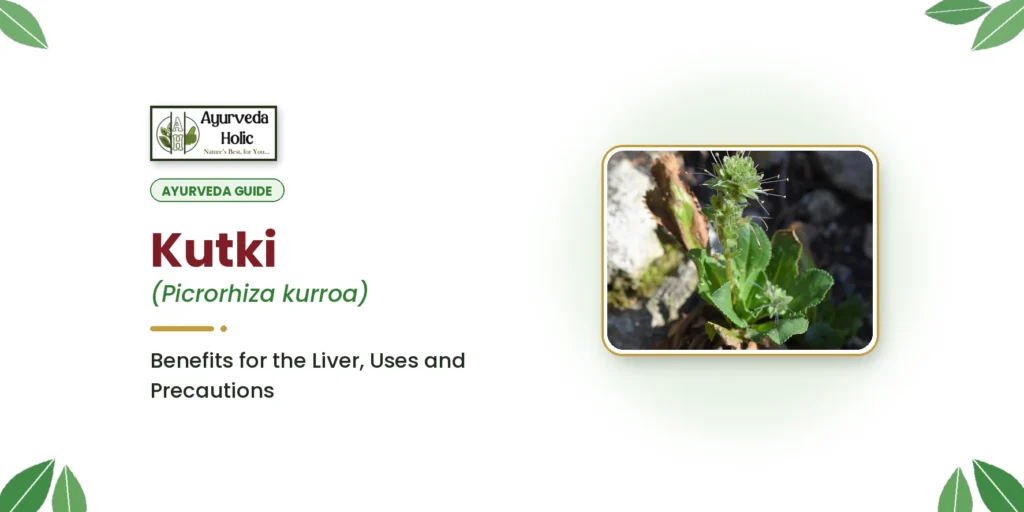
Short answer. Kutki, or kutaki, is a fiercely bitter root from the high Himalayas. It’s one of Ayurveda’s main liver herbs. The traditional kutki benefits are liver support, better digestion, Pitta-type fever and gentle bowel clearing. It’s in a lot of liver formulas, like Livamrit and Arogyavardhani. It’s strong stuff, so it’s used in small amounts, usually inside a formula.
Kutki sits right up there with kalmegh and chirayata as one of Ayurveda’s great bitters. Here’s what it’s used for, what the research says, and why it’s worth being careful.
What kutki is
Kutki is a small plant that grows high up in the Himalayas. Its dried root is intensely bitter. Overharvesting in the wild has made it a threatened species. So good-quality kutki isn’t cheap.
| Feature | Detail |
|---|---|
| Botanical name | Picrorhiza kurroa |
| Common names | Kutki, kutaki, katuka, kadu |
| Part used | Rhizome and root |
| Ayurvedic nature | Very bitter, cooling, light, dry |
| Dosha | Reduces Pitta and Kapha |
Kutki in classical texts
Classical texts call it katuka or tikta, after its bitterness. They describe it as cooling, light and dry. It’s used for Pitta and Kapha disorders, especially of the liver, and for fever. In bigger doses, it’s a purgative. It’s the main herb in Arogyavardhini Vati.
Kutki benefits in Ayurveda
- Liver support. Especially in Pitta conditions. Always alongside proper tests.
- Digestion and appetite. Bitters are said to wake up agni.
- Mild bowel clearing. In larger doses, it’s a laxative.
- Pitta-type fever. In classical fever formulas.
- Heat-related skin problems. In formulas.
What research says
Kutki contains bitter compounds called kutkosides and picrosides. A standardised extract, picroliv, has been studied mainly in animals for protecting the liver. A few small human trials in hepatitis and fatty liver reported better liver enzymes. They were small and need confirming. So kutki benefits are mostly traditional, with promising early research.
Products that contain kutki
| Product | Form |
|---|---|
| Patanjali Divya Livamrit Advance | Tablets with bhumi amla, kalmegh, punarnava and kutki |
| Patanjali Livamrit Tablet | Tablets |
| Patanjali Divya Punarnavadi Mandoor | Tablets with punarnava and mandoor bhasma |
| Patanjali Divya Arogyavardhani Vati | Classical tablet with kutki as the main herb |
Arogyavardhani Vati and Punarnavadi Mandoor also contain mineral bhasmas. Use them only under an Ayurvedic doctor.
For related liver herbs, see Kalmegh and Kasani.
How kutki is taken
- In formulas. At the pack dose. The simplest way.
- As powder. Only on a practitioner’s advice. The dose that helps appetite is far smaller than the one that loosens the bowels.
- With warm water or honey. Takes the edge off the bitterness.
Kutki and a liver-friendly routine
| Habit | Why it matters |
|---|---|
| Avoid alcohol | The biggest single step for your liver |
| Lose weight if you’re overweight | Cuts liver fat |
| Cut sugar and maida | Less fat building up in the liver |
| Move every day | Helps your body handle sugar |
| Bitter vegetables like karela and methi | Traditionally used for Pitta and the liver |
| A kutki formula at the label dose | Traditional support, with a doctor’s advice |
Who should be careful
- Liver disease, jaundice or hepatitis. See a doctor and get tested first. Use kutki only with their okay.
- Pregnancy and breastfeeding. Avoid it.
- Loose stools or IBS-D. It can loosen the bowels.
- Autoimmune conditions or immunosuppressants. Ask your doctor.
- Diabetes medicines. Bitters may lower blood sugar. Check more often.
Common mistakes
- Taking high doses of bitters for weeks without supervision.
- Stacking several liver churnas.
- Relying on herbs while liver tests keep getting worse.
- Using kutki as an everyday laxative.
Signs your liver needs a doctor
Yellow eyes or skin, dark urine, pale stools, a swollen belly or legs, vomiting blood, or confusion. All of these need prompt medical care.
Frequently asked questions
What are the main kutki benefits?
Ayurveda uses it for liver support, digestion and appetite, and Pitta-type fever.
Is kutki good for fatty liver?
It’s common in liver formulas. Fatty liver is managed mainly with weight loss, diet and exercise. Ask your doctor before adding herbs.
Is kutaki the same as kutki?
Yes. Kutaki is the Sanskrit name. Kutki is the everyday Hindi one.
Can kutki cause loose motions?
Yes, in larger amounts. Stick to the label dose.
Can kutki be taken with allopathic liver medicines?
Ask your doctor first. Herbal and prescribed liver medicines should only be combined under supervision.
How long can kutki formulas be taken?
Usually a few weeks at a time, then a review. Long, unsupervised use of strong bitters isn’t a good idea.
Is kutki safe for children?
Only at a child’s dose from a doctor or vaidya.
Shop: Patanjali Divya Livamrit Advance · Patanjali Livamrit Tablet
This article is for general information and isn’t medical advice. Talk to a doctor if you have liver disease or jaundice.
Header photo of Kutki by Krzysztof Ziarnek, Kenraiz, via Wikimedia Commons, licensed CC BY-SA 4.0.


