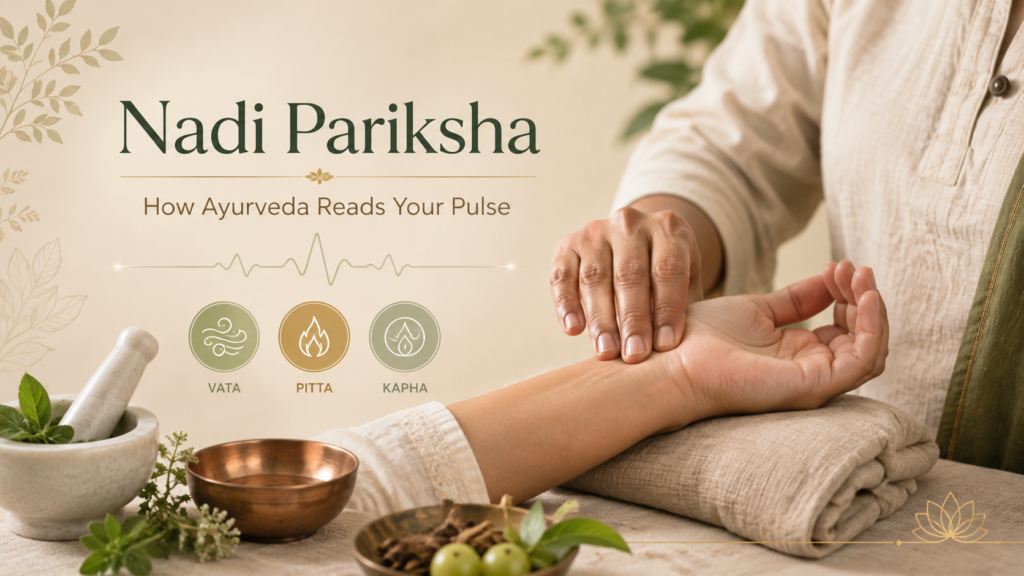
You sit down with an Ayurvedic practitioner and, before you say much, they place three fingers on your wrist and go quiet. This is Nadi Pariksha — Ayurvedic pulse diagnosis — one of the most fascinating and skilled tools in Ayurveda. Far more than counting heartbeats, it is a way of reading the state of your doshas, tissues and organs through the qualities of the pulse. Here is a beginner’s guide to what it is and what it can (and cannot) do.
What is Nadi Pariksha?
Nadi Pariksha (nadi = pulse, pariksha = examination) is the art of assessing health by feeling the radial pulse at the wrist. A trained practitioner reads not just the rate but the quality of the pulse — its rhythm, strength, temperature, and subtle character — to sense the balance of Vata, Pitta and Kapha, the state of the tissues and organs, and where imbalance (Vikriti) sits. It is a central diagnostic skill in classical Ayurveda, developed over a lifetime of practice.
The three doshas in the pulse
| Finger | Dosha | Classic quality |
|---|---|---|
| Index | Vata | Fast, thin, irregular — like a snake’s movement |
| Middle | Pitta | Strong, jumping, warm — like a frog’s leap |
| Ring | Kapha | Slow, steady, broad — like a swan’s glide |
By feeling which qualities dominate under which finger, a practitioner senses both your underlying constitution (Prakriti) and your current imbalance (Vikriti).
What a practitioner learns
- Doshic balance — which doshas are aggravated or depleted right now.
- Prakriti vs Vikriti — your natural type versus your current state.
- Digestion and Ama — the strength of Agni and signs of toxins.
- Tissue and organ health — at deeper levels of the pulse, in skilled hands.
- Overall vitality — the strength and steadiness of the life-force.
What to expect at an appointment
Pulse reading is usually done in the morning, before food, when you are rested and calm — caffeine, exercise, stress and a full stomach all change the pulse. The practitioner feels both wrists, often for a few minutes, and combines what they find with observation, questions and other diagnostics (tongue, eyes, history). Nadi Pariksha is rarely used alone; it is one input in a fuller assessment.
The skill behind the pulse
What looks like a quick touch of the wrist is the fruit of years of training. Classical practitioners learn to feel not one pulse but several levels — superficial, middle and deep — each revealing different information, and to distinguish dozens of subtle qualities. Traditionally students practised for years under a teacher before trusting their own reading. This is why the tool is only as good as the hands using it: in an expert it is remarkably informative, in an untrained one it means little. It is a genuine art, not a party trick.
Pulse reading and modern care
The sensible modern view is that Nadi Pariksha and conventional diagnostics answer different questions. The pulse tells an Ayurvedic practitioner about your doshic pattern — how to personalise diet, herbs and lifestyle for you. A blood test or scan tells a doctor about specific pathology. Neither replaces the other. A thoughtful approach uses Ayurvedic assessment to guide daily wellness and personalised care, while relying on modern medicine to catch and diagnose disease — getting the best of both.
What it can and cannot do
In skilled hands, Nadi Pariksha is a remarkable tool for sensing patterns of imbalance and guiding personalised Ayurvedic care. But it is important to be honest: it is a traditional, subjective, practitioner-dependent skill, not a replacement for medical diagnosis. It does not detect specific diseases the way a blood test or scan does, and its accuracy varies hugely with the practitioner’s experience. Use it for what it is — a guide to Ayurvedic treatment — and rely on conventional medicine for diagnosing serious conditions.
Frequently asked questions
What is Nadi Pariksha?
It is Ayurvedic pulse diagnosis — assessing the balance of the doshas, digestion and vitality by feeling the quality of the pulse at the wrist with three fingers.
How accurate is pulse diagnosis?
It is a skilled, subjective art that varies with the practitioner’s experience. In skilled hands it usefully guides Ayurvedic care, but it is not a substitute for medical diagnosis or tests.
How should I prepare for pulse diagnosis?
Ideally go in the morning before food, rested and calm, avoiding caffeine, heavy exercise and stress beforehand — all of which alter the pulse.
Can Nadi Pariksha diagnose disease?
No — it senses patterns of doshic imbalance to guide Ayurvedic treatment, but it does not diagnose specific diseases. Use medical testing for that.
The bottom line
Nadi Pariksha, Ayurvedic pulse diagnosis, is a subtle, skilled art of reading the doshas and vitality through the pulse — a beautiful, central tool of traditional Ayurveda that guides personalised care. Value it for what it is, in experienced hands, as part of a fuller assessment — and rely on modern medicine to diagnose serious conditions. The two work best together.
Related reading
Disclaimer
This article is for general information and educational purposes only and is not medical advice. Nadi Pariksha is not a substitute for medical diagnosis. Always consult a qualified doctor for diagnosing health conditions.