
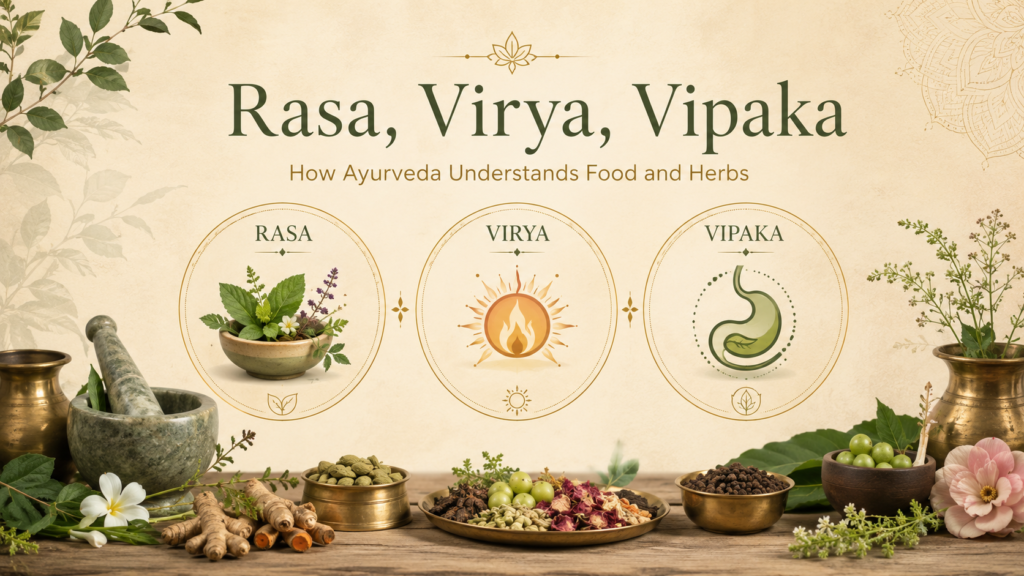
How does Ayurveda know what a food or herb will do to you? It reads three things: Rasa (taste), Virya (heating or cooling potency) and Vipaka (the after-effect once digested). Together with a fourth, Prabhava (special effect), these explain the entire logic of Ayurvedic diet and medicine. Understand them and you can predict how almost anything will affect your body. Here is a beginner’s guide.
The three-stage journey of food
Ayurveda sees a substance acting in stages as it moves through you — first on the tongue, then during digestion, then after. Rasa, Virya and Vipaka describe those three moments. This is why two foods that taste similar can have opposite long-term effects, and why Ayurveda never judges a food by taste alone.
Rasa, Virya, Vipaka and Prabhava
| Factor | Meaning | When it acts |
|---|---|---|
| Rasa | Taste (the six tastes) | Immediately, on the tongue |
| Virya | Potency — heating or cooling | During digestion |
| Vipaka | Post-digestive effect | After digestion, on the tissues |
| Prabhava | Special, unexplained effect | Beyond the above |
1. Rasa: taste
Rasa is the taste you experience — sweet, sour, salty, pungent, bitter or astringent — and it has an immediate effect on the doshas. Sweet grounds and cools; pungent heats and stimulates, and so on. Taste is the first and most obvious clue to a substance’s action, but it is not the whole story.
2. Virya: heating or cooling potency
Virya is the substance’s energetic potency — essentially whether it heats or cools the body as it is digested. This often matters more than taste. Ginger is pungent and heating; mint is pungent-ish but cooling. Honey is sweet but warming; sugar is sweet and cooling. When choosing foods for a hot or cold condition, Virya is usually the deciding factor.
3. Vipaka: the after-effect
Vipaka is the effect a substance has after digestion, on the deeper tissues — its long-term action. There are three Vipakas: sweet, sour and pungent. This explains some surprises: many sweet and salty foods have a sweet Vipaka (building, nourishing), pungent foods often end pungent (drying, reducing). It is the after-effect that shapes the substance’s deeper, ongoing influence on the body.
4. Prabhava: the special effect
Sometimes a substance acts in a way its taste and potency cannot explain — a unique, specific effect Ayurveda calls Prabhava. It is the “X-factor,” the reason a particular herb has a signature action beyond the rules. Prabhava is Ayurveda’s honest acknowledgement that not everything reduces to a formula.
A worked example: ginger vs mint
Take two pungent herbs. Ginger is pungent in taste, heating in potency, and pungent-to-sweet in after-effect — so it kindles digestion, warms the body and, used well, nourishes. Mint is also pungent-ish in taste but cooling in potency — so it freshens and cools rather than heats. Judged by taste alone they seem similar; judged by Virya they are opposites. This is exactly why the three-factor lens matters: it catches distinctions that taste hides, and it is how Ayurveda matches a food or herb to a hot or cold condition correctly.
Using this in the kitchen
You do not need to memorise the potency of every food. Just add the “heating or cooling?” question to taste when it matters — feeling overheated, favour cooling-potency foods (coconut, mint, cucumber, sweet fruit) even if some are not sweet; feeling cold and sluggish, favour warming ones (ginger, black pepper, cooked grains). Over time you build an intuitive feel for how foods act beyond their first impression on the tongue.
Why this matters
This framework is why Ayurveda can reason about a food or herb it has never “tested” in a lab: it reads the qualities and predicts the effect. For you, the practical lesson is to look past taste alone — especially to Virya (heating or cooling). If you are overheated, choose cooling-potency foods even if they are not sweet; if you are cold and sluggish, choose warming ones. Taste is the invitation; potency and after-effect are the real action.
Frequently asked questions
What are Rasa, Virya and Vipaka?
They are how Ayurveda understands a substance’s action: Rasa is taste (immediate), Virya is heating/cooling potency (during digestion), and Vipaka is the post-digestive after-effect on the tissues.
Which matters most for choosing food?
Often Virya (heating or cooling potency), especially for hot or cold conditions — it frequently outweighs taste in deciding a food’s effect.
What is Prabhava?
Prabhava is a substance’s special, specific effect that its taste and potency alone cannot explain — the “X-factor” behind a herb’s signature action.
Why can taste be misleading?
Because potency (Virya) and after-effect (Vipaka) can differ from taste — honey is sweet but warming, mint is cooling. Judge foods by all three, not taste alone.
The bottom line
Rasa, Virya and Vipaka — taste, potency and after-effect, plus the special Prabhava — are how Ayurveda reads the action of every food and herb. The practical key is to look beyond taste to heating-or-cooling potency and long-term after-effect. Master this simple three-stage lens and you can predict how almost anything will affect your body.
Related reading
Disclaimer
This article is for general information and educational purposes only and is not medical advice. Always consult a qualified doctor or registered Ayurvedic practitioner before starting any herb or regimen, especially if you are pregnant, breastfeeding, taking medication, or managing a health condition.