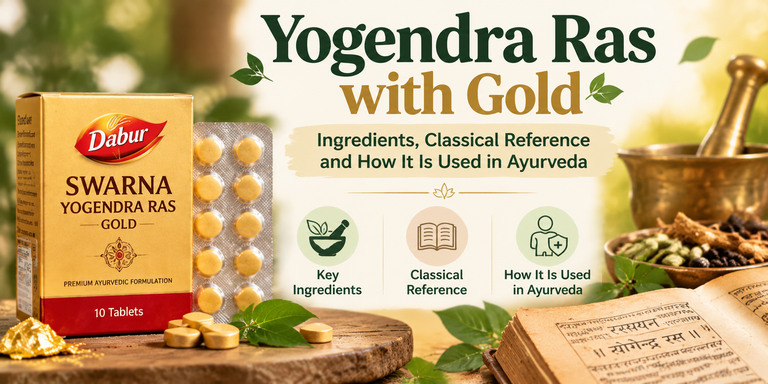
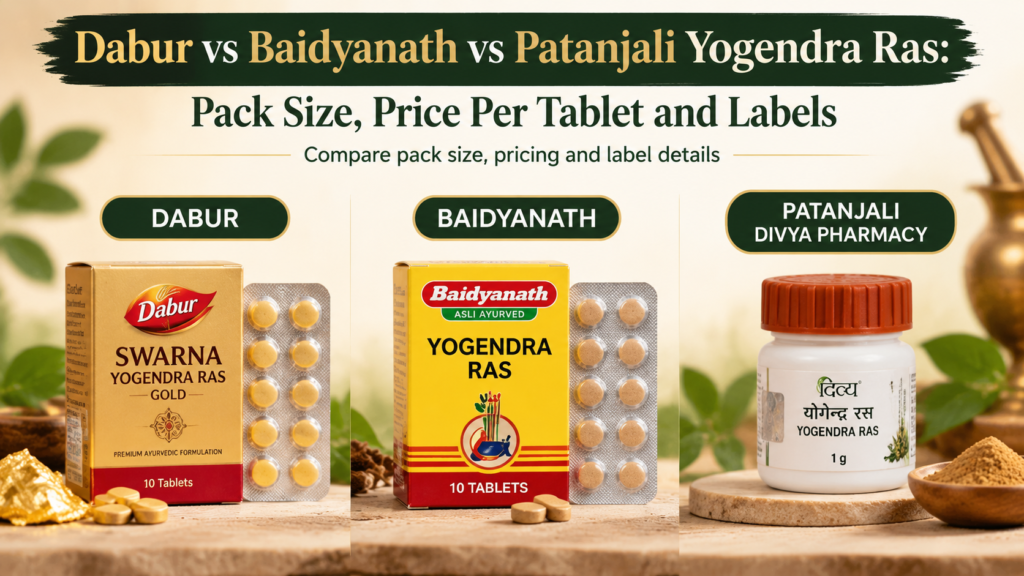
When comparing Ayurvedic medicines, the brand name and price are only part of the decision. Pack size, dosage form, ingredient declaration, manufacturing details and the instructions provided by a qualified practitioner are equally important.
Yogendra Ras is a traditional Ayurvedic herbo-mineral formulation associated with specialised preparations containing processed metals and minerals. Some products in this category include Swarna Bhasma, traditionally described as processed gold. Because these formulations may contain ingredients that require particular safety precautions, they should not be treated as ordinary daily supplements.
People researching Yogendra Ras may come across products associated with Dabur, Baidyanath and Patanjali. However, similar names do not establish that products have identical compositions, strengths or directions for use.
This guide compares the available pack and price information, explains how to calculate the price per tablet where applicable, and outlines what to check on the label before purchasing.
Yogendra Ras Brands: Dabur, Baidyanath and Patanjali
Yogendra Ras belongs to the classical Ayurvedic tradition of Rasaushadhi, a category that includes specialised formulations made using processed metals, minerals and other ingredients. Its preparation and use differ from those of ordinary herbal powders or nutritional supplements.
When comparing brands, it is important to distinguish a product containing Yogendra Ras from one that has the exact same formulation and dosage form.
Dabur Yogendra Ras with Gold
Dabur Yogendra Ras with Gold is listed on Ayurvedaholic in a pack containing 10 tablets. Its product description identifies it as a gold-containing herbo-mineral formulation.
The listing displays a selling price of ₹1,990 against an MRP of ₹2,820. These figures are taken from the Ayurvedaholic listing available when checked and may change.
Product details: Dabur Yogendra Ras with Gold — Ayurvedaholic
Baidyanath Yogendra Ras
Baidyanath is another established name in the Ayurvedic products market. However, I could not verify a current Baidyanath Yogendra Ras listing on Ayurvedaholic during this check.
For that reason, a current pack size, selling price, MRP or price per tablet cannot responsibly be quoted here. These details should not be inferred from another brand’s product or an outdated listing.
If you are comparing a Baidyanath product, check its exact product name, dosage form, declared ingredients and packaging before comparing it with Dabur or Patanjali.
Patanjali Yogendra Ras
Patanjali Yogendra Ras is listed on Ayurvedaholic in a 1 g pack. The listing displays a price of ₹1,140 against an MRP of ₹1,145. Its product description identifies it as a traditional herbo-mineral preparation containing ingredients including Ras Sindoor and Swarna Bhasma.
Product details: Patanjali Yogendra Ras — Ayurvedaholic
An important difference is that this listing describes a 1 g pack of fine powder, rather than a 10-tablet pack. Its price therefore cannot be directly compared with the price per tablet of Dabur Yogendra Ras with Gold.
Yogendra Ras Price Comparison: Pack Size and Current Listing Prices
The following comparison uses the product information available on Ayurvedaholic when checked. Prices and availability may change, so verify the listing again before ordering.
| Brand | Listed pack size | Listed MRP | Listed selling price | Price per tablet |
|---|---|---|---|---|
| Dabur Yogendra Ras with Gold | 10 tablets | ₹2,820 | ₹1,990 | ₹199 |
| Baidyanath Yogendra Ras | Not verified | Not verified | Not verified | Not calculable |
| Patanjali Yogendra Ras | 1 g powder | ₹1,145 | ₹1,140 | Not applicable |
Sources for the verified listing figures: Dabur and Patanjali product pages on Ayurvedaholic.
How is the price per tablet calculated?
For a pack of tablets, the calculation is straightforward:
\[ \text{Price per tablet}= \frac{\text{Selling price}}{\text{Number of tablets}} \]
For Dabur Yogendra Ras with Gold:
\[ ₹1,990 \div 10 = ₹199 \]
Therefore, the displayed selling price works out to ₹199 per tablet.
This is a retail-price calculation, not a recommended cost per dose. It does not establish the quantity that a person should take or how long a pack should last.
Why can’t all three brands be compared by price per tablet?
Price per tablet is useful only when the product is sold in tablets and the number of tablets is known. Patanjali’s listed product is a 1 g powder, so a per-tablet comparison would be misleading.
Even a price-per-gram comparison would not establish equivalence between different formulations. The composition, concentration, dosage form and manufacturing specifications must be considered separately.
What about discounts and shipping?
The selling price shown on a product page may differ from the amount payable at checkout. Shipping charges, promotional offers and changes in availability can affect the final amount.
Before placing an order, review the current selling price, MRP, shipping charges and final checkout total on Ayurvedaholic.
What Can Make Yogendra Ras Prices Different?
Yogendra Ras products may have different prices for several reasons. A higher price does not automatically mean that a formulation is more effective or safer.
Pack size and dosage form
A pack containing 10 tablets is not directly comparable with a 1 g powder pack. The quantity, form and declared composition must be understood before comparing prices.
Ingredient declaration
Some formulations are marketed as containing gold through Swarna Bhasma. The presence of a named ingredient alone does not establish its quantity, purity or quality in the finished product.
Review the actual label rather than assuming that two products with similar names contain the same ingredients in the same proportions.
Manufacturing and quality controls
Specialised herbo-mineral preparations require careful attention to manufacturing quality and product verification. Relevant information may include the manufacturer’s details, batch identification, applicable licence information and suitable quality-control documentation.
A product’s price or traditional reputation cannot substitute for reliable quality information.
Brand and packaging
Packaging, distribution costs, pack size and retailer pricing can also influence the selling price. Promotional discounts may change the price displayed online without changing the formulation itself.
For this reason, price should be treated as one comparison factor rather than the main basis for selecting a medicine.
How to Read the Label Before Buying Yogendra Ras
Checking the label is particularly important for specialised Ayurvedic formulations. Do not rely only on a product title, search result or short online description.
Check the complete product name
Confirm whether the product is Dabur Yogendra Ras with Gold, Baidyanath Yogendra Ras or Patanjali Yogendra Ras. Similar names do not prove that the products are interchangeable.
Review the ingredient declaration
Look for the full list of declared ingredients. Depending on the formulation, Yogendra Ras products may contain processed metal- or mineral-based ingredients.
For example, Ras Sindoor is associated with mercury and sulphur compounds, while Swarna Bhasma is traditionally described as a processed gold preparation. These names should prompt careful verification of the actual product rather than assumptions about its composition or safety.
Check the pack size and dosage form
Confirm whether the package contains tablets, powder or another form. Check the number of tablets or the net quantity and ensure that it matches the product description.
A 10-tablet pack and a 1 g powder pack should not be treated as equivalent merely because both carry the Yogendra Ras name.
Verify batch and expiry details
Before using the product, check the batch number, manufacturing information and expiry date where applicable. Avoid products with damaged packaging, altered labels, leakage or signs of tampering.
Keep your invoice and order confirmation for future reference.
Do not infer the dosage from the pack size
The number of tablets in a pack does not establish how many tablets should be taken, how often they should be taken or the appropriate duration of use.
Follow the specific product instructions and the guidance of the qualified practitioner who has assessed your circumstances.
Why Physician Guidance Matters
Yogendra Ras is a specialised herbo-mineral formulation, not a routine wellness supplement. Some formulations contain processed mercury, gold and other metal- or mineral-based ingredients, making careful assessment of product quality and individual suitability essential.
Traditional processing does not, by itself, guarantee that every finished product is free from toxicological risks.
Who should seek professional advice before use?
- People with kidney or liver conditions.
- People taking prescription medicines or multiple supplements.
- Pregnant or breastfeeding individuals.
- Children and older adults.
- Anyone with an existing medical condition or unexplained symptoms.
A qualified Ayurvedic physician should assess the exact formulation and determine whether it is appropriate. Where relevant, consultation with a conventional medical professional may also be necessary.
Can you choose a dosage based on an online article?
No. Dosage information should not be copied from a generic blog or from another manufacturer’s product description. The appropriate directions depend on the specific preparation and individual circumstances.
Do not increase the quantity, extend the duration or switch brands without consulting the prescribing practitioner.
Is a gold-containing formulation necessarily better?
No. The presence of Swarna Bhasma does not independently establish that a product is more effective, safer or more suitable than another formulation.
The correct decision depends on professional assessment, the exact composition, quality information and the intended use—not simply the price or presence of gold.
Where to Buy Yogendra Ras Online
If you are comparing Yogendra Ras products, Ayurvedaholic provides listings for Dabur Yogendra Ras with Gold and Patanjali Yogendra Ras. Review the available product details before ordering.

Dabur Yogendra Ras with Gold
10 tablets
₹1,990
Listed MRP: ₹2,820

Patanjali Yogendra Ras
1 g powder
₹1,140
Listed MRP: ₹1,145
Prices were displayed on the respective listings when checked. Confirm current prices, availability and product details before ordering.
Before completing your purchase, verify the product name, dosage form, pack quantity, manufacturer details, batch information and expiry date. If a practitioner has recommended a particular brand, confirm that the product you receive matches that recommendation.
A retailer’s product listing can help you review available details, but it is not independent proof of authenticity, safety or clinical effectiveness.
Frequently Asked Questions
1. What is the price of Dabur Yogendra Ras with Gold?
The Ayurvedaholic listing displayed a selling price of ₹1,990 against an MRP of ₹2,820 for a pack of 10 tablets when checked. The calculated selling price is ₹199 per tablet. Prices may change.
2. What is the price of Patanjali Yogendra Ras?
The Ayurvedaholic listing displayed ₹1,140 against an MRP of ₹1,145 for a 1 g pack. Since this is listed as powder rather than a tablet pack, the price per tablet is not applicable.
3. Is Baidyanath Yogendra Ras available on Ayurvedaholic?
I could not verify a current Baidyanath Yogendra Ras listing on Ayurvedaholic during this check. Its pack size and price have therefore been left unconfirmed rather than estimated.
4. Why is Dabur Yogendra Ras with Gold more expensive than Patanjali Yogendra Ras?
The displayed prices differ, but the products also have different listed pack formats. Price alone does not establish differences in effectiveness, safety or quality. Compare the declared composition, quantity and manufacturing information before drawing conclusions.
5. Does Yogendra Ras contain gold?
Some formulations are marketed as containing Swarna Bhasma, a traditionally processed gold preparation. Check the ingredient declaration of the exact product because formulations can differ by manufacturer.
6. Can I take Yogendra Ras without a prescription?
Do not self-prescribe this specialised herbo-mineral formulation. Consult a qualified Ayurvedic physician who can assess the exact product, your circumstances and appropriate directions for use.
7. How can I check whether a Yogendra Ras pack is genuine?
Check the manufacturer, complete ingredient declaration, batch number, expiry date and packaging integrity. Retain the invoice and purchase from a retailer that provides clear product information. These checks are useful but do not independently prove product quality.
Conclusion
Comparing Dabur, Baidyanath and Patanjali Yogendra Ras requires more than looking at the selling price. Pack size, dosage form, ingredient declaration and manufacturing information all matter.
Based on the Ayurvedaholic listings checked, Dabur Yogendra Ras with Gold costs ₹1,990 for 10 tablets, equivalent to ₹199 per tablet. Patanjali Yogendra Ras is listed at ₹1,140 for a 1 g powder pack, so a direct price-per-tablet comparison is not possible. Baidyanath pricing remains unverified on Ayurvedaholic.
If you are researching Yogendra Ras price, use these figures as a starting point and confirm the current listing before ordering. Most importantly, do not choose a formulation solely because it is cheaper or contains gold. Seek qualified professional guidance before considering any product in this category.