
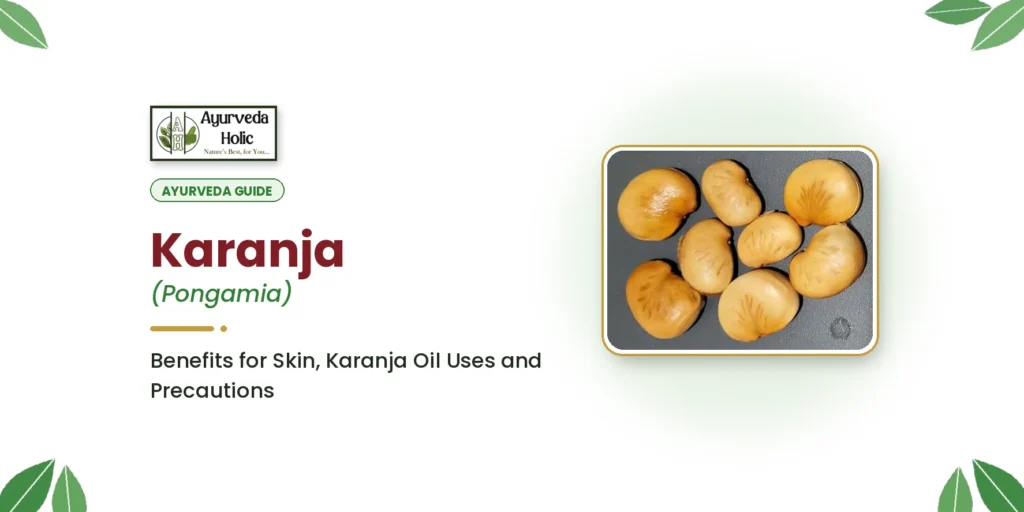
Short answer. Karanja is a shady Indian tree. Ayurveda uses its seed oil, leaves and bark mainly for the skin. The traditional karanja benefits are for itchy, scaly or infected skin, small wounds and scalp problems. It’s almost always used on the outside. You’ll find karanja oil in skin oils like Kayakalp Taila. The raw seeds and oil are toxic if swallowed. Never take them by mouth.
You’ve probably sat under a karanja tree without knowing it. It lines roads and riverbanks across India. Its seeds hide one of Ayurveda’s oldest skin oils. Here’s how it’s used, and how to use it safely.
What karanja is
Karanja grows fast and gives plenty of shade. Its pods hold one or two seeds. They’re pressed for a thick, bitter, dark-yellow oil. It was once used as lamp oil. These days it’s even studied as a biofuel.
| Feature | Detail |
|---|---|
| Botanical name | Pongamia pinnata (Millettia pinnata) |
| Common names | Karanja, karanj, Indian beech, pongam |
| Part used | Seed oil, leaves, bark |
| Ayurvedic nature | Bitter, pungent, heating |
| Dosha | Reduces Kapha and Vata |
Karanja in classical texts
Charaka lists karanja among herbs for skin disease (kushtha) and itching (kandu). Its seed oil appears in classical external formulas for wounds, eczema-like patches and scalp problems. Bhavaprakasha calls it bitter, pungent and heating. Its leaves went into poultices and bath water for skin and joint aches.
Karanja benefits in Ayurveda
- Itchy, scaly, patchy skin. As an oil or paste.
- Small wounds and boils. Cleaned and dressed with karanja-based oils.
- Dandruff and itchy scalp. Worked into the scalp.
- Skin infections. Lab studies show the oil acts against some bacteria and fungi.
- Joint pain. As a warming massage oil in some traditions.
What research says
Karanja oil contains karanjin and pongamol. Lab studies show antimicrobial, insect-repellent and anti-inflammatory effects. Farmers even use it as a natural insect repellent. Human studies on skin are very limited. So most of these uses are traditional.
Skin products that contain karanja
| Product | Form |
|---|---|
| Patanjali Divya Kayakalp Taila | Skin oil |
| Patanjali Divya Kayakalp Taila Advance | Skin oil with neem, haldi and karanj |
| Patanjali Divya Somraaji Taila | Oil with bakuchi and karanj |
| Patanjali Divya Dermagrit | Skin tablets |
Dermagrit is taken by mouth. It’s a prepared formula at a fixed dose, though. That’s nothing like swallowing raw karanja oil.
How to use karanja oil
| Step | What to do |
|---|---|
| Patch test | Dab a little diluted oil inside your forearm. Wait a day |
| Dilute | One part karanja oil to three or four parts coconut or sesame oil |
| Apply | On clean, dry skin, once or twice a day |
| Scalp | A few drops in your usual hair oil. Wash out after an hour |
| Review | Stop if the skin gets red, hot or itchier |
Keep it away from your eyes. Skip broken or weeping skin unless your doctor says otherwise.
Karanja vs neem
| Feature | Karanja | Neem |
|---|---|---|
| Smell | Strong, earthy | Strong, garlicky |
| Main use | Skin patches, scalp, wounds | Skin, scalp, mouth care |
| Taken by mouth? | No, not at home | Leaves sometimes, with care |
They’re often used together. Our neem guide has more.
Who should be careful
- Never swallow raw karanja seeds or oil. They can cause vomiting and stomach pain. They’re especially dangerous for children. Keep the bottle out of reach.
- Pregnant and breastfeeding women. Use only on a doctor’s advice.
- Sensitive skin. It can sting. Stop if redness or burning gets worse.
Common mistakes
- Putting undiluted oil on big patches of skin.
- Using it on raw, weeping or infected wounds.
- Expecting it to replace treatment for psoriasis or fungal infections.
When skin problems need a doctor
See a dermatologist for a rash that spreads, patches that don’t improve in a few weeks, skin that oozes or feels hot and painful, or a new or changing mole.
Frequently asked questions
What are the main karanja benefits?
Ayurveda uses it on the skin for itchy and scaly patches, small wounds, dandruff and skin infections.
Can I take karanja oil internally?
No. Raw karanja oil and seeds are toxic if swallowed. Only take karanja inside prepared formulas, at the label dose.
Is karanj good for psoriasis?
It’s a traditional oil for scaly skin. Psoriasis still needs a dermatologist. Use it alongside treatment, not instead.
Does karanja oil help dandruff?
It’s traditionally used for an itchy scalp and dandruff. Patch test, and wash it out after an hour.
Can karanja oil be mixed with neem oil?
Yes. Lots of traditional skin oils combine them. Dilute the mix and patch test first.
Is karanja oil good for wounds?
Diluted, on small, clean, healing wounds. Deep, dirty or infected wounds need a doctor.
Shop: Patanjali Divya Kayakalp Taila · Patanjali Divya Somraaji Taila
This article is for general information and isn’t medical advice. See a dermatologist for persistent skin problems.
Header photo of Karanja by a Wikimedia Commons contributor, via Wikimedia Commons, licensed CC BY 4.0.


