
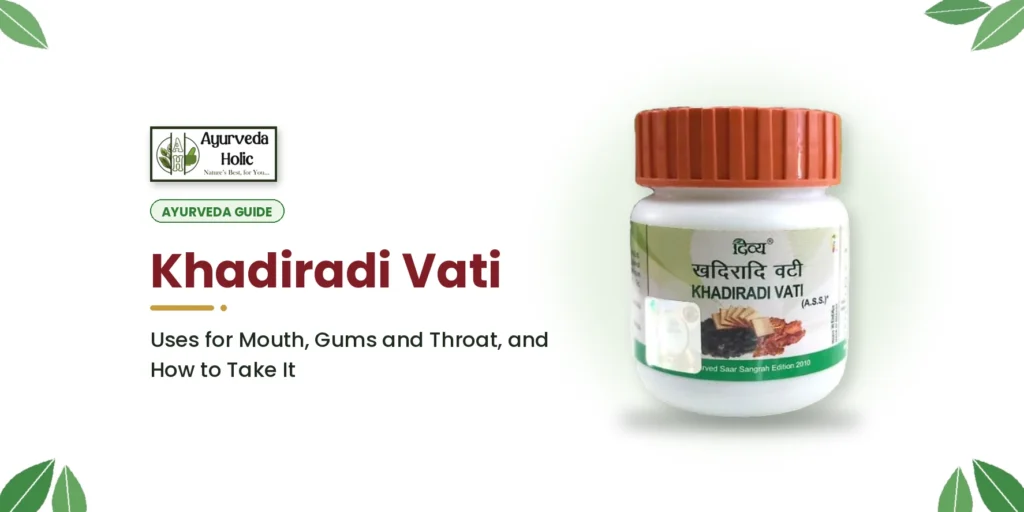
Short answer. Khadiradi Vati is a tiny Ayurvedic tablet you suck slowly. It’s made mainly with khair, or catechu, the source of kattha. Ayurveda uses it for bad breath, sore or bleeding gums, mouth ulcers and an irritated throat. Use it at the pack dose for a few days. See a dentist if your gums keep bleeding. See a doctor for any mouth ulcer that hasn’t healed in two weeks.
If you’ve had paan, you’ve tasted kattha. That same astringent bite is the heart of Khadiradi Vati. Here’s what’s in it, how to use it, and when to skip it and see a dentist.
What Khadiradi Vati is
Khadira is the catechu tree. Its heartwood extract, kattha, is what goes in paan. It’s strongly astringent. That’s why it’s been used for gums and the mouth for centuries. The formula is described in classical texts like the Sharangadhara Samhita and Bhaishajya Ratnavali, under mouth disorders (mukha roga).
Here’s what Patanjali Divya Khadiradi Vati lists on our product page.
| Ingredient | Common name | Traditional role |
|---|---|---|
| Khair saar | Catechu (kattha) | Astringent. Tightens gums |
| Javitri | Mace | Aromatic |
| Kankol | Cubeb pepper | Aromatic, warming |
| Kapoor | Camphor | Cool, fresh feeling |
| Supari | Betel nut | Part of the classical recipe |
Check your pack for the full list.
Khadiradi Vati uses (traditional)
- Bad breath
- Sore, swollen or bleeding gums
- Mouth ulcers
- An irritated throat or hoarse voice
- A bad taste in the mouth
These are traditional uses. It doesn’t treat gum disease, cavities or infections.
What research says
Lab studies of catechu extract show antimicrobial and antioxidant effects against some mouth bacteria. There are very few studies of Khadiradi Vati itself. It’s reasonable for short-term comfort. Ongoing mouth problems need a dentist or doctor.
How to take Khadiradi Vati
- Suck it slowly. Let it dissolve. Don’t chew it or swallow it whole.
- Dose. As printed on the pack, or as your doctor says.
- A few days at a time. Not every day for months.
- Wait before eating. Skip food and drink for a short while afterwards.
A note about betel nut
Supari is part of the classical recipe. The amount in one tablet is small. But heavy, regular betel nut chewing, especially with tobacco in paan or gutka, is linked with mouth cancer. That’s one more reason to use Khadiradi Vati only now and then, never as a daily habit.
Daily habits for a healthy mouth
| Habit | Why |
|---|---|
| Brush twice a day with a soft brush | Removes plaque |
| Clean between your teeth | Prevents gum disease |
| Scrape your tongue each morning | Cuts bad breath |
| Oil pulling with sesame or coconut oil | A traditional gum-care habit |
| Skip tobacco, gutka and paan masala | Major causes of mouth disease |
| See a dentist once a year | Catches problems early |
Who should avoid it
- Pregnant and breastfeeding women, and children. Only on a doctor’s advice.
- People with oral submucous fibrosis. That’s stiffness and burning in the mouth, and trouble opening it wide. See a doctor, and avoid betel nut products.
- People sensitive to camphor.
Common mistakes
- Chewing or swallowing it instead of sucking.
- Using it for weeks to hide bad breath.
- Ignoring a mouth ulcer that won’t heal.
- Giving it to small children, who could choke.
When to see a dentist or doctor
- Gums that bleed every time you brush. Or that are swollen or receding. See a dentist.
- An ulcer, or a white or red patch, that lasts over two weeks. See a doctor soon.
- Bad breath that won’t go. It’s often gum disease or decay. See a dentist.
- A sore throat with high fever or trouble swallowing. See a doctor.
Frequently asked questions
What is Khadiradi Vati used for?
Ayurveda uses it for bad breath, sore or bleeding gums, mouth ulcers and an irritated throat.
How should I take Khadiradi Vati?
Suck it slowly and let it dissolve. Follow the pack dose.
Is Khadiradi Vati good for mouth ulcers?
It’s traditionally used for them. An ulcer lasting over two weeks needs a doctor.
Khadiradi Vati vs Lavangadi Vati, which should I take?
Khadiradi is mainly for the mouth and gums. Lavangadi is mainly for the throat and cough with mucus.
Can I take Khadiradi Vati every day?
Use it for a few days at a time. It contains betel nut, so don’t make it a daily habit.
Does Khadiradi Vati help with tonsils?
It may soothe a sore throat. Swollen tonsils with fever need a doctor.
Shop: Patanjali Divya Khadiradi Vati · Patanjali Divya Lavangadi Vati · Patanjali Dant Kanti Gandush
This article is for general information and isn’t medical advice. See a dentist or doctor for ongoing mouth or gum problems.


