
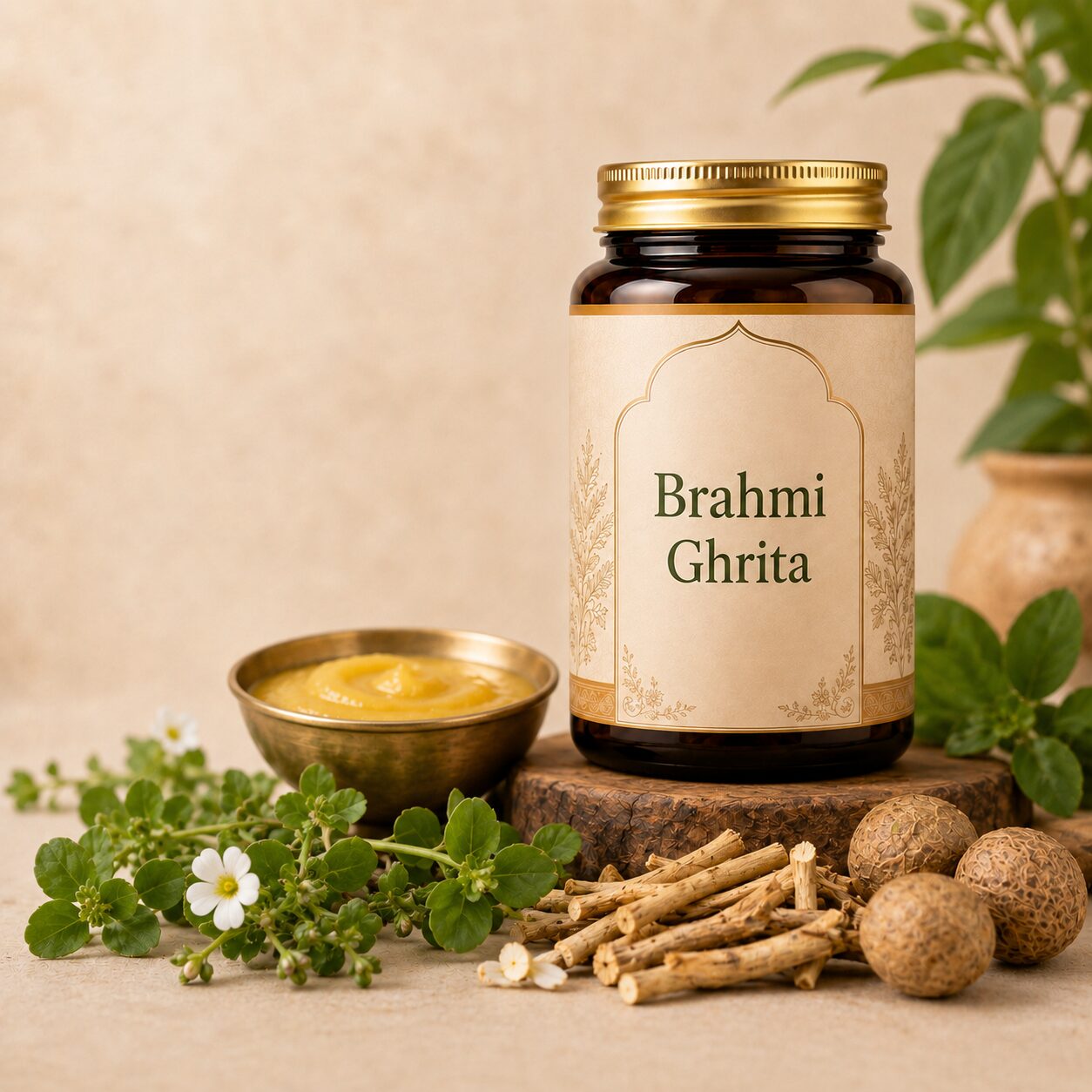
Brahmi Ghrita (Introduction, Benefits, and Usages)
Brahmi Ghrita benefits are rooted in one of Ayurveda’s most sophisticated delivery systems — medicated ghee. By infusing Bacopa monnieri (Brahmi) in purified ghee, ancient Ayurvedic physicians created a preparation where the fat-soluble bacosides are fully extracted into a lipid medium that crosses the blood-brain barrier far more effectively than water-based preparations. This formulation is listed in the Ashtanga Hridayam and classical texts as the premier treatment for cognitive disorders, mental disease, and nervous system conditions. See Wikipedia: Bacopa monnieri and Wikipedia: Ghee. For related preparations, explore Brahmi and Brahmi Ghrita.
What Is Brahmi Ghrita? A Complete Introduction
Origin and History of Brahmi Ghrita
Brahmi Ghrita is a classical Ayurvedic medicated ghee (Ghrita) formulation with Brahmi (Bacopa monnieri) as the primary ingredient. Ghrita (medicated ghee) preparations have been used in Ayurveda for over 2,500 years — the Charaka Samhita and Ashtanga Hridayam describe ghee as the finest vehicle for delivering fat-soluble medicinal compounds to deep tissues, particularly the brain and nervous system. The classical preparation process involves extracting active compounds from Brahmi herb in ghee over extended cooking, concentrating the therapeutic compounds in a bioavailable lipid medium. Brahmi Ghrita is classified as a Medhya Rasayana — a cognitive rejuvenative formulation.
Key Compounds and Active Profile
The primary active compounds are Brahmi’s bacosides A and B — triterpenoid saponins — extracted into the ghee medium. The lipid matrix of ghee dramatically improves bacoside absorption compared to water-based extracts, as bacosides are fat-soluble. Purified ghee (Shuddha Ghrita) itself contributes butyric acid (anti-inflammatory gut and brain support), omega-3 fatty acids, fat-soluble vitamins A, D, E, K, and medium-chain triglycerides that cross the blood-brain barrier. Some formulations include additional Medhya herbs — Shankhpushpi, Vacha, Shatavari — providing synergistic cognitive and nervous system support. See Wikipedia: Bacoside.
Top Health Benefits of Brahmi Ghrita
Brahmi Ghrita Benefits for Cognitive Health and Overall Wellbeing
The cognitive benefits of Brahmi Ghrita centre on the same mechanisms as standalone Brahmi, but with potentially superior bioavailability from the lipid delivery system. Clinical and traditional use indicates improvements in memory consolidation, attention span, mental clarity, and learning capacity. The formulation is particularly indicated in Ayurveda for Unmada (psychiatric disorders), Apasmara (epilepsy), and conditions of nervous system weakness (Vatavyadhi). The ghee component adds its own neuroprotective benefits — butyric acid is a known HDAC inhibitor with anti-inflammatory and neuroprotective effects in the brain.
Brahmi Ghrita for Skin, Hair, and Beauty
Applied externally, Brahmi Ghrita serves as a deeply nourishing scalp and hair treatment. The ghee base penetrates the hair shaft to condition from within, while Brahmi’s bacosides and flavonoids nourish follicles and reduce scalp inflammation. For skin, ghee’s fatty acid composition — particularly butyric acid — is deeply moisturising and promotes wound healing. Brahmi’s antioxidant compounds add UV protection and anti-ageing effects. Classical Ayurvedic Shiroabhyanga (head massage) uses Brahmi Ghrita specifically to calm the nervous system, improve sleep, and nourish the scalp and hair.
Medicinal Properties of Brahmi Ghrita
How Brahmi Ghrita Works as a Natural Remedy
Brahmi Ghrita’s mechanism combines Brahmi’s bacoside effects on synaptic plasticity, BDNF upregulation, and acetylcholinesterase inhibition with ghee’s superior lipid delivery system. Medium-chain triglycerides in ghee are preferentially absorbed and transported directly to the liver for conversion to ketone bodies — an alternative brain fuel that crosses the blood-brain barrier efficiently and supports neuronal energy metabolism. The butyric acid in ghee acts as an HDAC inhibitor, reducing neuroinflammation through epigenetic mechanisms. Together, the formulation addresses cognitive function through multiple simultaneous pathways.
Brahmi Ghrita in Ayurveda and Traditional Medicine
In Ayurveda, Brahmi Ghrita is classified as a premier Medhya Rasayana — it improves Dhi (learning), Dhriti (retention), and Smriti (memory), the three pillars of cognitive function. It reduces Vata in Majja Dhatu (nervous tissue) and addresses conditions of mental weakness, anxiety, epilepsy, and psychiatric disorders. The preparation is used both internally (taken with warm milk) and externally (Shiroabhyanga scalp massage). Classical texts recommend it as part of Panchakarma treatment protocols for neurological conditions — particularly Shirodhara (oil pouring on forehead) with Brahmi Ghrita.
How to Use Brahmi Ghrita — Practical Usages
Brahmi Ghrita in Food, Tea, and Cooking
Internal use (Aabhyantara Chikitsa): take 5–10 ml of Brahmi Ghrita with warm milk on an empty stomach in the morning, or as directed by an Ayurvedic physician. The warm milk enhances absorption and provides a complementary nourishing medium. It can also be taken with warm water or honey. Start with 5 ml daily and gradually increase to the therapeutic dose. In classical Panchakarma protocols, Brahmi Ghrita is used as Snehapaana (therapeutic ghee ingestion) in progressively increasing doses over several days before purification procedures.
Brahmi Ghrita as a Supplement or Topical Application
Topical use (Bahyachikitsa): warm Brahmi Ghrita slightly (to just above body temperature) and massage into the scalp for 10–15 minutes before bathing. Leave for 30 minutes to an hour before washing. For Shirodhara, a trained practitioner pours a continuous stream of warm Brahmi Ghrita on the forehead — one of the most deeply calming Ayurvedic treatments for anxiety, insomnia, and neurological conditions. Available from reputable Ayurvedic manufacturers — look for products made from genuine Shuddha (purified) ghee and properly standardised Brahmi extract.
Side Effects and Precautions of Brahmi Ghrita
- Kapha aggravation: ghee is heavy and unctuous — people with significant Kapha imbalance, high cholesterol, or obesity should use with guidance from an Ayurvedic physician
- Digestive capacity: Brahmi Ghrita should only be used when digestive fire (Agni) is adequate — if digestion is weak, the heavy ghee will not be properly processed
- Brahmi cautions apply: bradycardia risk, potential thyroid interaction, pregnancy contraindication — all the same cautions as standalone Brahmi apply to this formulation
- Quality matters: use Brahmi Ghrita from reputable Ayurvedic manufacturers; poorly prepared products may not have properly extracted the active compounds into the ghee medium
Frequently Asked Questions About Brahmi Ghrita
What are the main Brahmi Ghrita benefits?
Key Brahmi Ghrita benefits: superior bioavailability of Brahmi’s cognitive compounds via lipid delivery, enhanced memory and learning through bacoside and ghee synergy, neuroprotection from butyric acid and antioxidants, nervous system strengthening for Vata conditions, anxiety reduction, support for epilepsy management (as adjunct therapy), scalp and hair nourishment through topical application, and deep calming effects through Shiroabhyanga and Shirodhara treatments.
Is Brahmi Ghrita better than plain Brahmi?
For cognitive and neurological applications, Brahmi Ghrita may be superior to water-based Brahmi preparations because the lipid medium dramatically improves bacoside absorption and the ghee adds its own neuroprotective and brain-fuel effects. However, for people who can’t tolerate significant fat intake (high cholesterol, liver conditions, obesity), standardised Brahmi extract capsules may be more practical. Ayurveda views Ghrita as the finest medicine vehicle (Anupana) for deep tissue and nervous system conditions — a principle that has sound pharmacological rationale.
How to use Brahmi Ghrita for memory?
For memory improvement: take 5–10 ml of Brahmi Ghrita with warm milk on an empty stomach each morning. Allow 6–8 weeks of consistent use before assessing cognitive effects. For deeper neurological support, combine internal use with scalp Shiroabhyanga (head massage) 2–3 times weekly using slightly warmed Brahmi Ghrita. Classical Ayurvedic protocols for memory enhancement also include Nasya (medicated nasal drops) with Brahmi Ghrita — 2 drops in each nostril in the morning on an empty stomach.
Can Brahmi Ghrita help with epilepsy?
Brahmi Ghrita is one of Ayurveda’s classical treatments for Apasmara (epilepsy-like conditions). Modern pharmacological research confirms Brahmi’s anticonvulsant effects, and ghee’s butyric acid has HDAC-inhibiting properties relevant to seizure management. However, epilepsy requires professional medical management — Brahmi Ghrita should be used as a complementary therapy alongside conventional antiepileptic medication, under the supervision of both a neurologist and an experienced Ayurvedic physician. Never use it as a replacement for prescribed anticonvulsants.
Where can I buy quality Brahmi Ghrita?
Buy Brahmi Ghrita from established Ayurvedic manufacturers who follow Good Manufacturing Practices (GMP) — brands like Dabur, Baidyanath, Arya Vaidya Sala, Kottakkal, and Nagarjuna have long track records for classical formulation quality. Look for products that specify the Brahmi species (Bacopa monnieri), the ghee source (ideally organic cow ghee), and preparation method. Avoid very cheap preparations — proper Brahmi Ghrita requires quality ghee and properly prepared herb, which has a real cost.
Brahmi Ghrita benefits represent one of Ayurveda’s most elegant formulation principles: the right medicine in the right vehicle for the right tissue. The ghee medium isn’t just tradition — it’s pharmacologically sound, enhancing fat-soluble compound absorption and adding its own neuroprotective brain-fuel effects. Take it consistently for at least 6–8 weeks, use it topically for scalp and nervous system support, and consider Shirodhara treatment at a reputable Panchakarma centre for the full therapeutic experience of this classical formulation.
Add comment