
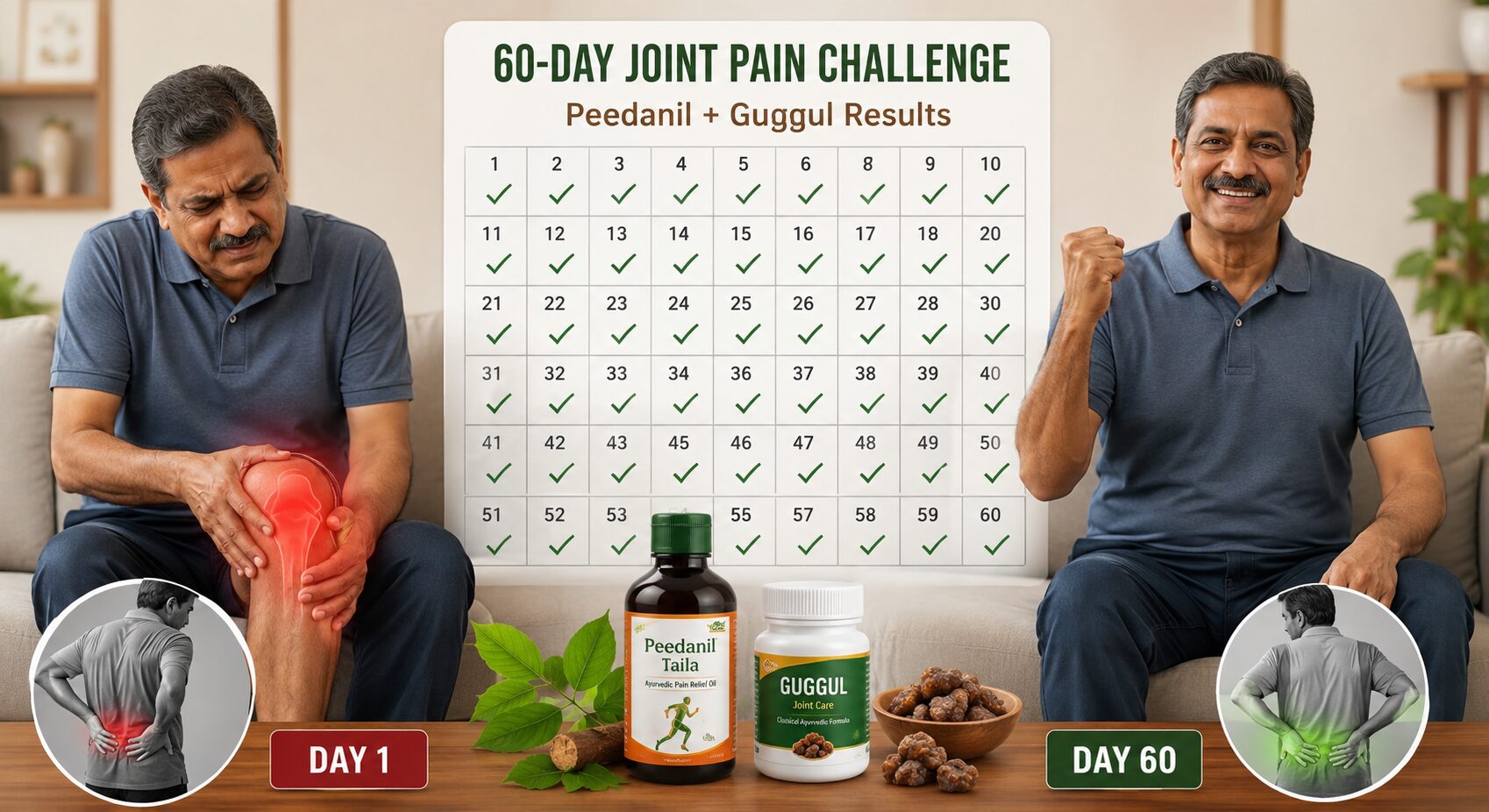
60-Day Joint Pain Challenge: Peedanil + Guggul Results
A time-boxed plan works well here, provided the timeline you set actually matches the biology. Peedanil Taila (Patanjali classical pain oil) is one of the herbs people reach for most often for joint pain and arthritis — and unlike much of what is sold as Ayurvedic, this one has real pharmacology behind it.
Stiff, aching joints quietly shrink your life — the stairs you avoid, the walk you cut short, the sleep broken by a throbbing knee. Ayurveda treats this not as wear-and-tear to be endured but as an imbalance to be corrected.
This guide keeps it practical: what the herb does at the level of the body, the dose and timing that actually matter, who should avoid it, how it fits alongside diet and other herbs for joint pain and arthritis, and what the evidence honestly supports. No hype, and no pretending a single herb is a cure.
What Is Peedanil Taila?
Peedanil Taila, botanically Patanjali classical pain oil and also known as Peedantak Taila, is classified in Ayurveda as Vata-Kapha pacifying, external. Its activity comes chiefly from nirgundi and gandhapura (wintergreen) in a sesame base. Classically it is used for Sandhivata (osteoarthritis) or Amavata (rheumatoid arthritis), where the underlying pattern is Vata-dominant with dryness and degeneration in Sandhivata; Ama plus Vata in Amavata, where toxins lodge in the joint.
How Peedanil Taila Works for Joint Pain
A warming external Vata oil. Wintergreen supplies methyl salicylate, a natural salicylate that dulls local pain, while nirgundi reduces swelling and the sesame base carries both into the joint capsule.
This matters for joint pain and arthritis because the root problem is vata-dominant with dryness and degeneration in sandhivata; ama plus vata in amavata, where toxins lodge in the joint. Peedanil Taila acts on that pattern rather than masking the symptom — which is why it takes weeks to show its full effect, and why the benefit tends to hold.
Peedanil Taila Dosage and How to Take It
- Dose: 5–10 ml per application, warmed
- Timing: massaged in for 10–15 minutes, twice daily, ideally before a warm bath
- Course length: a minimum of eight weeks — judging it earlier is the commonest mistake
- Carrier: warm water suits most preparations; warm milk suits Rasayana and calming herbs
Peedanil Taila Side Effects and Who Should Avoid It
External use only. Never apply to broken skin or a hot, red, acutely swollen joint — heat on acute inflammation makes it worse. Its wintergreen salicylate is absorbed through skin, so go easy if you take blood thinners or react to aspirin.
None of this makes the herb dangerous — it makes it a real medicine with real interactions. Tell your doctor what you are taking; that one habit prevents almost every avoidable problem.
What the Research Says About Peedanil Taila
Medicated-oil massage has trial support for reduced pain and better mobility; the salicylate action is well documented. For an independent read, see the NIH summary, and the NCCIH overview for the condition itself.
What a Realistic Timeline Looks Like
Most disappointment comes from a mismatch between the plan and the tissue. Digestion responds fastest and often shifts within one to two weeks. Energy and sleep follow at four to eight weeks. Skin turns over roughly monthly, so give it six to eight weeks. Hair is slowest of all because the follicle cycle is slow — reduced fall by six weeks, but visible new growth needs three to four months. Joints and deep tissue repair run to three to six months. Set your checkpoint honestly against that, take a photo or measurement at day zero, and judge at the end rather than daily in the mirror.
Herbs That Work Well With Peedanil Taila
Peedanil Taila is rarely used alone for joint pain and arthritis. Classical practice pairs it with herbs covering the other angles of the same problem:
- Shallaki (Boswellia) — It inhibits 5-lipoxygenase — a different inflammatory pathway from NSAIDs, which block COX.
- Guggul — Guggulsterones antagonise the farnesoid X receptor, increasing hepatic LDL uptake and lowering cholesterol.
- Turmeric — Curcumin inhibits NF-kB — the master switch of the inflammatory cascade — and suppresses COX-2, TNF-alpha and IL-6.
Diet and Lifestyle Alongside Peedanil Taila
A herb only carries part of the load. For joint pain and arthritis, these changes decide how well Peedanil Taila works.
Foods to Favour
- Ginger, turmeric and garlic daily
- Warm soups and cooked vegetables
- Warm, moist, well-cooked food
- Ghee and healthy fats to lubricate the joints
Foods to Limit or Avoid
- Sitting still for long stretches
- Potatoes and nightshades if you notice a flare
- Cold, dry and raw food, which aggravates Vata
- Curd at night and excess sour food in Amavata
Track morning stiffness duration, pain score, and range of movement so you judge results on evidence rather than impression.
Which Form of Peedanil Taila Should You Use?
Peedanil Taila is sold in several forms and they are not interchangeable. A standardised extract gives a known amount of nirgundi and gandhapura (wintergreen) in a sesame base per dose — what trials use, and what you want for a therapeutic result. Raw churna is cheaper and closer to classical practice but varies batch to batch, so you need more of it. Capsules solve the taste problem, which matters more than people admit with bitter herbs. The best form is the one you will still be taking in week eight.
How to Choose a Good Product
Quality decides whether Peedanil Taila works at all. Look for a stated active-compound percentage, an FSSAI or AYUSH number, and a manufacturer you recognise — Himalaya and Organic India for standardised extracts, Baidyanath and Kottakkal for classical formulations, Patanjali and Dabur for value. A price far below market usually means a diluted or adulterated product.
What the Research Really Says About Joint Pain
The evidence for Peedanil Taila is worth understanding honestly rather than through marketing. Medicated-oil massage has trial support for reduced pain and better mobility; the salicylate action is well documented. Its measurable action comes from nirgundi and gandhapura (wintergreen) in a sesame base, and a warming external Vata oil. Wintergreen supplies methyl salicylate, a natural salicylate that dulls local pain, while nirgundi reduces swelling and the sesame base carries both into the joint capsule.
That said, three caveats apply to almost all Ayurvedic research on joint pain and arthritis. First, many studies are small and run in India, so they need larger independent replication before the results are considered settled. Second, herbal trials struggle to blind properly — the taste and smell of a churna are hard to disguise with a placebo, which can inflate the apparent benefit. Third, whole-herb preparations vary batch to batch, so a result from a standardised extract does not automatically transfer to the powder on your shelf. None of this means the herbs do not work; it means the honest position is ‘promising and traditionally supported’, not ‘clinically proven cure’.
It also helps to know how the classical and modern pictures line up. Ayurveda described Sandhivata (osteoarthritis) or Amavata (rheumatoid arthritis) and its pattern of vata-dominant with dryness and degeneration in sandhivata centuries before anyone could measure a cytokine or a hormone, and much of what modern pharmacology now documents maps onto those older observations rather than contradicting them. The gap is in the standard of proof, not usually in the direction of the effect — traditional texts recorded what practitioners saw repeatedly, while modern trials are still catching up on measuring it rigorously.
The practical takeaway is to treat the research as a reason to try a well-made product carefully, alongside the diet and lifestyle changes that carry the strongest evidence of all — and to track morning stiffness duration, pain score, and range of movement so you have your own data rather than relying on a study done on someone else. If eight to twelve consistent weeks show no change in your own measurements, that is a genuine signal to reassess rather than to keep spending.
Frequently Asked Questions
Why did I see no change in the first two weeks?
Because almost nothing except digestion moves that fast. Skin needs six to eight weeks, hair three to four months, joints three to six. Two weeks of no visible change is the normal starting point, not a failure.
How long does Peedanil Taila take to work?
First signs in two to four weeks, a clear change by eight. Peedanil Taila rebuilds function rather than forcing it, so it is slower than a drug — but the benefit does not vanish the moment you stop.
What is the correct Peedanil Taila dosage?
5–10 ml per application, warmed, taken massaged in for 10–15 minutes, twice daily, ideally before a warm bath. Doubling it does not speed anything up; it only raises the chance of side effects.
Who should not take Peedanil Taila?
External use only. Never apply to broken skin or a hot, red, acutely swollen joint — heat on acute inflammation makes it worse. Its wintergreen salicylate is absorbed through skin, so go easy if you take blood thinners or react to aspirin.
Is my arthritis Sandhivata or Amavata?
Sandhivata (osteoarthritis) is dry, worse with movement, mainly in knees and hips, and improves with warm oil. Amavata (rheumatoid) brings migrating pain, swelling, morning stiffness over an hour, and a heavy, toxic feeling. Crucially, oil massage helps Sandhivata but can worsen active Amavata — clear the Ama first.
The Bottom Line
Peedanil Taila is a genuine, well-studied option for joint pain and arthritis when used properly: 5–10 ml per application, warmed, taken massaged in for 10–15 minutes, twice daily, ideally before a warm bath, for at least eight weeks, from a brand you trust. Respect the cautions, pair it with the diet and lifestyle changes above, and track morning stiffness duration, pain score, and range of movement. That combination is what produces results.
Related Reading
- How to use herbal guggulu for joint pain relief?
- Guggul
- Rajasthan Herbals Pain Niwaran Churna
- Where to Purchase Ayurvedic Pain Relief Balms with Natural Ingredients?
- Divya Peedanil Gold Tablet
Disclaimer
This article is for general information and educational purposes only. It is not medical advice, a diagnosis, or a prescription, and it does not claim to cure, treat, or prevent any disease. Ayurvedic herbs can interact with medicines and are not suitable for everyone — responses vary from person to person. Always consult a qualified doctor or registered Ayurvedic practitioner before starting any herb, supplement, or remedy, especially if you are pregnant, breastfeeding, taking medication, or managing a health condition. Never stop prescribed treatment without professional guidance.






Add comment