Classical Rasa Aushadhi
Vrihat Vat Chintamani Ras
Traditional uses, ingredients and the precautions that matter.
Vrihat Vat Chintamani Ras is one of those medicines you rarely see outside an Ayurvedic doctor’s prescription pad, and for good reason. It contains gold, silver, pearl and several other processed minerals, and it is meant for people under a practitioner’s care, usually older adults with long-standing Vata complaints.
If it has been prescribed to you or a family member, this guide explains what it is, what goes into it, and the precautions you should know before the first dose.
The name and its spellings
You will see this medicine written several ways:
- Vrihat Vat Chintamani Ras (the spelling Patanjali uses)
- Brihat Vata Chintamani Rasa
- Vrihat Vatchintamani Ras or Bruhat Vat Chintamani
- In Hindi, वृहत वात चिंतामणि रस
They all refer to the same formula. Vrihat or Brihat means “greater”, which separates it from the simpler Vat Chintamani Ras. Vata is the dosha it addresses, and Chintamani is the legendary wish-fulfilling jewel. So the name roughly means “the greater jewel for Vata”, which tells you how highly the classical physicians rated it.
The formula is described in Bhaishajya Ratnavali, a respected compendium of Ayurvedic formulations, in the section on Vata disorders.
Traditional uses
In Ayurveda, Vata dosha governs movement in the body, including nerve impulses, muscle activity and circulation. When Vata is aggravated, the classical texts describe symptoms like stiffness, tremor, weakness, pain that moves around, dryness and disturbed sleep. Vrihat Vat Chintamani Ras is traditionally used by physicians in this setting:
- Vata Vyadhi, disorders of the nerves, muscles and joints, as part of a supervised treatment plan
- Support for the nervous system during long recovery periods
- Heart support, as described in the traditional literature, again under a doctor’s supervision
- Rasayana for older adults, to support strength and vitality
It is important to be clear about what this does not mean. Vrihat Vat Chintamani Ras is not a treatment for stroke, paralysis, Parkinson’s disease, heart disease or any other medical condition, and it should never replace treatment from your physician or cardiologist. Ayurvedic doctors who prescribe it usually do so alongside other care, not instead of it.
Ingredients
The classical formula contains a set of precious Bhasmas and Pishtis:
| Ingredient | What it is |
|---|---|
| Swarna Bhasma | Processed gold |
| Rajat Bhasma | Processed silver |
| Abhrak Bhasma | Processed mica |
| Lauh Bhasma | Processed iron |
| Pravala Pishti | Coral, prepared by grinding with rose water |
| Mukta Pishti | Pearl, prepared the same way |
| Ras Sindoor | A preparation of purified mercury and sulphur |
These are ground together and processed with Ghritkumari (Aloe vera) juice. A Pishti is different from a Bhasma: Bhasmas are made by repeated heating, while Pishtis are made by long grinding without heat, which is why pearl and coral are usually used as Pishti.
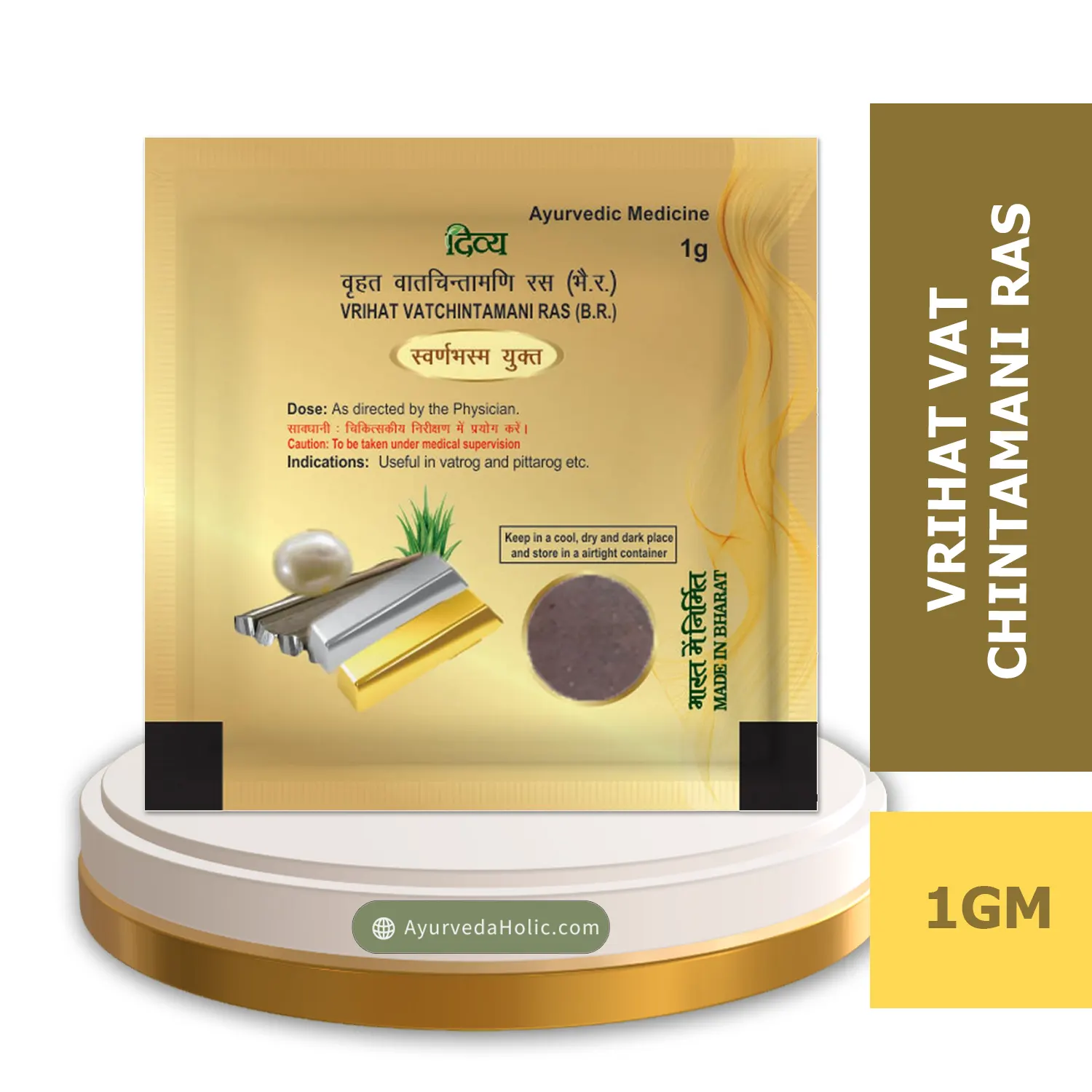
Patanjali’s version is made by Divya Pharmacy, Haridwar, and sold as a 1 g pack. As with every Rasa Aushadhi, check the composition panel on your pack for the exact quantities.
If you want to understand the individual ingredients better, we have separate guides on Swarna Bhasma and Mukta Bhasma.
How it is taken
Because of its mineral content, Vrihat Vat Chintamani Ras is used in very small doses, measured in milligrams. It is usually given with honey, though your doctor may choose a different anupana (carrier) depending on your condition.
A few practical points:
- Only take the dose written on your prescription. Do not adjust it yourself.
- A 1 g pack lasts a long time at these doses. Store it tightly closed in a cool, dry place.
- Ask your doctor how long the course should run and when you should come back for a review.
Precautions and who should avoid it
These precautions apply to Vrihat Vat Chintamani Ras and to most gold and mineral Rasa Aushadhis:
- Not for pregnant or breastfeeding women or children.
- Liver, kidney or heart conditions: your doctor must approve it first.
- High blood pressure or diabetes: discuss with your doctor before starting.
- Regular medicines: tell both your Ayurvedic doctor and your regular doctor what you are taking.
- Warning signs: stop and seek medical advice if you notice tremors, dizziness, stomach upset, a metallic taste that does not go away, or an allergic reaction.
Quality matters more with this medicine than with almost any herbal product. A poorly prepared Bhasma can contain unprocessed metal. Buy only sealed packs from licensed manufacturers, with batch number, dates and licence number printed on the label. Our guide on how to buy gold-containing Ayurvedic medicines safely goes through the checks in detail.
How it compares with similar medicines
Doctors often choose between a few classical Ras medicines for Vata conditions. Yogendra Ras is frequently prescribed for the nerves and heart, and Rasraj Ras is another classical option. We compare them side by side in Rasraj Ras vs Brihat Vat Chintamani Ras vs Ashwagandha.
Brands and pack sizes
We stock Patanjali Vrihat Vat Chintamani Ras 1 g, made by Divya Pharmacy. Other classical manufacturers also make it, often in tablet form. If your doctor names a specific brand, follow that.
How it is prepared
Vrihat Vat Chintamani Ras is one of the more demanding preparations in Rasashastra, which is part of why it costs what it does.
- Each ingredient is prepared separately. Gold, silver, iron and mica are each purified and turned into Bhasma through repeated grinding with herbal juices and controlled heating. Pearl and coral are made into Pishti by grinding them with rose water for days, without heat.
- Ras Sindoor is prepared from purified mercury and sulphur by a separate classical process.
- Everything is combined in the proportions the text gives.
- Bhavana with Aloe vera juice. The mixture is ground with fresh Ghritkumari juice until the juice is absorbed, then dried. This is repeated.
- The finished Ras is packed as a fine powder or made into small pills.
Skipping steps or rushing the Bhasma process is how poor-quality products end up with unprocessed metal. That is the main reason we keep repeating the advice to buy only from licensed manufacturers.
The Ayurvedic view: why Vata, and why older adults
Ayurveda describes life in three broad stages. Childhood is dominated by Kapha, adulthood by Pitta, and older age by Vata. That is why dryness, stiffness, thinner skin, lighter sleep, tremor and slower recovery are seen as natural tendencies of ageing in this system.
When Vata becomes seriously aggravated, the texts describe it affecting the nervous system, the muscles and the heart. Vrihat Vat Chintamani Ras was formulated for this situation. Its ingredients are chosen to be both strengthening and steadying:
- Gold and silver are traditional Rasayanas, described as strengthening the heart and mind.
- Pearl and coral are cooling and calming in the Ayurvedic reading.
- Iron and mica are traditionally associated with strength and blood.
- Aloe vera as the processing juice adds a soothing quality.
This is a traditional framework, not a modern diagnosis. A Vaidya uses it alongside, not instead of, what your regular doctor finds.
Diet and routine alongside the medicine
Ayurvedic doctors rarely give a Vata medicine without lifestyle advice. Typical recommendations include:
- Warm, moist, freshly cooked food with a little ghee: soups, dal, khichdi, cooked vegetables.
- Fewer dry, cold and raw foods, and less fasting or skipping meals.
- Daily oil massage (abhyanga) with warm sesame oil or a medicated oil, followed by a warm bath, if your doctor agrees.
- A regular routine: meals, sleep and waking at the same times each day.
- Gentle movement, such as walking and simple yoga, rather than strenuous exercise.
- Keeping warm, especially in winter and in air-conditioned rooms.
These are often the parts that make the biggest day-to-day difference.
वृहत वात चिंतामणि रस, आसान हिंदी में
वृहत वात चिंतामणि रस स्वर्ण भस्म युक्त एक शास्त्रीय रस औषधि है, जिसका वर्णन भैषज्य रत्नावली में मिलता है। इसमें स्वर्ण, रजत, अभ्रक और लौह भस्म, मोती और प्रवाल पिष्टी तथा रस सिंदूर होते हैं, जिन्हें घृतकुमारी (एलोवेरा) के रस में तैयार किया जाता है। आयुर्वेद में इसे वात व्याधि, नसों, जोड़ों और हृदय के सहयोग के लिए, खासकर बड़ी उम्र के लोगों में, परंपरागत रूप से दिया जाता है। इसकी मात्रा मिलीग्राम में होती है, इसलिए इसे केवल पंजीकृत आयुर्वेदिक चिकित्सक की सलाह से ही लें। गर्भवती महिलाएं और बच्चे इसका सेवन न करें।
Frequently asked questions
What is the price of Patanjali Vrihat Vat Chintamani Ras?
We list the 1 g pack at ₹1,542 as of October 2026. Prices change, so check the product page for today’s price.
Do I need blood tests while taking it?
Many practitioners check kidney and liver function before and during a course of any metal-containing Rasa Aushadhi, especially in older adults. Ask your doctor.
Is Vrihat Vat Chintamani Ras the same as Vat Chintamani Ras?
No. “Vrihat” refers to the greater version, which contains gold and a fuller set of Bhasmas. Check that your pack matches what was prescribed.
Does Vrihat Vat Chintamani Ras contain gold?
Yes. Swarna Bhasma is one of its main ingredients, along with Rajat Bhasma (silver) and other minerals.
Can I take it for general weakness without a prescription?
No. It is a Rasa Aushadhi with processed metals. Take it only when a registered Ayurvedic practitioner prescribes it.
How long can it be taken?
Your doctor decides the duration based on your condition, and usually reviews you during the course.
This article describes the traditional use of a classical Ayurvedic medicine for general information. It is not medical advice and does not replace consultation with a qualified doctor.