
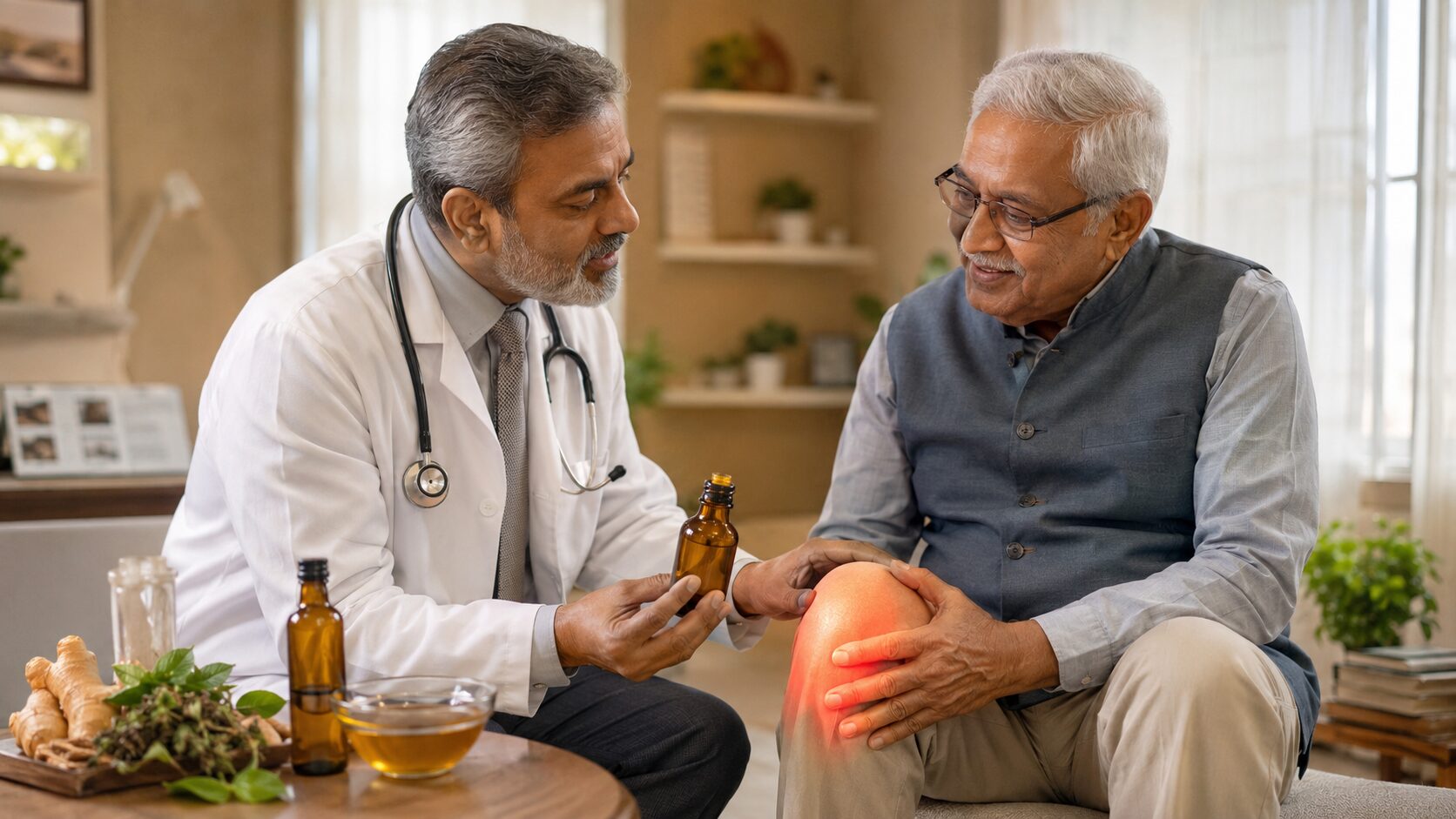
Best Joint Oil for Arthritis Patients: Doctor’s Recommendations
If you are dealing with joint pain and arthritis, Ayurveda offers something a quick fix cannot: a working explanation of why it keeps happening, and a plan aimed at that cause rather than the symptom.
Stiff, aching joints quietly shrink your life — the stairs you avoid, the walk you cut short, the sleep broken by a throbbing knee. Ayurveda treats this not as wear-and-tear to be endured but as an imbalance to be corrected.
Below, we walk through how Ayurveda actually understands joint pain and arthritis, the specific herbs worth knowing with their real doses and cautions, the food and daily habits that do at least half the work, and an honest look at what the research does and does not show. The aim is a plan you can genuinely follow — not vague advice to ‘stay balanced’.
How Ayurveda Understands Joint Pain
In the classical texts, joint pain and arthritis is described as Sandhivata (osteoarthritis) or Amavata (rheumatoid arthritis). The underlying pattern is Vata-dominant with dryness and degeneration in Sandhivata; Ama plus Vata in Amavata, where toxins lodge in the joint. That reading matters practically: it tells you which herbs to use and which will make things worse — a mistake people make constantly when copying a remedy that suited the opposite pattern.
Modern research increasingly echoes the same observations in biochemical language. The point is not to silence the symptom but to correct the pattern producing it, then let the tissue recover.
Best Ayurvedic Herbs for Joint Pain
These are the herbs with the strongest case for joint pain and arthritis, each doing a different job:
Shallaki (Boswellia) (Boswellia serrata)
It inhibits 5-lipoxygenase — a different inflammatory pathway from NSAIDs, which block COX. That is why it eases joint pain without damaging the stomach lining, and it also slows cartilage-degrading enzymes. Shallaki (Boswellia) is taken at 300–400 mg standardised extract (65% boswellic acids) three times daily, with food. Generally well tolerated; mild reflux or nausea in some.
Guggul (Commiphora mukul)
Guggulsterones antagonise the farnesoid X receptor, increasing hepatic LDL uptake and lowering cholesterol. They also inhibit NF-kB, which underlies the anti-arthritic effect, and Guggul is a classic Ama-scraper (Lekhana). Guggul is taken at 500 mg (standardised to 2.5% guggulsterones) two to three times daily, after meals with warm water. It can interact with thyroid medication (it raises T3), blood thinners and oral contraceptives.
Turmeric (Curcuma longa)
Curcumin inhibits NF-kB — the master switch of the inflammatory cascade — and suppresses COX-2, TNF-alpha and IL-6. Its weak point is absorption, which is why it must be paired with black pepper and a fat. Turmeric is taken at 500–1,000 mg curcumin daily, always with 5–10 mg piperine (black pepper) and a little fat or ghee, with meals, since fat markedly improves absorption. High doses can irritate an empty stomach and may add to blood-thinning medication.
Mahanarayan Taila (classical Vata oil (Bala, Ashwagandha base))
Warm sesame oil penetrates deeply and pacifies Vata in the joints and nerves; the medicated herbs reduce local inflammation while massage itself improves circulation and frees the stiff joint capsule. Mahanarayan Taila is taken at 5–10 ml, warmed, per application, massage for 10–15 minutes, ideally before a warm bath; twice daily in acute pain. External use only.
Ginger (Zingiber officinale)
It blocks 5-HT3 receptors in the gut (the nausea signal), speeds gastric emptying through a prokinetic cholinergic action, and damps inflammatory prostaglandins. Ginger is taken at 1 g dried ginger daily, or fresh ginger tea from a 2 cm piece, 30 minutes before meals to kindle Agni; 1–2 hours before travel for motion sickness. It is warming, so it can aggravate acidity in Pitta types.
Diet for Joint Pain
Food does more of the work here than most people expect. For joint pain and arthritis, these are the changes that matter most.
Foods to Favour
- Warm, moist, well-cooked food
- Ghee and healthy fats to lubricate the joints
- Ginger, turmeric and garlic daily
- Warm soups and cooked vegetables
Foods to Limit or Avoid
- Cold, dry and raw food, which aggravates Vata
- Curd at night and excess sour food in Amavata
- Sitting still for long stretches
- Potatoes and nightshades if you notice a flare
A Practical Daily Routine
- Morning: Shallaki (Boswellia) at 300–400 mg standardised extract (65% boswellic acids) three times daily
- Midday: make lunch the largest meal, when Agni is strongest
- Evening: thirty minutes of movement, and a light, early dinner
- Night: a calming or regulating herb as appropriate, with warm milk
- Weekly: log morning stiffness duration, pain score, and range of movement
Precautions and When to See a Doctor
- Tell your doctor about every herb you take
- Herbs complement conventional treatment for serious disease; they do not replace it
- Pregnancy, breastfeeding and childhood need professional guidance first
- Buy only certified brands — unregulated products carry a real heavy-metal risk
What the Evidence Shows
Randomised trials in knee osteoarthritis report reduced pain and improved function within 8 weeks, with cartilage-protective signals. The independent NIH overview covers the condition, and the NCCIH review covers the lead herb.
Common Mistakes People Make With Joint Pain
- Expecting results in days — this works over weeks, and quitting at two weeks guarantees failure
- Taking the herbs but ignoring the diet, which usually does more of the work
- Copying a remedy that suited someone with the opposite dosha pattern
- Switching herbs constantly instead of giving one combination a fair eight-week trial
- Stopping the moment symptoms ease, before the pattern has actually corrected
What the Research Really Says About Joint Pain
The evidence for Shallaki (Boswellia) is worth understanding honestly rather than through marketing. Randomised trials in knee osteoarthritis report reduced pain and improved function within 8 weeks, with cartilage-protective signals. Its measurable action comes from boswellic acids (AKBA), and it inhibits 5-lipoxygenase — a different inflammatory pathway from NSAIDs, which block COX. That is why it eases joint pain without damaging the stomach lining, and it also slows cartilage-degrading enzymes.
That said, three caveats apply to almost all Ayurvedic research on joint pain and arthritis. First, many studies are small and run in India, so they need larger independent replication before the results are considered settled. Second, herbal trials struggle to blind properly — the taste and smell of a churna are hard to disguise with a placebo, which can inflate the apparent benefit. Third, whole-herb preparations vary batch to batch, so a result from a standardised extract does not automatically transfer to the powder on your shelf. None of this means the herbs do not work; it means the honest position is ‘promising and traditionally supported’, not ‘clinically proven cure’.
It also helps to know how the classical and modern pictures line up. Ayurveda described Sandhivata (osteoarthritis) or Amavata (rheumatoid arthritis) and its pattern of vata-dominant with dryness and degeneration in sandhivata centuries before anyone could measure a cytokine or a hormone, and much of what modern pharmacology now documents maps onto those older observations rather than contradicting them. The gap is in the standard of proof, not usually in the direction of the effect — traditional texts recorded what practitioners saw repeatedly, while modern trials are still catching up on measuring it rigorously.
The practical takeaway is to treat the research as a reason to try a well-made product carefully, alongside the diet and lifestyle changes that carry the strongest evidence of all — and to track morning stiffness duration, pain score, and range of movement so you have your own data rather than relying on a study done on someone else. If eight to twelve consistent weeks show no change in your own measurements, that is a genuine signal to reassess rather than to keep spending.
Frequently Asked Questions
Is my arthritis Sandhivata or Amavata?
Sandhivata (osteoarthritis) is dry, worse with movement, mainly in knees and hips, and improves with warm oil. Amavata (rheumatoid) brings migrating pain, swelling, morning stiffness over an hour, and a heavy, toxic feeling. Crucially, oil massage helps Sandhivata but can worsen active Amavata — clear the Ama first.
Should I use hot or cold on the joint?
Hot for chronic, stiff, Vata-type pain — warm oil and a hot pack. Cold for acute, red, swollen, hot joints. Applying heat to an actively inflamed joint makes it worse.
Is Shallaki better than painkillers?
It works on a different pathway — 5-LOX rather than COX — so it eases pain without damaging the stomach lining, but it acts over weeks rather than hours. Many people use it to reduce, not replace, their NSAID use, under medical advice.
How long before I see results?
Two to four weeks for the first signs, four to eight for a clear change, three to six months for full benefit. Track morning stiffness duration, pain score, and range of movement weekly.
The Bottom Line
Ayurvedic management of joint pain and arthritis works when treated as a system rather than a pill: the right herbs for vata-dominant with dryness and degeneration in sandhivata, the diet changes above, and consistency for eight to twelve weeks. Track morning stiffness duration, pain score, and range of movement and keep your doctor informed.
Related Reading
- How to use herbal guggulu for joint pain relief?
- Eucalyptus Oil
- Fish Oil
- Kumkumadi Tailam Oil
- Kerala Ayurveda Kumkumadi Oil
Disclaimer
This article is for general information and educational purposes only. It is not medical advice, a diagnosis, or a prescription, and it does not claim to cure, treat, or prevent any disease. Ayurvedic herbs can interact with medicines and are not suitable for everyone — responses vary from person to person. Always consult a qualified doctor or registered Ayurvedic practitioner before starting any herb, supplement, or remedy, especially if you are pregnant, breastfeeding, taking medication, or managing a health condition. Never stop prescribed treatment without professional guidance.





Add comment