
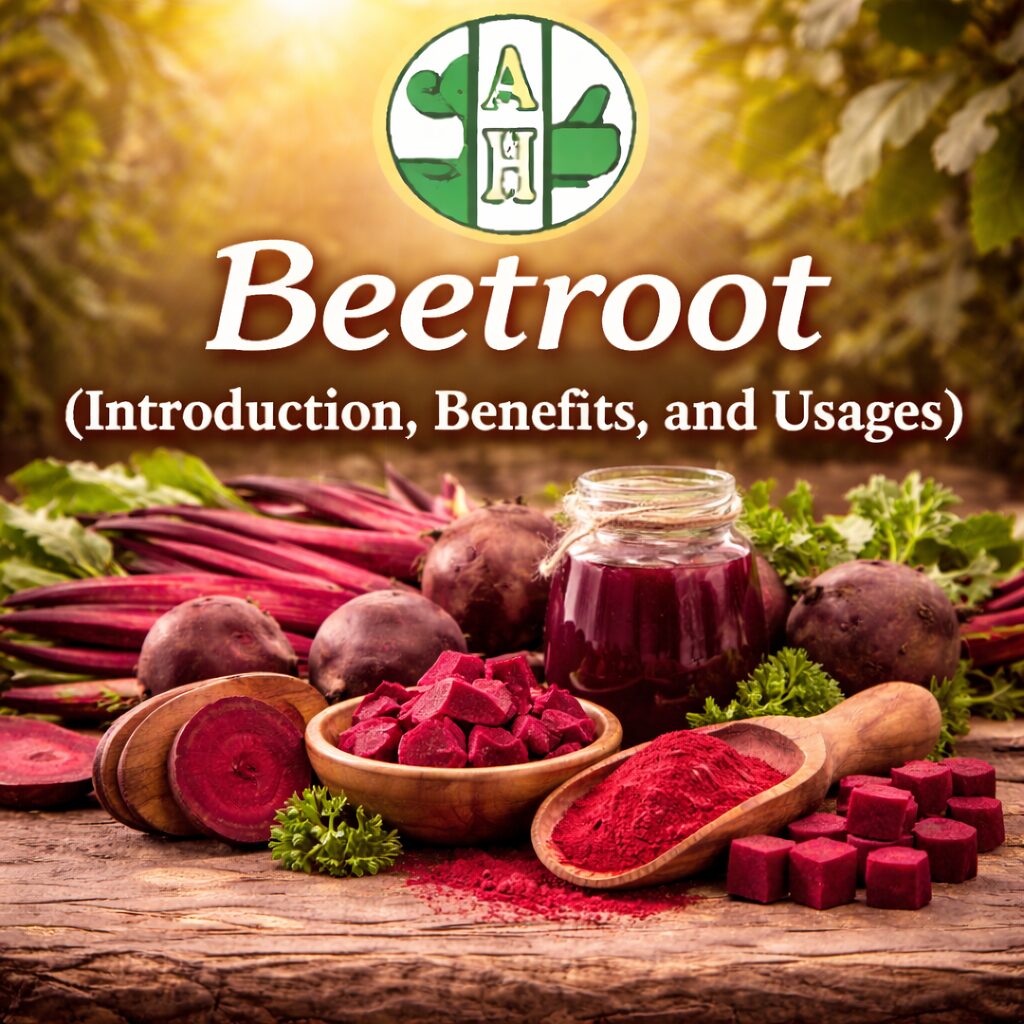
Beetroot: Introduction, Benefits, and Usages
Few vegetables command as much visual drama as the beetroot. With its deep crimson flesh, earthy sweetness, and extraordinary pigment that stains everything it touches, beetroot is one of nature’s most striking foods. Yet beyond its bold appearance lies an equally impressive nutritional story — one that has propelled this ancient root vegetable from the pages of traditional medicine into the forefront of modern sports science, cardiovascular research, and functional nutrition.
Beetroot, known scientifically as Beta vulgaris subsp. vulgaris, belongs to the Amaranthaceae family and is closely related to spinach, chard, and quinoa. Its wild ancestor, the sea beet (Beta vulgaris subsp. maritima), grew naturally along the coastlines of Europe, North Africa, and Asia. Ancient civilizations first cultivated beet plants primarily for their leaves, which were used as food and medicine. The Greeks offered beet leaves as tribute to the god Apollo at the temple of Delphi, and the Romans prized both the leaves and roots for their medicinal properties — using them to treat fevers, constipation, and wounds.
The thick, fleshy root we recognize today as beetroot was selectively developed through cultivation during the Middle Ages, primarily in Germany and other parts of northern Europe, where it thrived in cooler climates. By the 16th and 17th centuries, beetroot had become a common vegetable across Europe, and by the 18th century it had taken on additional commercial importance when scientists discovered that sugar beet — a pale-fleshed variety of the same species — could be processed to produce sucrose, offering an alternative to cane sugar. Today, sugar beet accounts for roughly 20% of the world’s sugar production.
The common red beetroot is now cultivated globally and is available in several varieties beyond the classic deep red, including golden beetroot, Chioggia (candy stripe), and white beetroot — each with slightly different flavour profiles and pigment compositions. It is grown across Europe, North America, Asia, and Australia, and has surged in popularity over the past two decades largely due to growing scientific evidence of its remarkable health benefits.
Beetroot Benefits
Beetroot has one of the most impressive and well-researched nutritional profiles among root vegetables. A 100g serving of raw beetroot provides approximately 43 calories, 10 grams of carbohydrates, 2.8 grams of fiber, 1.6 grams of protein, and meaningful quantities of folate, manganese, potassium, iron, vitamin C, and magnesium. Its low calorie density combined with high micronutrient content makes it an exceptionally efficient food from a nutritional standpoint.
The compound that has generated the most scientific excitement around beetroot is inorganic nitrate. Beetroot is one of the richest dietary sources of nitrate, containing between 250 and 1,000 mg per kilogram of fresh weight. When consumed, dietary nitrates are converted by bacteria in the mouth and by enzymes in the body into nitric oxide — a molecule that causes blood vessels to dilate, reduces arterial stiffness, lowers blood pressure, and improves the efficiency of oxygen delivery to tissues.
The cardiovascular implications of this process are profound. Multiple clinical trials have demonstrated that regular beetroot consumption — or supplementation with beetroot juice — can reduce systolic blood pressure by 4 to 10 mmHg, an effect comparable to some pharmaceutical antihypertensive medications. A landmark study published in the journal Hypertension found that drinking just 250 ml of beetroot juice daily for four weeks produced sustained reductions in blood pressure in patients with hypertension, without any adverse effects.
Athletic performance is another area where beetroot’s nitrate content delivers measurable benefits. By increasing nitric oxide levels, beetroot effectively reduces the oxygen cost of exercise — meaning the muscles can do the same amount of work while consuming less oxygen. Research from the University of Exeter, widely published in peer-reviewed journals, demonstrated that beetroot juice supplementation improved endurance performance, extended time to exhaustion, and enhanced high-intensity exercise capacity in both recreational and elite athletes. Many professional sports teams and Olympic athletes now routinely incorporate beetroot juice into their training and competition nutrition protocols.
The vivid crimson colour of red beetroot comes from a class of pigments called betalains — specifically betacyanins (red-purple) and betaxanthins (yellow-orange). These pigments are potent antioxidants and anti-inflammatory agents. Research has shown that betalains can inhibit the activity of pro-inflammatory enzymes, reduce oxidative stress markers in the blood, and may offer protective effects against chronic diseases including certain cancers. Unlike many other antioxidant pigments, betalains are relatively stable during cooking and digestion, meaning a significant portion of their bioactivity is preserved when beetroot is consumed cooked.
Folate — also known as vitamin B9 — is present in beetroot in particularly generous quantities. A 100g serving provides approximately 20% of the recommended daily intake of folate, which is essential for DNA synthesis and repair, red blood cell formation, and the prevention of neural tube defects during pregnancy. Beetroot’s iron content, while moderate, is complemented by its vitamin C, which significantly enhances the absorption of non-heme iron and makes beetroot a useful food for those at risk of iron-deficiency anaemia.
Liver health is another traditional and increasingly scientifically supported benefit of beetroot consumption. Betaine, a compound derived from choline that is found in notable quantities in beetroot, plays a key role in liver function — specifically in the methylation processes that help the liver process fats and reduce the accumulation of lipids in liver tissue. Studies suggest that betaine supplementation may help protect against non-alcoholic fatty liver disease, one of the most common liver conditions in the modern world.
Beetroot Uses
It is remarkably versatile in the kitchen, in health applications, and in industrial contexts.
In cooking, beetroot can be roasted, boiled, steamed, pickled, or eaten raw when grated or thinly sliced. Roasting intensifies its natural sweetness and earthy depth, making it a popular ingredient in warm salads, grain bowls, and vegetable sides. Raw grated beetroot adds colour, crunch, and nutrition to slaws and salads. Pickled beetroot — preserved in vinegar with spices — is a beloved condiment across the United Kingdom, Eastern Europe, and Scandinavia, where it accompanies everything from cold meats to herring.
Beetroot juice has become one of the most popular functional beverages in the health and sports nutrition market. Sold fresh, cold-pressed, or as concentrated shots, it is consumed for its blood pressure-lowering and performance-enhancing effects. Beetroot powder — made from dehydrated and ground beetroot — is widely used as a natural food colouring agent in products ranging from pasta and hummus to cakes and ice cream, offering a vivid pink-to-red hue without synthetic dyes.
In traditional medicine across India, the Middle East, and Eastern Europe, beetroot has long been used to treat anaemia, liver complaints, digestive disorders, and skin conditions. Beetroot leaves — often discarded — are in fact nutritious greens rich in calcium, iron, and vitamins A and K, and can be sautéed or used in salads much like chard or spinach.
Emerging research is exploring beetroot-derived betalain pigments as natural, stable alternatives to synthetic food dyes — a growing area of interest as consumers and regulators push for cleaner food labelling. Beetroot extracts are also being investigated for applications in cosmetics, particularly in natural skincare products where betalains’ antioxidant and anti-inflammatory properties may offer skin-protective benefits.
Disclaimer
The information in this article is for educational purposes only and does not constitute medical advice, diagnosis, or treatment. Always consult a qualified Ayurvedic practitioner or healthcare professional before using any herb or formulation, especially if you are pregnant, breastfeeding, or on medication. Individual results may vary. Ayurvedaholic does not claim to diagnose, treat, cure, or prevent any disease.
References :
- Wikipedia – Beetroot: https://en.wikipedia.org/wiki/Beetroot
- USDA FoodData Central – Beets, raw nutritional profile: https://fdc.nal.usda.gov/fdc-app.html#/food-details/169145/nutrients
- American Heart Association – Dietary nitrate and blood pressure: https://www.ahajournals.org/doi/10.1161/HYPERTENSIONAHA.114.04675
- MDPI – Red beetroot supplementation: https://www.mdpi.com/2072-6643/7/4/2801

Add comment