Ayurveda for children
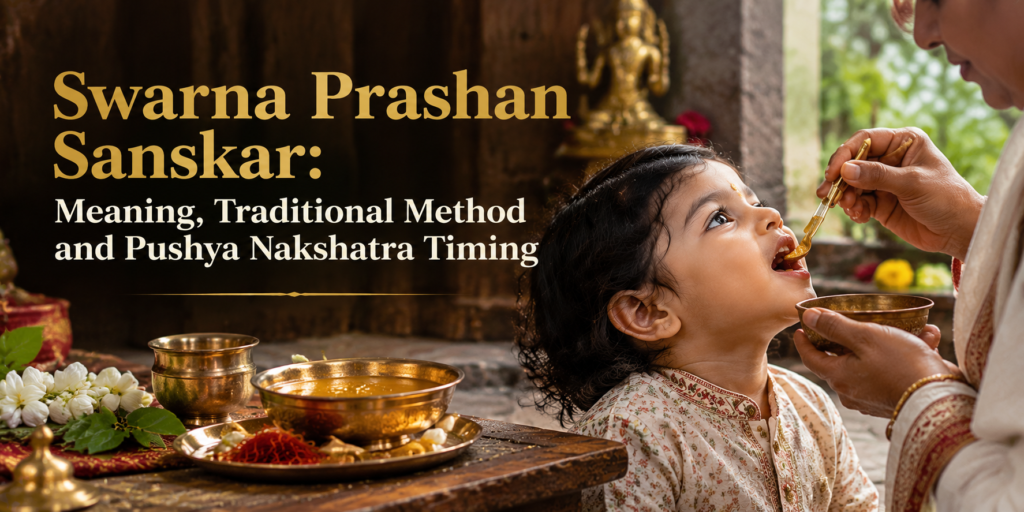
Swarna Prashan Sanskar
Meaning, classical method and the Pushya Nakshatra tradition, explained simply.

Ask a grandparent in Gujarat or Maharashtra about Swarna Prashan and you will probably hear about a small drop of something golden on a baby’s tongue, given on a particular morning each month. Ask a paediatric Ayurveda clinic and they will hand you a calendar of Pushya Nakshatra dates. Both are describing the same custom, which is now practised far more widely than it was twenty years ago.
This guide explains what the term means, what the classical text actually says, how the Pushya Nakshatra link came about, and what a parent should check before starting.
What does Swarna Prashan mean? (स्वर्ण प्राशन क्या होता है)
The name is two Sanskrit words. Swarna (स्वर्ण) means gold. Prashan (प्राशन) means to eat or to lick. Put together, Swarna Prashan simply means “taking gold by mouth”.
In practice it is a tiny dose of Swarna Bhasma (gold that has been purified and processed into a fine ash according to Rasashastra) mixed with cow ghee, honey and herbs that Ayurveda calls Medhya, meaning supportive of the mind. Brahmi, Shankhpushpi and Vacha are the herbs you will most often see on the label.
In Hindi you will hear it called स्वर्ण प्राशन संस्कार. The word sanskar is used because the practice is tied to Jatakarma, one of the sixteen traditional rites of childhood. During Jatakarma, the newborn is given a lick of honey and ghee touched with gold. Swarna Prashan grew out of that same idea.
What the classical texts say
The main source is the Kashyapa Samhita, the classical Ayurvedic text devoted to children’s health. In its chapter on Lehana (preparations given to infants by licking), it describes gold rubbed with honey and ghee and given to the child.
The best-known verse lists the qualities the text attributes to the practice: it is said to support medha (intellect), agni (digestion), bala (strength) and ayu (a long life), and to be good for complexion. The same passage says a child given Swarna Prashan for a month becomes sharp of mind, and one given it for six months remembers what they hear.
Two points are worth keeping in mind when you read claims online:
- These are traditional descriptions from a text written many centuries ago, not results of modern clinical trials.
- Modern research on Swarna Prashan is still limited. Some small studies have been published by Ayurvedic institutions, but there is nothing large enough to treat as proof.
So the honest way to see Swarna Prashan is as a respected traditional Rasayana practice, not as a vaccine or a medicine for any illness. It does not replace your child’s vaccination schedule.
Why Pushya Nakshatra?
Pushya (पुष्य) is one of the 27 nakshatras, the lunar mansions used in the Hindu calendar. The Moon passes through Pushya roughly once every 27 days, so the day comes around about once a month.
Pushya is traditionally considered one of the most auspicious nakshatras for beginning anything nourishing, and many Ayurvedic clinics give Swarna Prashan on that day each month. You will not find a rule in the Kashyapa Samhita that says it must be Pushya. The timing is a later tradition, and a popular one, because it gives families a simple monthly rhythm.
Some families give a small daily dose at home instead, following the pack directions. Others only attend the monthly Pushya camps at a clinic. Both approaches are common.
How to check the dates
Pushya Nakshatra dates change every month, and the exact start and end times depend on your location. We deliberately do not publish a list of dates here, because a list copied from the internet is easy to get wrong. Instead:
- Look up a reliable Hindi or regional panchang for your city for the month.
- Or ask your Ayurvedic clinic, since most announce the next Pushya date in advance.
- If the nakshatra starts late in the day, clinics usually follow the next morning when Pushya is still running. Ask yours which convention they use.
The traditional method, step by step
The way most clinics and families follow it today looks like this:
- Morning, empty stomach. Swarna Prashan is traditionally given early in the day, before the child’s first feed or breakfast.
- The right dose for age. Drops for infants, a tablet or a measured amount for older children. This depends entirely on the product and your doctor’s advice.
- Given by mouth, slowly. Drops or the paste are placed on the tongue so the child licks it, which is the original lehana method.
- Nothing to eat for a short while afterwards. Many practitioners suggest waiting about half an hour before food, but follow your doctor’s instruction.
What age is it for?
Clinic practice usually starts from infancy and continues through childhood, often up to around 16 years. That said, the right starting age and dose are decisions for a qualified Ayurvedic paediatric doctor, not for a blog or a WhatsApp forward. This matters most for babies under a year old.
If your child has an ongoing health condition, allergies to honey or dairy, or is on regular medicines, speak to their paediatrician as well.
Tablets or drops?
Swarna Prashan comes in two common forms. Liquid preparations in a ghee and honey base, such as Krishna Ayurveda Swarna Prashan, are closer to the classical licking method and are easier for infants. Tablets, such as Dabur Swarna Prashan Tablets, are pre-measured and more convenient for school-age children.
We have compared the two forms in detail in Swarna Prashan Tablets vs Drops, and the Dabur tablets have their own guide: Dabur Swarna Prashan benefits and uses.
Safety notes parents should not skip
Swarna Prashan contains processed gold. Properly made Swarna Bhasma has a long history of use, but the quality of a Bhasma depends heavily on how it was prepared. A few practical rules:
- Buy only sealed packs from a licensed manufacturer, with a batch number, manufacturing date and expiry on the label.
- Never make your own at home or buy loose, unlabelled preparations.
- Stick to the dose on the pack or the one your doctor gives. More is not better.
- Stop and see a doctor if your child has vomiting, a rash or any unusual reaction.
If you want to understand the gold ingredient itself, our article on Swarna Bhasma uses and side effects covers how it is made and where it is used.
How Swarna Prashan is prepared
The quality of Swarna Prashan depends almost entirely on two things: the Swarna Bhasma and the base it is mixed into.
Swarna Bhasma is made by purifying gold and then reducing it to a fine ash through repeated rounds of grinding with herbal juices and controlled heating. Done properly, this takes days and a great deal of skill. A well-made Bhasma is an extremely fine powder that the classical texts consider safe in small doses. A badly made one may still contain metal particles.
The base is usually cow ghee and honey. Ghee is described in Ayurveda as a carrier that helps take herbs deeper into the body, and honey is traditionally used for children because it is easy to lick. The Medhya herbs, most often Brahmi, Shankhpushpi and Vacha, are processed into the ghee so that their qualities are carried along with the gold.
You may notice that ghee and honey are mixed in unequal amounts. That is deliberate. Ayurveda warns against combining ghee and honey in exactly equal quantities, and classical recipes follow this rule.
The Medhya herbs and what they add
| Herb | Traditional role in Ayurveda |
|---|---|
| Brahmi | The best-known Medhya herb, traditionally used for memory, learning and calm |
| Shankhpushpi | Traditionally used for the mind, concentration and sleep |
| Vacha | Traditionally used for speech, alertness and clarity, in very small amounts |
| Ashwagandha | Present in some tablet forms, traditionally used for strength and growth |
Not every product contains every herb. Read the composition on your pack.
Why parents in India are choosing it again
Swarna Prashan faded from everyday practice for much of the twentieth century and has come back strongly over the last fifteen to twenty years. Several things have driven that:
- Ayurvedic hospitals and colleges began running free or low-cost monthly Pushya camps, which made it easy to try.
- Parents became more interested in traditional, preventive approaches alongside modern medicine.
- Ready-made, licensed products appeared, so families no longer had to rely on a local vaidya preparing it by hand.
Most families who use it treat it as one part of a child’s routine, next to vaccinations, good food, sleep and play, not as a substitute for any of them.
Questions to ask your Ayurvedic paediatric doctor
- Is my child old enough to start, and in what form, drops or tablets?
- How many drops or what dose, and how often: daily, or only on Pushya days?
- How long should we continue, and when should we review?
- Is it safe with my child’s allergies or any medicines they take?
- Which brand do you trust, and why?
- What should make us stop and come back to you?
स्वर्ण प्राशन संस्कार, आसान हिंदी में
स्वर्ण प्राशन का अर्थ है सोने का सेवन। इसमें बच्चों को बहुत कम मात्रा में स्वर्ण भस्म, गाय का घी, शहद और ब्राह्मी, शंखपुष्पी, वचा जैसी मेध्य जड़ी-बूटियां दी जाती हैं। इसका वर्णन काश्यप संहिता में मिलता है। आजकल कई आयुर्वेदिक अस्पताल हर महीने पुष्य नक्षत्र के दिन इसे देते हैं, क्योंकि पुष्य को पोषण देने वाले कामों के लिए शुभ माना जाता है। पुष्य नक्षत्र की तारीख अपने शहर के पंचांग या अपने आयुर्वेदिक क्लिनिक से पता करें। बच्चे की उम्र के अनुसार सही मात्रा केवल आयुर्वेदिक बाल रोग विशेषज्ञ ही बताएं। यह टीकाकरण की जगह नहीं लेता।
Frequently asked questions
Can Swarna Prashan be given with other medicines?
Tell both your child’s paediatrician and your Ayurvedic doctor about everything your child takes. Most practitioners pause Swarna Prashan during an acute illness and restart once the child is well.
What if my child vomits after the dose?
Do not repeat the dose that day. If it happens again, stop and speak to your doctor.
Swarna Prashan kya hota hai?
Swarna Prashan is a traditional Ayurvedic practice in which children are given a very small amount of processed gold (Swarna Bhasma) with ghee, honey and Medhya herbs. It comes from the Kashyapa Samhita and is meant to support immunity, intellect and growth in the traditional sense.
Is Swarna Prashan given only on Pushya Nakshatra?
No. Pushya Nakshatra is a popular monthly date that many clinics follow, but some families give a daily dose at home as directed on the pack. Your Ayurvedic doctor can tell you which routine suits your child.
Is Swarna Prashan the same as a vaccine?
No. It is a traditional wellness practice. It does not replace any vaccine or medical treatment, and it is not meant to treat illness.
Can I start Swarna Prashan for a newborn?
Only on the advice of an Ayurvedic paediatric doctor. Infants need a carefully chosen product and dose.
How long should a child take it?
There is no fixed rule. Many families follow it for months or years on Pushya days. Discuss the plan with your doctor and review it from time to time.
This article is for general information about a traditional practice. It is not medical advice. Please consult a qualified doctor before giving any Ayurvedic preparation to a child.