Inside the formula
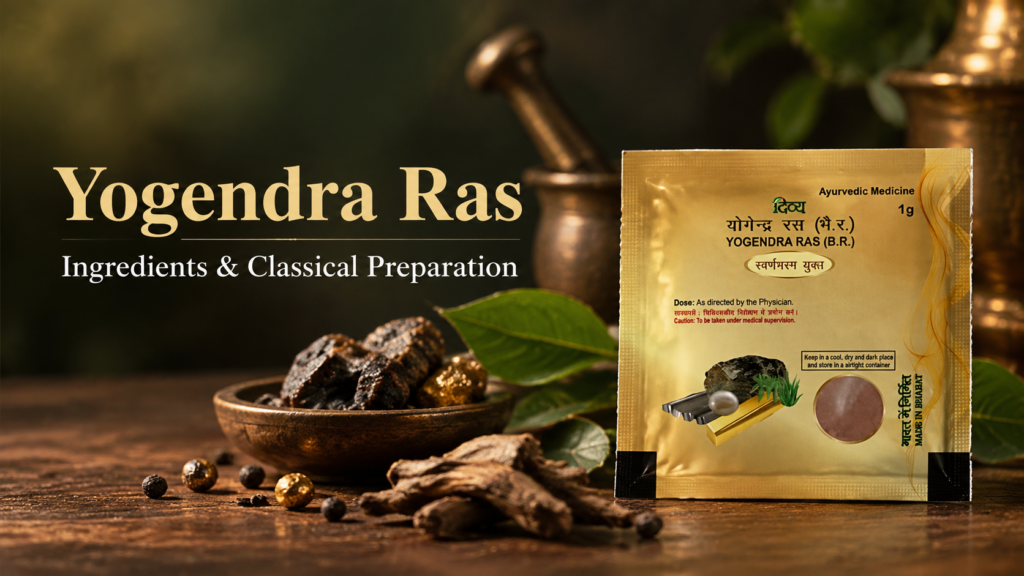
Yogendra Ras: Ingredients and Preparation
Classical source, the role of each Bhasma and how it is made.

Yogendra Ras has one of the shortest ingredient lists among the classical gold medicines, and one of the longest preparations. If you have ever wondered why a single gram of it costs over a thousand rupees, or what exactly is in that small pack, this guide walks through the formula one component at a time.
For an overview of uses and benefits, see our Yogendra Ras uses, benefits and ingredients guide. For brand prices, see the Yogendra Ras price and brand comparison.
Classical source and meaning of the name
Yogendra Ras is described in Bhaishajya Ratnavali, one of the most widely used compendiums of Ayurvedic formulations, in the context of Vata Vyadhi, the disorders Ayurveda links with an aggravated Vata dosha.
The name is made of two parts:
- Yoga here means a combination or formulation (as in a yoga of medicines), and also carries the sense of union.
- Indra means king or chief.
So Yogendra can be read as “the king of formulations”. Ras tells you it belongs to the Rasa Aushadhi group, made according to Rasashastra with purified metals and minerals.
It is traditionally used for Vata disorders affecting the nerves and muscles, to support nerve strength, as part of physician-guided plans for heart support, and as a Rasayana. These are traditional uses, not proven treatments.
The ingredient list and the role of each Bhasma
The formula, as reflected on Patanjali’s pack, is built from six components:
| Ingredient | What it is | Role in the formula, traditionally |
|---|---|---|
| Ras Sindoor | A classical preparation of purified mercury and sulphur | The core “Ras” ingredient, described as enhancing and carrying the effect of the others |
| Swarna Bhasma | Processed gold | The principal Rasayana, traditionally associated with the nerves, heart, mind and immunity |
| Kant Lauh Bhasma | A form of processed iron | Strength, blood and endurance |
| Abhrak Bhasma | Processed mica | A Rasayana linked with vitality and the nervous system |
| Mukta Bhasma | Processed pearl | Cooling and calming, traditionally balancing the warming metals |
| Vang Bhasma | Processed tin | Strength and vitality |
These are ground together with Ghritkumari (Aloe vera) juice. See your pack for exact quantities. Dabur’s tablet version, Dabur Yogendra Ras with Gold, follows the same classical formula.
How the parts work together, in the traditional view
The structure of the formula is quite logical once you see it:
- Ras Sindoor acts as the base and carrier.
- Gold, mica and iron provide the strengthening, Rasayana action.
- Pearl cools and calms, balancing the heat associated with the metals and with Ras Sindoor.
- Aloe vera, as the processing liquid, adds a soothing quality and is traditionally considered good for the liver.
This is the classical rationale. Modern research on Yogendra Ras as a complete formula is very limited.
Rasashastra processing, in plain words
Making Yogendra Ras involves three layers of work.
1. Purifying each raw material (Shodhana)
Each metal or mineral is purified separately, according to the method set out in the Rasashastra texts. Typical methods involve heating the material and quenching it repeatedly in liquids such as sesame oil, buttermilk, cow’s urine, Kanji (a sour fermented liquid) or herbal decoctions. The aim is to remove impurities and make the material brittle enough for the next step.
2. Turning each into Bhasma (Marana)
The purified material is ground with specific herbal juices into a paste, shaped into small flat cakes, dried, sealed between two clay saucers and heated. The heated cakes are cooled, ground again and the cycle repeated. Depending on the material, this can be done many times.
Pearl is often prepared as Bhasma for this formula, though some makers use Pishti, which is made by long grinding with rose water instead of heating.
Ras Sindoor is prepared separately, by a special classical process involving purified mercury and sulphur heated in a glass bottle coated with clay.
3. Combining and processing the formula (Bhavana)
All the components are weighed in the classical proportions, mixed, and ground with fresh Aloe vera juice until the juice is absorbed. The mass is dried and the grinding repeated. Finally it is packed as a fine powder, or made into small pills or tablets.
At each stage there is skilled labour, fuel, time and loss of material. That, plus gold as a raw material, is what the price reflects.
Safety and quality testing
Rasashastra has its own classical tests for whether a Bhasma is properly made. Some of the best known:
- Rekhapurnata: the Bhasma is so fine it fills the lines of the fingertips when rubbed.
- Varitara: a pinch floats on the surface of still water.
- Nishchandratva: it has no metallic shine.
- Nirdhuma: it gives no smoke when heated.
Responsible modern manufacturers also use laboratory tests, such as checking particle size and testing heavy metal content. These tests are important. Studies of Ayurvedic products sold without supervision have repeatedly found heavy metals in some of them, particularly in poorly made Rasashastra products.
What this means for you:
- buy only licensed products from established manufacturers
- check the composition, batch number, manufacturing and expiry dates, and licence number on the pack
- avoid loose, homemade or unbranded “Yogendra Ras”
- take it only on prescription, at the prescribed dose, with review
Precautions
- Not for pregnant or breastfeeding women, or children.
- People with liver, kidney or heart conditions, high blood pressure or diabetes, or who take regular medicines, must consult their doctor first.
- Stop and see a doctor if you notice tremors, dizziness, stomach upset, a metallic taste or an allergic reaction.
For a fuller safety guide, see Patanjali Yogendra Ras Dosage, Side Effects and Precautions.
Which brands make it
| Brand | Form and pack | Listed price (Oct 2026) |
|---|---|---|
| Patanjali Divya Yogendra Ras | Powder, 1 g | ₹1,140 |
| Dabur Yogendra Ras with Gold | Tablets, 10 | ₹1,990 |
| Baidyanath and other classical makers | Usually tablets | Not stocked by us |
Prices change, so check the product pages for today’s price.
योगेंद्र रस के घटक और निर्माण, आसान हिंदी में
योगेंद्र रस भैषज्य रत्नावली में वर्णित एक शास्त्रीय रस औषधि है। इसके घटक हैं रस सिंदूर, स्वर्ण भस्म, कांत लौह भस्म, अभ्रक भस्म, मुक्ता भस्म और वंग भस्म, जिन्हें घृतकुमारी (एलोवेरा) के रस में घोटा जाता है। हर धातु का पहले शोधन, फिर मारण करके भस्म बनाई जाती है, और अंत में सबको मिलाकर भावना दी जाती है। यह लंबी प्रक्रिया ही इसकी ऊंची कीमत की वजह है। इसे केवल चिकित्सक की सलाह से ही लें।
Frequently asked questions
What are the ingredients of Yogendra Ras?
Ras Sindoor, Swarna Bhasma, Kant Lauh Bhasma, Abhrak Bhasma, Mukta Bhasma and Vang Bhasma, ground with Aloe vera juice. Check your pack for exact quantities.
Which classical text describes Yogendra Ras?
Bhaishajya Ratnavali, in the section on Vata disorders.
Does Yogendra Ras contain mercury?
Yes, in the form of Ras Sindoor, a classical processed preparation of mercury and sulphur. This is one reason it should be taken only under supervision.
Is Patanjali Yogendra Ras the same as Dabur Yogendra Ras with Gold?
Both follow the classical formula. Patanjali’s is a 1 g powder for doctor-measured doses, and Dabur’s comes as tablets.
This article describes a classical Ayurvedic formulation for general information. It is not medical advice. Take Rasa Aushadhis only under the supervision of a registered Ayurvedic practitioner.