
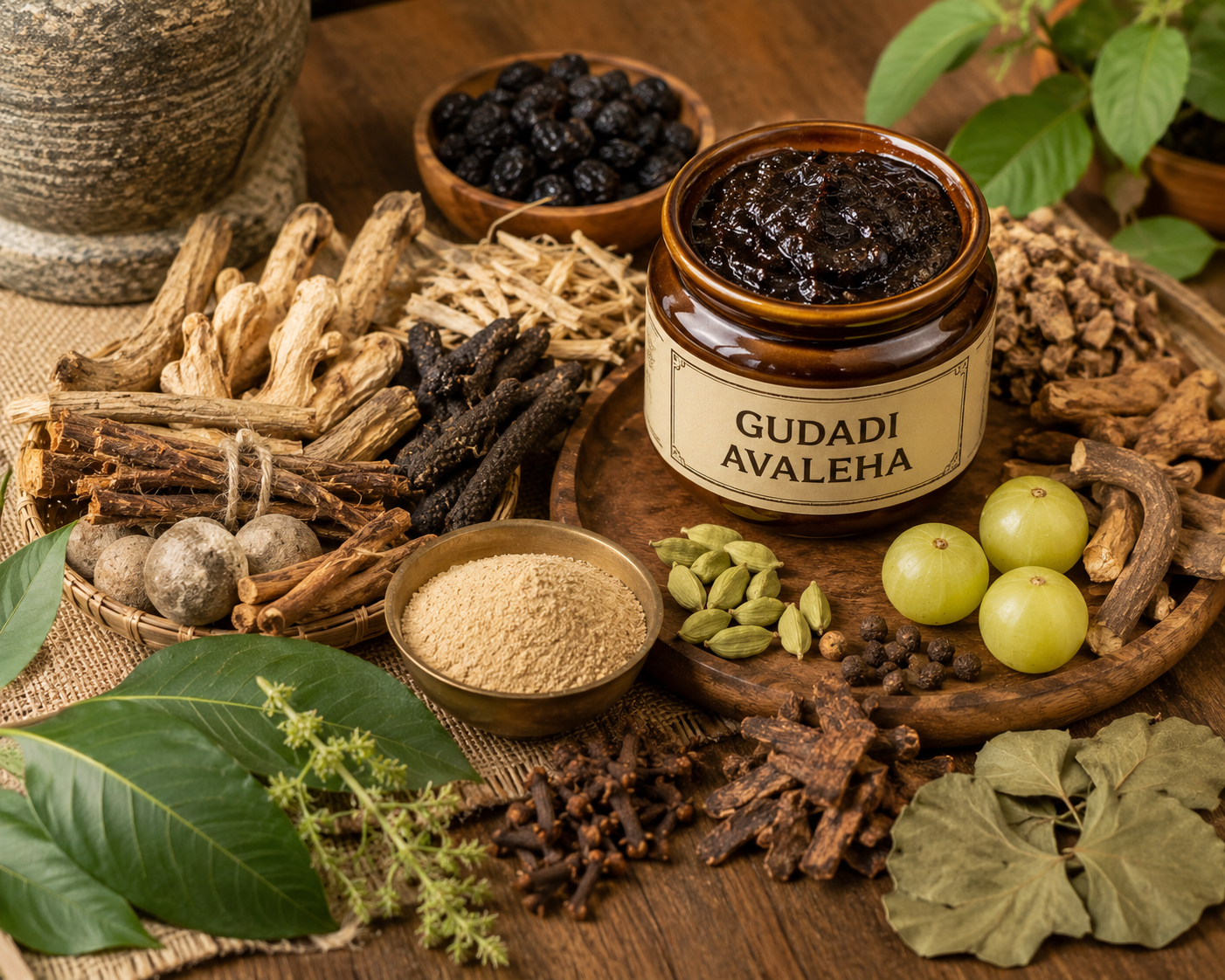
Gudadi Avaleha (Introduction, Benefits, and Usages)
Gudadi Avaleha benefits centre on respiratory health, digestive support, and strength restoration — making this classical Ayurvedic electuary (Avaleha) formulation one of the important preparations for Kasa (cough), Shwasa (asthma), and general debility recovery. Avaleha preparations are semi-solid, honey-based medicinal preparations that combine the therapeutic properties of multiple herbs in a form that is pleasant to consume and easily absorbed. See Wikipedia: Ayurveda. For related Ayurvedic formulations, explore Sitopaladi Churna and Talisadi Churna.
What Is Gudadi Avaleha? A Complete Introduction
Origin and History of Gudadi Avaleha
Gudadi Avaleha is a classical Ayurvedic formulation described in the Ashtanga Hridayam and Charaka Samhita traditions for respiratory and digestive conditions. The name derives from its primary ingredients — “Guda” (jaggery) and the formulation type “Avaleha” (electuary, from the Sanskrit root meaning “to lick”). Avaleha preparations have been used in Ayurveda for over 2,000 years — the combination of active herbal compounds in a honey or jaggery base was recognised as providing superior palatability and absorption compared to raw herb preparations. Gudadi Avaleha represents a specific formulation within this category, with ingredients chosen for their combined action on the respiratory and digestive systems.
Key Compounds and Active Profile
Gudadi Avaleha contains multiple herbs typically including Guda (jaggery) as the base, along with herbs such as Pippali (Piper longum), Shunthi (dried ginger), Maricha (black pepper), Haritaki (Terminalia chebula), and other formulation-specific ingredients depending on the classical text followed. Pippali provides piperine for enhanced bioavailability and bronchodilatory, expectorant, and immunomodulatory activity. Shunthi contributes anti-inflammatory shogaols and diaphoretic effects for respiratory conditions. Haritaki provides the rasayana and digestive tonic properties. Honey (if included) adds its own antimicrobial, soothing, and bioavailability-enhancing properties as an Anupana (vehicle). See Wikipedia: Piper longum.
Top Health Benefits of Gudadi Avaleha
Gudadi Avaleha Benefits for Respiratory Health and Overall Wellbeing
Gudadi Avaleha’s primary clinical application is respiratory disease — particularly productive cough, bronchitis, asthma, and respiratory weakness following illness. The Pippali content provides piperine and related alkaloids with documented bronchodilatory effects and mucolytic activity (thinning mucus for easier expectoration). Shunthi’s shogaols and gingerols reduce bronchial inflammation and have diaphoretic effects useful for fever accompanying respiratory infections. The formulation’s honey or jaggery base has soothing demulcent effects on irritated throat and bronchial mucosa, providing immediate symptomatic relief alongside the deeper therapeutic effects of the herbal components.
Gudadi Avaleha for Digestive Health and Strength
The Trikatu (Pippali, Shunthi, Maricha) component of Gudadi Avaleha provides potent Deepana (digestive stimulant) and Pachana (digestive) effects — stimulating Agni (digestive fire), increasing digestive enzyme secretion, and improving assimilation of nutrients. Haritaki adds Anulomana (promoting downward movement in the gut) and mild laxative action for constipation associated with Vata aggravation in chronic disease. The overall formulation is considered a Balya (strength-giving) and Rasayana preparation — restoring vitality and improving general health during recovery from chronic illness.
Medicinal Properties of Gudadi Avaleha
How Gudadi Avaleha Works as a Natural Remedy
Gudadi Avaleha’s mechanism is synergistic — multiple herbal compounds acting simultaneously on overlapping targets. Piperine enhances the bioavailability of all co-administered compounds through P-glycoprotein inhibition and CYP3A4 modulation, meaning the entire formulation is better absorbed when Pippali is present. The Trikatu combination stimulates gastric acid secretion, bile production, and pancreatic enzyme release — addressing digestive weakness at multiple levels. The mucolytic and expectorant effect of the combined formulation reduces bronchial mucus viscosity and stimulates the cough reflex to expel accumulated Kapha from the respiratory tract.
Gudadi Avaleha in Ayurveda and Traditional Medicine
In Ayurveda, Gudadi Avaleha is classified under Kasa Chikitsa (treatment of cough) and Shwasa Chikitsa (treatment of respiratory disease). The formulation addresses Kapha accumulation in the lungs and respiratory tract — the primary pathological mechanism in Ayurvedic understanding of chronic cough and asthma. It also corrects Vata-aggravated digestive weakness that commonly accompanies respiratory disease. The Avaleha (electuary) format is chosen deliberately — the thick, sweet, slowly-absorbed preparation coats and soothes the throat and bronchial mucosa as it is swallowed, providing both local demulcent benefit and systemic therapeutic absorption.
How to Use Gudadi Avaleha — Practical Usages
Gudadi Avaleha Dosage and Administration
The standard adult dose of Gudadi Avaleha is 5–10g twice daily — typically taken with warm water, warm milk, or honey as the Anupana (vehicle). Take 30 minutes before meals for digestive benefit, or at any time for respiratory applications. The preparation can be licked slowly off a spoon (the traditional Avaleha method) to maximise contact time with throat mucosa for cough and throat conditions. For children, the dose is typically half the adult dose, administered with honey to improve palatability.
Gudadi Avaleha as a Supplement
Gudadi Avaleha is available from established Ayurvedic manufacturers including Dabur, Baidyanath, and Arya Vaidya Sala. It should be used under Ayurvedic physician guidance for chronic respiratory conditions — particularly asthma and chronic bronchitis — as part of a comprehensive treatment protocol that may include other formulations, Panchakarma, dietary modification, and lifestyle recommendations. It’s generally safe for short-term use in acute cough and respiratory infections without prescription, but chronic conditions warrant professional Ayurvedic assessment.
Side Effects and Precautions of Gudadi Avaleha
- Pitta aggravation: the heating Trikatu ingredients can aggravate Pitta — people with acid reflux, gastritis, or Pitta-predominant constitution may need to use with caution or under guidance
- Diabetes: the jaggery/honey base contains significant sugars — use with caution in diabetic patients; some formulations use alternative bases or lower amounts
- Drug interactions: piperine in Pippali enhances bioavailability of many drugs — potentially beneficial but requires awareness if on pharmaceutical medications with narrow therapeutic windows
- Pregnancy: some formulations contain herbs with uterine-stimulating properties — use only under qualified Ayurvedic physician guidance during pregnancy
Frequently Asked Questions About Gudadi Avaleha
What are the main Gudadi Avaleha benefits?
Key Gudadi Avaleha benefits: expectorant and mucolytic action for productive cough and bronchitis, bronchodilatory effects from Pippali piperine, anti-inflammatory respiratory benefit from Shunthi shogaols, digestive stimulation from Trikatu combination, strength and vitality restoration as a Balya Rasayana preparation, throat soothing and demulcent action from the Avaleha base, and enhanced bioavailability of all components through piperine’s absorption-enhancing effects.
How is Gudadi Avaleha different from other Avaleha preparations?
Gudadi Avaleha is distinguished by its jaggery base and specific herb combination targeting respiratory and digestive conditions simultaneously. Other common Avaleha preparations include Chyavanprash (comprehensive Rasayana with Amla as primary ingredient), Vasavaleha (Vasa-based for bronchitis and bleeding), and Agastya Haritaki (for chronic respiratory disease). Each Avaleha has a specific dosha and disease target. Gudadi Avaleha specifically addresses Kapha-predominant respiratory disease with accompanying Vata digestive weakness.
Can Gudadi Avaleha be taken with other Ayurvedic medicines?
Yes, Gudadi Avaleha is typically used as part of a comprehensive Ayurvedic treatment protocol alongside other formulations. Common combinations include Sitopaladi Churna for additional respiratory support, Tulsi Ghan Vati for antimicrobial benefit, and Dashmularishta for overall Vata-Kapha balancing. The combination should be supervised by an Ayurvedic physician to ensure appropriate selection, dose, and sequencing of multiple preparations.
How long should I take Gudadi Avaleha?
For acute respiratory infections: 1–2 weeks alongside appropriate supportive care. For chronic respiratory conditions (chronic bronchitis, asthma, recurrent cough): typically 1–3 months as a therapeutic course, reassessing at each stage with physician guidance. As a general Rasayana for vitality and immunity: some classical texts prescribe seasonal courses of Avaleha preparations. The Balya and Rasayana properties make extended use reasonable for debilitated or elderly patients with appropriate dosage adjustment.
Where can I buy quality Gudadi Avaleha?
Buy from established GMP-certified Ayurvedic manufacturers — Dabur, Baidyanath, Kottakkal Arya Vaidya Sala, Nagarjuna, and AVN Arogya produce quality classical formulations. Check that the product follows classical text proportions and that manufacturing is GMP certified. Avoid unknown brands without manufacturing details. Consulting an Ayurvedic physician before purchase ensures the correct formulation for your specific condition — there are multiple Avaleha preparations for respiratory conditions, and selecting the right one requires proper assessment.
Gudadi Avaleha benefits are most fully realised when used as part of a complete Ayurvedic treatment approach for respiratory and digestive conditions. It’s not a standalone quick fix — it’s a classical formulation designed to work synergistically with appropriate diet, lifestyle, and other Ayurvedic treatments. For cough, bronchitis, and respiratory weakness during recovery, it provides a time-tested, multi-mechanistic treatment option that addresses both the symptom and the underlying Dosha imbalance.


Add comment