
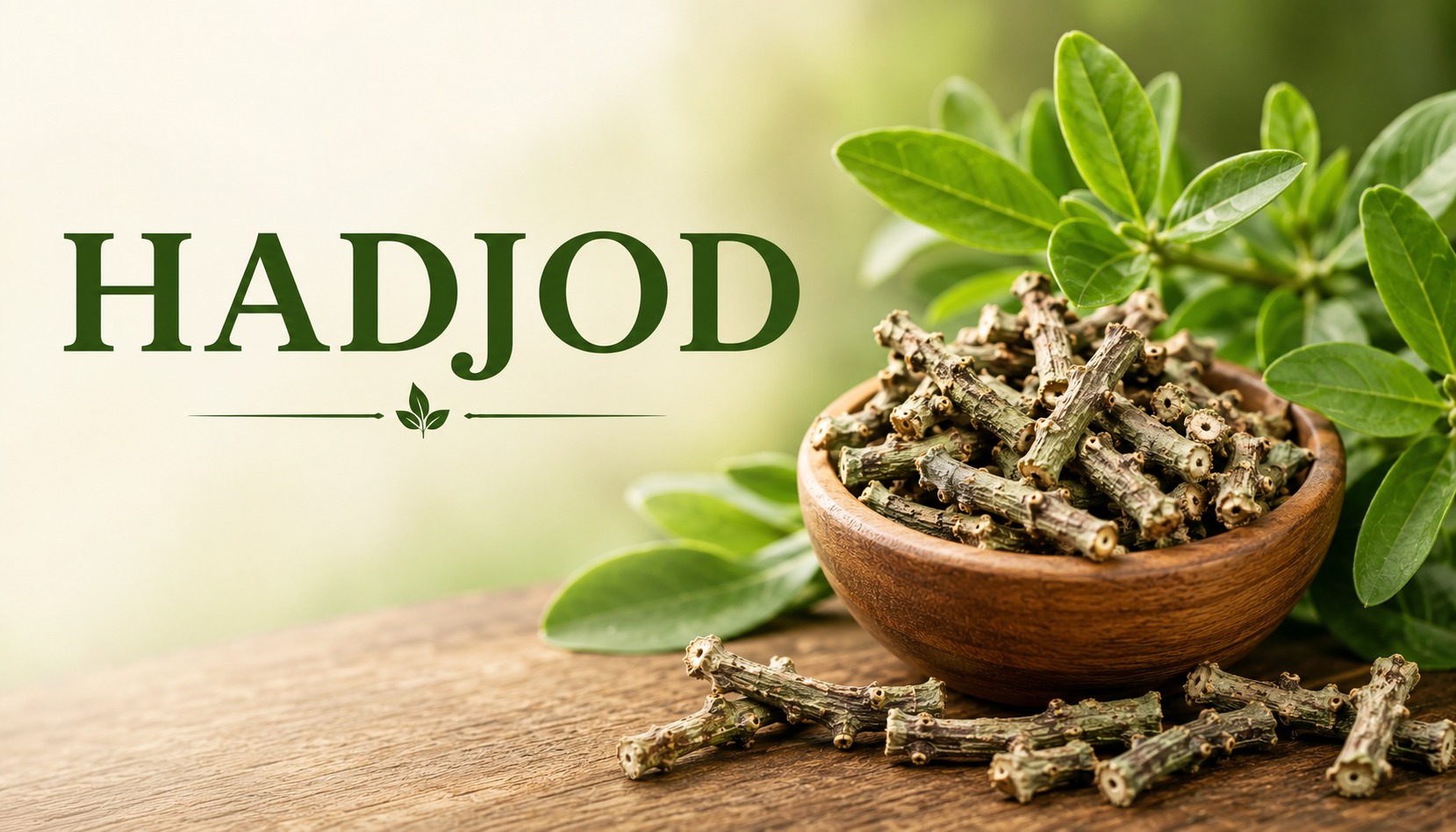
Hadjod (Introduction, Benefits, and Usages)
Hadjod benefits centre on bone healing, fracture recovery, and musculoskeletal health — making Cissus quadrangularis one of Ayurveda’s most clinically validated herbs for bone and joint conditions. The name Hadjod itself means “bone joiner” in Hindi, and clinical research confirms this isn’t just folklore — multiple trials demonstrate significantly accelerated fracture healing, improved bone mineral density, and anti-osteoporotic effects. See Wikipedia: Cissus quadrangularis. For related bone and joint herbs, explore Shallaki and Lakshadi Guggul.
What Is Hadjod? A Complete Introduction
Origin and History of Hadjod
Hadjod (Cissus quadrangularis) is a succulent vine in the grape family (Vitaceae), native to India, Sri Lanka, and parts of Africa and Southeast Asia. Its distinctive four-angled (quadrangular) stem and reddish-purple berries make it easily identifiable. The Charaka Samhita, Sushruta Samhita, and Ashtanga Hridayam all describe this herb for Bhagna (fracture) treatment and bone health. Sushruta used it in his famous surgical texts as a treatment for fractures — one of the earliest documented evidence-based surgical-herbal protocols. In Ayurveda, Hadjod is classified as Asthisamharaka (bone strengthener) — a direct description of its primary action. Traditional use for fracture healing is found not only in India but also in African traditional medicine systems, suggesting independent discovery of the same effect.
Key Compounds and Active Profile
Hadjod’s bioactive compounds include phytosterols (beta-sitosterol, delta-7-sterol) that mimic and support anabolic hormone signalling relevant to bone formation. Triterpenoids including onocer-8(26)-ene-3 alpha, 21 beta-diol and related compounds stimulate osteoblast (bone-forming cell) activity. Ketosteroids have anabolic effects on bone and muscle tissue. Vitamin C, carotenoids, and calcium are nutritionally present at significant levels in the fresh stem — directly providing raw materials for bone matrix synthesis and repair. Resveratrol-related compounds contribute antioxidant and anti-inflammatory effects relevant to injury recovery. See Wikipedia: Phytosterol.
Top Health Benefits of Hadjod
Hadjod Benefits for Bone Health and Overall Wellbeing
Hadjod’s bone-healing benefits are the most consistently evidenced. A randomised controlled trial found Cissus quadrangularis extract significantly accelerated fracture healing — patients showed 50–60% faster radiographic evidence of callus formation and bone consolidation compared to placebo. The mechanism involves stimulation of osteoblast proliferation and activity, enhanced calcium and phosphorus deposition in healing bone, and reduction of osteoclast (bone-resorbing cell) activity. For osteoporosis, clinical studies in postmenopausal women found Hadjod supplementation significantly improved bone mineral density and reduced markers of bone resorption over 6 months.
Hadjod for Joint Pain, Weight, and Skin
Hadjod has well-documented anti-inflammatory and analgesic effects on joint conditions. Clinical trials confirm significant pain reduction and improved joint function in osteoarthritis patients. For weight management, a randomised trial found Cissus quadrangularis supplementation significantly reduced body weight, waist circumference, and blood lipids in overweight adults — possibly through its effect on serotonin and cortisol pathways, and through appetite-modulating mechanisms. For skin, the vitamin C and antioxidant content supports collagen synthesis, and the anti-inflammatory compounds reduce skin inflammation — making Hadjod relevant for both wound healing and general skin health.
Medicinal Properties of Hadjod
How Hadjod Works as a Natural Remedy
Hadjod’s bone-healing mechanism involves multiple pathways. Phytosterols stimulate anabolic hormone signalling pathways that promote osteoblast differentiation and function. Triterpenoids directly stimulate osteoblast proliferation and calcium deposition. The Vitamin C content is essential for collagen synthesis in bone matrix (type I collagen makes up 90% of bone organic matrix). Anti-inflammatory compounds reduce the inflammatory phase of fracture healing that if prolonged, delays bone repair. The ketosteroids have mild anabolic effects that accelerate muscle and bone tissue regeneration during recovery. Together, these mechanisms comprehensively address all phases of fracture repair — inflammation resolution, callus formation, and bone remodelling.
Hadjod in Ayurveda and Traditional Medicine
In Ayurveda, Hadjod (Asthisamharaka, Asthisamdhani) is classified as Tikta (bitter) and Kashaya (astringent) in taste, with Laghu (light) and Ruksha (dry) qualities, heating, and primarily Vata-Kapha reducing. Its primary affinity is for Asthi Dhatu (bone tissue) — the most specific herbal action on bone in the Ayurvedic pharmacopoeia. Classical applications include Bhagna (fractures), Sandhivata (osteoarthritis), Asthi Kshaya (bone loss/osteoporosis), and Kati Shoola (lower back pain). In classical formulations, Hadjod is often combined with Lakshadi Guggul and sesame for bone and joint conditions. In African traditional medicine, Cissus stem paste is applied directly to fracture sites — reflecting the same bone-healing applications identified independently.
How to Use Hadjod — Practical Usages
Hadjod in Traditional Preparations
The fresh Hadjod stem can be consumed directly — the stem is peeled, the juice extracted, and taken with warm milk and honey (5–10 ml fresh juice daily). Dried Hadjod powder (Churna) at 3–5g twice daily with warm milk or ghee is the standard Ayurvedic preparation for fracture healing and osteoporosis. Traditional external application: fresh Hadjod stem paste mixed with sesame oil is applied to fracture sites and inflamed joints — the local anti-inflammatory and osteoblast-stimulating compounds provide both symptomatic relief and healing support through transdermal absorption.
Hadjod as a Supplement
Standardised Cissus quadrangularis extract (500–1500 mg daily, typically standardised to ketosteroid content) is the form used in clinical trials for fracture healing, osteoporosis, osteoarthritis, and weight management. For fracture healing: 500–750 mg twice daily during the healing period. For osteoporosis prevention: 500 mg once or twice daily as an ongoing supplement. For joint pain: 500–750 mg twice daily alongside anti-inflammatory support from Shallaki or Turmeric for synergistic benefit.
Side Effects and Precautions of Hadjod
- Digestive discomfort: some users experience mild gastric discomfort, nausea, or diarrhoea at higher doses — take with food to minimise; start with lower doses
- Hormonal effects: the phytosterol and ketosteroid content has mild hormonal activity — use with caution in hormone-sensitive conditions; discuss with a doctor if on hormone medications
- Pregnancy: avoid during pregnancy — the anabolic and hormonal compounds have insufficient safety data for pregnancy
- Blood sugar: some evidence suggests blood sugar-lowering effects — monitor glucose if on antidiabetic medication
Frequently Asked Questions About Hadjod
What are the main Hadjod benefits for health?
Key Hadjod benefits: accelerated fracture healing (50–60% faster callus formation in clinical trials), improved bone mineral density for osteoporosis prevention and treatment, anti-inflammatory and analgesic effects for osteoarthritis, weight management support through metabolic and appetite-modulating mechanisms, muscle recovery support through anabolic compounds, wound healing from vitamin C-driven collagen synthesis, and classical Ayurvedic bone tonic as the primary Asthisamharaka (bone strengthener) herb.
How long does Hadjod take to work for fractures?
In clinical fracture healing trials, radiographic evidence of improved callus formation was seen as early as 2–3 weeks with Hadjod supplementation, with significant differences from control at 6 weeks. Bone consolidation (fracture fully healed) was seen approximately 2–3 weeks earlier in the Hadjod group compared to control. For maximum benefit, start Hadjod supplementation as early as possible after fracture (ideally within 24–48 hours) and continue for the full healing period (typically 6–12 weeks depending on fracture severity).
Can Hadjod help with osteoporosis?
Yes. Clinical studies in postmenopausal women (the highest-risk group for osteoporosis) show Hadjod supplementation significantly improves bone mineral density and reduces bone resorption markers over 6 months. The phytosterol and triterpenoid content stimulates osteoblast activity (bone formation) while reducing osteoclast activity (bone breakdown) — the ideal dual action for osteoporosis treatment. As a complement to calcium, vitamin D, and lifestyle measures, Hadjod provides evidence-backed bone-protective benefit.
How to use Hadjod in Ayurveda for joint pain?
Hadjod for joint pain in Ayurveda: take 3–5g of Hadjod churna with warm sesame oil or warm milk twice daily. Apply fresh Hadjod stem paste mixed with sesame oil externally to painful joints. Combine with Lakshadi Guggul internally for classical Sandhivata (osteoarthritis) management. The Tiktakshira preparation (Hadjod decoction in milk) is a classical Ayurvedic protocol for bone and joint conditions. For comprehensive joint management, combine internal Hadjod with Panchakarma treatment including medicated Basti (enema) under qualified Ayurvedic physician guidance.
Is Hadjod good for weight loss?
Clinical evidence supports Hadjod for weight management. A randomised trial found Cissus quadrangularis supplementation reduced body weight by 3.6 kg, waist circumference by 4.9 cm, and significantly improved blood lipid profiles over 8 weeks in overweight adults, compared to placebo. The mechanism isn’t fully characterised but may involve serotonin pathway modulation (reducing appetite), cortisol reduction (reducing stress-related weight gain), and improved fat metabolism. It’s a useful addition to a weight management strategy, not a standalone solution.
Hadjod benefits are most significant for anyone dealing with fractures, osteoporosis, or joint conditions — these are the applications with the strongest clinical evidence and the deepest Ayurvedic validation. The name “bone joiner” is a direct, accurate clinical description, not marketing. If you’ve fractured a bone, start Hadjod supplementation immediately alongside conventional orthopaedic care. If you’re at risk for osteoporosis, make Hadjod part of your bone protection strategy alongside calcium, vitamin D, and weight-bearing exercise.


Add comment