Comparison guide
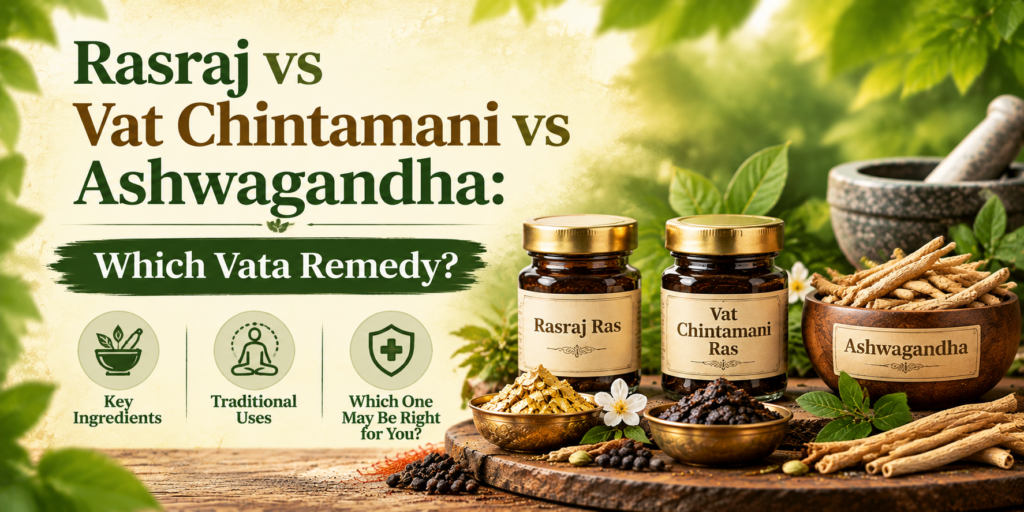
Rasraj Ras vs Vat Chintamani vs Ashwagandha
Three Vata formulations compared by ingredients, gold content and use.

People living with long-standing Vata complaints, such as stiffness, weakness in the limbs, tremor or poor sleep, often hear three names from friends and relatives: Rasraj Ras, Brihat Vat Chintamani Ras and Ashwagandha. They are sometimes spoken about as if they were interchangeable. They are not.
Two of them are gold-containing mineral medicines that only a doctor should prescribe. The third is a single herb that many people take as a daily supplement. This guide explains the differences so you can have a better conversation with your Vaidya.
Why Vata formulations exist in the first place
In Ayurveda, Vata dosha is responsible for movement: nerve signals, muscle action, breathing, circulation, elimination. With age, overwork, poor sleep or illness, Vata is said to become aggravated. The classical texts link this with dryness, stiffness, pain, tremors, weakness, anxiety and disturbed sleep.
Ayurvedic doctors address Vata through diet, oil massage, routine and medicines. Among medicines, there is a scale: gentle herbs at one end, potent Rasa Aushadhis (metal and mineral preparations) at the other. Ashwagandha sits at the gentle end. Rasraj Ras and Brihat Vat Chintamani Ras sit firmly at the potent end.
Rasraj Ras vs Vat Chintamani vs Ashwagandha at a glance
| Rasraj Ras | Brihat Vat Chintamani Ras | Ashwagandha | |
|---|---|---|---|
| Type | Rasa Aushadhi (herbo-mineral) | Rasa Aushadhi (herbo-mineral) | Single herb |
| Contains gold | Yes, Swarna Bhasma | Yes, Swarna Bhasma | No |
| Other key ingredients | Ras Sindoor, Abhrak, Lauh, Rajat and Vang Bhasma, Ashwagandha, clove, nutmeg | Rajat, Abhrak and Lauh Bhasma, Pravala and Mukta Pishti, Ras Sindoor | Withania somnifera root |
| Classical source | Bhaishajya Ratnavali | Bhaishajya Ratnavali | Charaka Samhita and many others |
| Traditional focus | Vata disorders of nerves and muscles, limb weakness | Vata disorders of nerves, muscles and joints, heart support, older adults | Strength, stress, sleep, general Rasayana |
| Typical dose | Milligrams, or as tablet | Milligrams | Grams of powder or capsules |
| Needs a prescription | Yes | Yes | Advisable, not always required |
The ingredient lists above come from the classical recipes and our product pages. Exact compositions vary a little by brand, so always check your pack.
Rasraj Ras in short
Rasraj Ras means “king of Ras medicines”. Traditionally, physicians use it when Vata weakness shows up in the nerves and muscles, such as weakness in the arms or legs during a long recovery. Interestingly, the formula itself contains Ashwagandha, alongside clove and nutmeg, combined with gold and other Bhasmas.
We stock two versions. Dabur Rasraj Ras with Gold comes as pre-measured tablets, and Patanjali Rasraj Ras comes as a 1 g pack for doctor-measured doses. We compare the brands in Rasraj Ras Gold: Patanjali vs Baidyanath vs Dabur.
Brihat Vat Chintamani Ras in short
Brihat (or Vrihat) Vat Chintamani Ras has a richer mineral profile, with silver, pearl and coral added to gold. Classical use leans towards the nervous system and the heart, and doctors often reserve it for older patients. Read more in our Vrihat Vat Chintamani Ras guide.
Ashwagandha in short
Ashwagandha is the herb most people already know. It is a classical Rasayana and Balya (strength-giving) herb, and it is one of the few Ayurvedic herbs with a reasonable number of modern human studies, mostly on stress, sleep and muscle strength. The studies are small, but the evidence base is better than for most herbs.
It is not risk-free. There have been reports of liver problems in a small number of people, it is not recommended in pregnancy, and it can interact with thyroid and sedative medicines. Our Ashwagandha guide covers this in more detail.
Why this is not a “pick one” decision
You will notice something about the table. Ashwagandha is gentle and widely used. The two Ras medicines are potent and specific. A Vaidya does not choose between them the way you would choose a brand of tea. They may:
- start with diet, routine, oil massage and a herb such as Ashwagandha
- add a Rasa Aushadhi only if the condition calls for it
- combine one Ras medicine with herbal support
- avoid Rasa Aushadhis entirely if your kidneys, liver or heart need protecting, or if you take many other medicines
None of these medicines is a replacement for neurological or cardiac care. If you have sudden weakness, numbness, slurred speech or chest pain, go to a hospital first.
Questions to ask your Vaidya
Take these to your next appointment:
- Do I actually need a Rasa Aushadhi, or can we start with herbs and lifestyle?
- Why this particular Ras medicine rather than the other?
- What dose, with what anupana, and for how long?
- Do I need any blood tests before or during the course?
- Is it safe with the medicines I already take? (Bring the list.)
- Which brand do you trust, and why?
- What side effects should make me stop and call you?
Buying and storage
Buy only sealed packs with batch number, dates and licence number printed. Store them tightly closed, away from heat and children. Our safe buying checklist for gold Ayurvedic medicines walks through the label checks step by step.
Frequently asked questions
Can I take Ashwagandha instead of Rasraj Ras?
They are not substitutes. Ashwagandha is a herb, and Rasraj Ras is a gold-containing mineral medicine. Your Vaidya decides which, if either, suits you.
Is Brihat Vat Chintamani Ras stronger than Rasraj Ras?
They are different rather than stronger or weaker. Brihat Vat Chintamani Ras has silver, pearl and coral added to gold, and its traditional use leans towards the nerves and heart in older patients.
Can these be taken together?
Only if your doctor prescribes it. Ashwagandha is part of the Rasraj Ras formula itself, so doubling up should be discussed first.
Do I need a prescription for Ashwagandha?
Not legally, but it is still wise to speak to a doctor if you are pregnant, have thyroid or autoimmune conditions, liver problems, or take regular medicines.
This comparison is for general information only and is not medical advice. Rasa Aushadhis should be taken only under the supervision of a registered Ayurvedic practitioner.