Dosage and safety
Swarna Vasant Malti Ras: Safe Use
Dosage principles, anupana, precautions and who should avoid it.

Most questions we get about Swarna Vasant Malti Ras are not about what it does, but about how to take it: how much, with what, for how long, and whether it is safe for a particular person. Those are the right questions to ask about any gold-containing medicine. This guide answers them as clearly as we can, while being honest that the final decisions belong to your doctor.
For what the medicine is and how it differs from Vasant Kusumakar Ras, see Swarna Vasant Malti Ras vs Vasant Kusumakar Ras: Traditional Differences and our Patanjali Swarna Vasant Malti Ras guide.
A quick recap
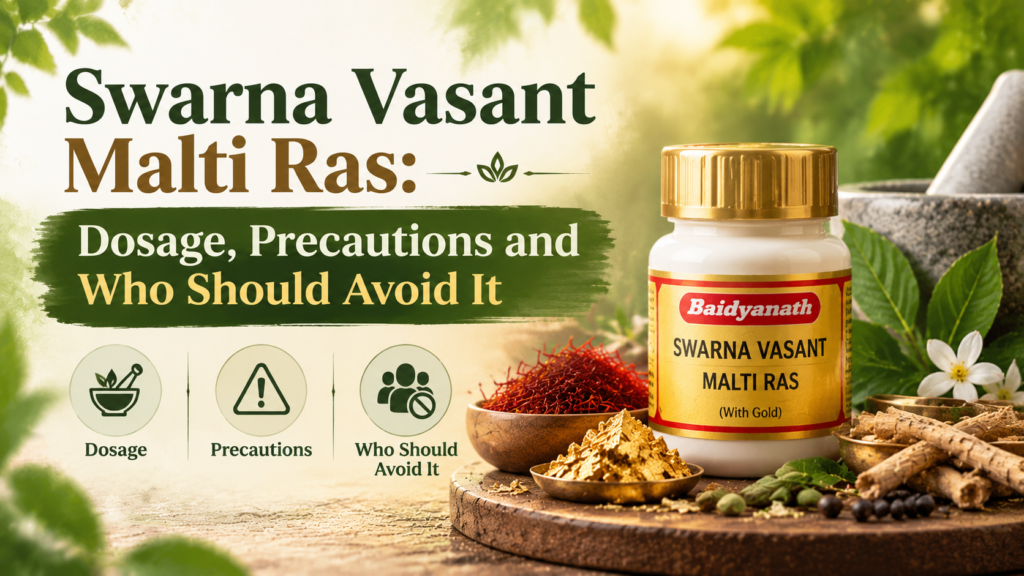
Swarna Vasant Malti Ras (also Suvarna Vasant Malti, or Basant Malti) is a classical Rasa Aushadhi from Bhaishajya Ratnavali and Yoga Ratnakara. Its listed ingredients include Swarna Bhasma (gold), Mukta Pishti (pearl), Shuddha Hingul, Maricha (black pepper) and Kharpar Bhasma, processed with fresh butter and lemon juice. It is traditionally used in chronic or recurring fever (Jeerna Jwara), for respiratory strength, during recovery from illness and as a Rasayana.
The general dosage principle: practitioner-directed
There is a reason Rasa Aushadhis do not come with a simple “take two a day” instruction on a 1 g pack. Three things decide the dose:
- The person. Age, body weight, digestive strength (Agni), constitution (Prakriti) and overall health.
- The condition. What it is being used for, how long it has been present, and what else is being treated.
- The form. Patanjali’s version is a 1 g powder, measured in milligrams. Dabur’s Basant Malti Ras (Gold) comes as tablets.
So the honest answer to “what is the dose of Swarna Vasant Malti Ras” is: whatever a registered Ayurvedic practitioner prescribes for you, usually in very small amounts, for a defined period.
Practical tips once you have a prescription
- Ask your doctor to show you how to measure the dose from the 1 g pack, or whether a tablet form would be easier.
- Take it at the times your doctor specifies.
- Do not “catch up” on a missed dose by doubling the next one.
- Keep a simple note of when you started and when your review is due.
Anupana explained
Anupana is the substance a medicine is taken with. In Ayurveda it is not a minor detail: the anupana is believed to help carry the medicine to where it is needed and to support its action.
For Swarna Vasant Malti Ras, the common anupanas are:
| Anupana | Why it is used, traditionally |
|---|---|
| Honey | A classical carrier for Rasa Aushadhis, considered to help absorption and to suit respiratory and Kapha conditions |
| Honey with Pippali powder | Pippali (long pepper) is traditionally used for the respiratory system and digestion, and complements the pepper in the formula |
| Other, as prescribed | Some doctors use milk, ghee or a specific decoction depending on the person |
Use only the anupana your doctor prescribes. A small but useful rule from Ayurveda: honey should never be heated or added to hot liquids.
Swarn Vasant Malti Ras precautions
Pregnancy and breastfeeding
Swarna Vasant Malti Ras is not for pregnant or breastfeeding women. Gold and other mineral preparations are avoided in pregnancy and during breastfeeding unless a specialist specifically decides otherwise.
Children
It is not for children unless prescribed by an Ayurvedic paediatric specialist, at a dose calculated for the child. Never give an adult’s medicine to a child.
Gold Bhasma safety
Properly prepared Swarna Bhasma has a long history of use in Ayurveda, but the safety of any Bhasma depends on how well it was made and how much is taken. To stay on the safe side:
- buy only from licensed manufacturers
- take only the prescribed dose for the prescribed period
- do not combine it with other Rasa Aushadhis unless prescribed
- ask your doctor whether kidney and liver tests are advisable during a longer course
Other conditions and medicines
- Liver, kidney or heart conditions, high blood pressure or diabetes: consult your doctor before use.
- Regular medicines: tell both your Ayurvedic and regular doctor everything you take.
- Ongoing fever: get it properly investigated. Swarna Vasant Malti Ras is supportive therapy, not a substitute for diagnosis and treatment of the cause.
Warning signs: stop and see a doctor
- tremors or dizziness
- stomach upset, vomiting or persistent loose stools
- a persistent metallic taste
- rash, itching or swelling
- any new or worsening symptom
Who should avoid it
| Avoid, unless a specialist decides otherwise | Check with your doctor first |
|---|---|
| Pregnant women | People with liver or kidney disease |
| Breastfeeding women | People with heart conditions or high blood pressure |
| Children | People with diabetes |
| Anyone with a known reaction to the formula | People on several regular medicines |
Diet during a course
During recovery from fever, the traditional advice is simple:
- eat light, warm, freshly cooked and easily digested food, such as khichdi, soups and moong dal
- avoid heavy, oily, fried and very cold foods
- drink warm water
- rest well and return to exercise gradually
Storage
- Keep the container tightly closed in a cool, dry place, away from sunlight and moisture.
- Use a clean, dry spoon or the measure your doctor gives you. Moisture can spoil the powder.
- Keep it well out of reach of children.
- Keep the outer box with the batch number until the pack is finished.
- Do not use it after the expiry date.
How to identify a genuine pack
- Check both seals, the outer box and the container.
- Look for the manufacturer’s name and address, drug licence number, batch number, manufacturing date and expiry.
- Confirm Swarna Bhasma is listed in the composition, since non-gold Vasant Malti also exists.
- Compare print quality with a known genuine pack.
- Be cautious of prices well below the usual listed price.
- Buy from a licensed pharmacy or established store.
We stock Patanjali Swarna Vasant Malti Ras 1 g, listed at ₹1,180 in October 2026, and Dabur Basant Malti Ras (Gold), listed at ₹939. Check the product pages for current prices. Our general checklist for buying gold Ayurvedic medicines safely has more detail.
हिंदी में: खुराक और सावधानियां
स्वर्ण वसंत मालती रस की खुराक केवल पंजीकृत आयुर्वेदिक चिकित्सक तय करते हैं, क्योंकि यह व्यक्ति की उम्र, पाचन शक्ति और स्थिति पर निर्भर करती है। इसे आम तौर पर शहद या शहद और पिप्पली चूर्ण के साथ दिया जाता है। गर्भवती महिलाएं, स्तनपान कराने वाली महिलाएं और बच्चे इसका सेवन न करें। लिवर, किडनी, दिल, ब्लड प्रेशर या डायबिटीज़ के मरीज़ पहले डॉक्टर से पूछें। बार-बार आने वाले बुखार की जांच पहले डॉक्टर से कराएं। दवा को ठंडी, सूखी जगह पर बंद डिब्बे में रखें।
Frequently asked questions
What is the dose of Swarna Vasant Malti Ras?
Your Ayurvedic doctor decides the dose, usually a very small amount measured in milligrams, for a defined period.
What is Swarna Vasant Malti Ras taken with?
Usually honey, or honey with Pippali powder, though your doctor may choose a different anupana.
Can Swarna Vasant Malti Ras be given to children?
Only if an Ayurvedic paediatric specialist prescribes it at a dose suitable for the child.
What are the side effects of Vasant Malti Ras?
Taken correctly under supervision, most people do not have problems. Stop and see a doctor if you notice tremors, dizziness, stomach upset, a metallic taste or a rash.
How long can I take it?
For the period your doctor prescribes. It is meant to be taken as a course with review, not indefinitely.
This article is for general information only. It is not medical advice. Take Rasa Aushadhis only on the prescription and under the supervision of a registered Ayurvedic practitioner.