Gold Rasayana comparison
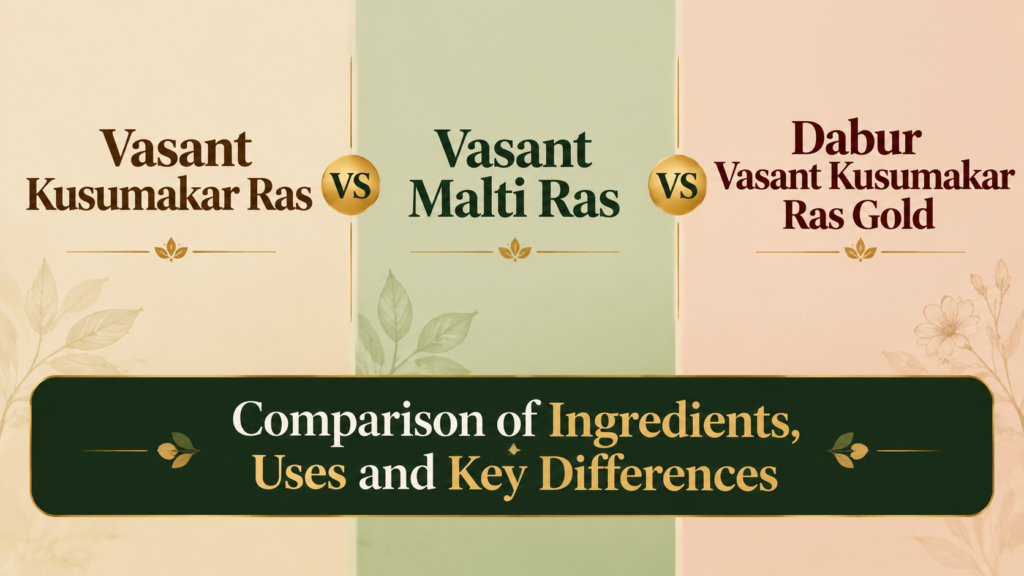
Vasant Kusumakar vs Vasant Malti Ras
Two gold medicines, two very different traditional uses.

The word Vasant means spring, and two of Ayurveda’s best-known gold medicines carry it: Vasant Kusumakar Ras and Swarna Vasant Malti Ras. The shared name and the shared gold content lead to a common mistake, where someone buys one when their doctor prescribed the other.
They are not interchangeable. This guide explains what separates them and how the Patanjali and Dabur versions of each compare.
The short answer
- Vasant Kusumakar Ras is traditionally used in Prameha (Ayurveda’s term for metabolic and urinary disorders) and as a Rasayana for strength, nerves and heart.
- Swarna Vasant Malti Ras is traditionally used in Jeerna Jwara (chronic or recurring fever), respiratory weakness and recovery after illness.
One leans towards metabolism and ageing. The other leans towards fever and convalescence.
Ingredients compared
| Vasant Kusumakar Ras | Swarna Vasant Malti Ras | |
|---|---|---|
| Gold (Swarna Bhasma) | Yes | Yes |
| Silver (Rajat Bhasma) | Yes | No |
| Other metals and minerals | Vang, Naag, Kant Lauh, Abhrak Bhasma, Ras Sindoor | Kharpar Bhasma, Shuddha Hingul |
| Pearl and coral | Mukta and Pravala Pishti | Mukta Pishti |
| Herbs and processing | Processed with juices of Vasa, Haridra, sugarcane, lotus and Chandan | Maricha (black pepper), processed with fresh butter and lemon juice |
| Classical sources | Bhaishajya Ratnavali | Bhaishajya Ratnavali, Yoga Ratnakara |
| Traditional focus | Prameha, Rasayana, nerves and heart | Chronic fever, respiratory strength, convalescence |
These compositions come from the classical recipes listed on our product pages. Brands vary slightly, so check your pack.
The ingredient lists explain the difference in use. Vasant Kusumakar Ras is the heavier, more complex formula with a large set of metals. Vasant Malti Ras is lighter, with black pepper and lemon pointing it towards the respiratory and digestive fire (Agni), which Ayurveda links with fever.
Vasant Kusumakar Ras: Patanjali vs Dabur
| Patanjali Divya Vasant Kusumakar Ras | Dabur Vasant Kusumakar Ras Gold | |
|---|---|---|
| Form | Ras (fine powder) | Tablets |
| Pack | 1 g | 10 tablets |
| Our listed price | ₹1,340 | ₹1,147 (about ₹115 per tablet) |
| Dosing | Milligrams, measured by your doctor | Pack guidance: 1 tablet once or twice a day with honey or milk, or as prescribed |
Prices as listed on our store in October 2026. Check the product page for the current price.
The difference between them is mostly practical. The Patanjali pack needs a doctor-measured dose. The Dabur tablets are pre-measured, which makes them easier to take consistently at home. Both are available here: Patanjali Divya Vasant Kusumakar Ras and Dabur Vasant Kusumakar Ras Gold.
For a full guide to the formula itself, read Divya Vasant Kusumakar Ras: benefits, ingredients and uses.
Swarna Vasant Malti Ras: Patanjali vs Dabur
Patanjali sells Swarna Vasant Malti Ras in a 1 g pack, while Dabur’s version is called Dabur Basant Malti Ras (Gold) and comes as 10 tablets. “Basant” is simply another spelling of Vasant.
Our guides on both: Patanjali Swarna Vasant Malti Ras and Dabur Basant Malti Ras.
Questions for your Vaidya
If you have been prescribed one of these, these questions are worth asking:
- Which one did you mean, Vasant Kusumakar or Vasant Malti? (Write the full name on the prescription.)
- Is the gold version specifically required?
- What dose, with what anupana, and for how long?
- Should I have any tests before or during the course?
- Is it safe with my other medicines?
That last question is especially important if you take medicines for diabetes. Vasant Kusumakar Ras is traditionally linked with Prameha, but it must never replace your diabetes treatment. We cover this in Vasant Kusumakar Ras and blood sugar: what Ayurveda actually says.
Authenticity checklist
Both medicines contain gold, and both are faked. Before you buy:
- check both seals, the outer box and the inner container
- look for batch number, manufacturing and expiry dates, and the manufacturer’s licence number
- read the composition panel and confirm Swarna Bhasma is listed
- be suspicious of prices far below the brand’s listed price
- buy from a licensed pharmacy or established store
Our checklist for buying gold Ayurvedic medicines safely goes into more detail.
Who should not take either
Neither medicine is suitable for pregnant or breastfeeding women or children. People with liver, kidney or heart conditions, high blood pressure or diabetes, or who take regular medicines, must check with their doctor first. Stop and seek advice if you notice tremors, dizziness, stomach upset or an allergic reaction.
How each one is made
Both medicines are made by the Rasashastra method of bhavana, which means grinding the Bhasmas for hours with a liquid until the liquid is absorbed, then drying and repeating. The liquids chosen are a big part of what gives each formula its character.
For Vasant Kusumakar Ras, the metal and mineral Bhasmas are ground with a series of plant juices and decoctions: Vasa (Malabar nut), Haridra (turmeric), sugarcane, lotus and Chandan (sandalwood), among others. Several of these are cooling and soothing in Ayurvedic terms, and sugarcane and lotus add a nourishing quality. The result is a formula the texts treat as a deep, slow-acting Rasayana.
For Swarna Vasant Malti Ras, the classical method is quite different. Swarna Bhasma, Mukta Pishti, purified Hingul and Maricha (black pepper) are rubbed with fresh butter until they blend, and then ground with lemon juice. Pepper is sharp and heating, and lemon is sour and stimulating to digestion. That combination points the medicine towards Agni, the digestive and metabolic fire that Ayurveda links with fever and recovery.
Because both processes take a long time and use gold, both medicines are expensive and both are targets for fake or diluted versions.
The traditional reading: who each one suits
Ayurvedic doctors do not choose between these two by the name of a disease alone. They look at the person.
Vasant Kusumakar Ras is usually considered for people who are depleted over a long period: older adults, people with long-standing Prameha, or those whose strength and stamina have worn down with age or chronic illness. Its nourishing, cooling-leaning processing is part of why it is thought of as a Rasayana for ageing and for the nerves and heart.
Swarna Vasant Malti Ras is usually considered for people who are weak after fever: recurring low-grade fevers, slow recovery after a respiratory illness, or ongoing tiredness and poor appetite after being unwell. Its sharper processing is meant to rekindle digestion and appetite while the gold supports strength.
This is why a doctor might prescribe Vasant Malti to a young adult recovering from a long fever and Vasant Kusumakar to a sixty-year-old with diabetes and low stamina, even though both medicines contain gold.
Anupana and diet during a course
The anupana, the substance a medicine is taken with, matters in Ayurveda because it is thought to carry the medicine to where it is needed.
| Vasant Kusumakar Ras | Swarna Vasant Malti Ras | |
|---|---|---|
| Common anupana | Honey, milk or butter, as prescribed | Honey, or honey with Pippali powder, as prescribed |
| Typical diet advice | Cut back on sweets, refined flour and day sleep, especially in Prameha | Light, warm, easily digested food while recovering from fever |
| Timing | As your doctor directs, often morning and evening | As your doctor directs |
These are general patterns. Your doctor may choose differently for good reasons, so follow the prescription.
वसंत कुसुमाकर रस और वसंत मालती रस में अंतर (हिंदी में)
दोनों दवाओं में स्वर्ण भस्म होती है, लेकिन इनका पारंपरिक उपयोग अलग है। वसंत कुसुमाकर रस को आयुर्वेद में प्रमेह, बढ़ती उम्र की कमज़ोरी, नसों और हृदय के सहयोग के लिए रसायन के रूप में दिया जाता है। स्वर्ण वसंत मालती रस को पुराने या बार-बार आने वाले बुखार (जीर्ण ज्वर), बीमारी के बाद की कमज़ोरी और श्वसन तंत्र के सहयोग के लिए दिया जाता है। दोनों रस औषधियां हैं, इसलिए इन्हें सिर्फ़ पंजीकृत आयुर्वेदिक चिकित्सक की सलाह से ही लें। गर्भवती महिलाएं और बच्चे इनका सेवन न करें।
Frequently asked questions
Can Vasant Kusumakar Ras and Vasant Malti Ras be taken together?
Only if your doctor prescribes both. They are sometimes used in sequence or together in specific cases, but taking two gold Rasa Aushadhis without supervision doubles your intake of metals.
Is long-term use safe?
These medicines are meant to be taken in courses with regular review, not indefinitely. Ask your doctor how long your course should be and whether you need blood tests during it.
Can I take Vasant Malti Ras instead of Vasant Kusumakar Ras?
No. They have different ingredients and different traditional uses. Take the one your doctor prescribed.
Which is stronger?
Neither is simply stronger. Vasant Kusumakar Ras has a larger set of metals and is used for long-term Rasayana and Prameha support. Vasant Malti Ras is used for chronic fever and recovery.
Is Dabur Vasant Kusumakar Ras Gold the same as Patanjali Vasant Kusumakar Ras?
Both follow the classical formula. Dabur’s comes as pre-measured tablets, and Patanjali’s as a 1 g pack for doctor-measured doses.
Is Basant Malti the same as Vasant Malti?
Yes. Basant and Vasant are two spellings of the same word.
This comparison is for general information only. It is not medical advice. Take Rasa Aushadhis only on the prescription of a registered Ayurvedic practitioner.