Buyer's checklist
Buying Gold Ayurvedic Medicines Safely
Read the label, check the licence and know the red flags before you pay.

A one-gram pack of a gold Ayurvedic medicine can cost more than a month’s supply of most herbal products. Those prices attract counterfeiters, and the ingredients themselves (processed gold, silver, mercury compounds, iron, mica) are not things you want to get wrong. A badly made Bhasma is not just useless. It can be harmful.
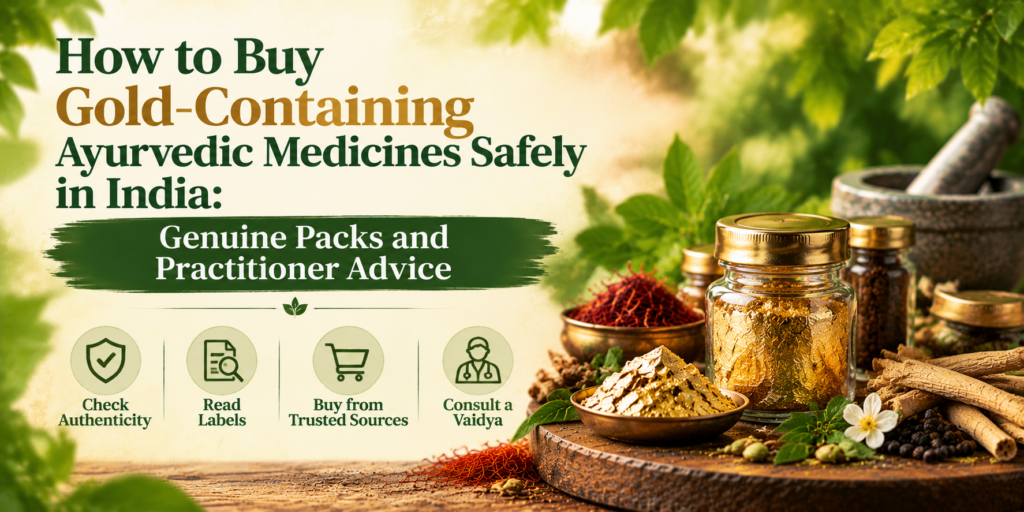
This is the checklist we would want a family member to use before buying any gold-containing Ayurvedic medicine.
What Rasa Aushadhi and Bhasma actually mean
Ayurvedic medicines fall broadly into two groups. Most are herbal: churnas, kwaths, arishtas, oils. A smaller group comes from Rasashastra, the branch of Ayurveda that works with metals and minerals. Medicines from this branch are called Rasa Aushadhi.
A Bhasma is a metal or mineral that has been purified (shodhana) and then reduced to a fine ash (marana) through repeated cycles of grinding with herbal juices and controlled heating. The classical aim is to turn the metal into a form the texts consider safe and absorbable. When this is done properly it takes skill, time and a lot of fuel. When it is rushed, metal particles can remain.
Gold-containing Rasa Aushadhis you may come across include:
- Vrihat Vat Chintamani Ras
- Rasraj Ras Gold
- Yogendra Ras
- Vasant Kusumakar Ras
- Swarna Vasant Malti Ras
- Swarna Bhasma on its own
Why a doctor should be involved
This is not a formality. Studies have repeatedly found heavy metals in Ayurvedic products sold without supervision. A 2008 study published in JAMA tested Ayurvedic medicines bought online and found lead, mercury or arsenic in about one in five of them, with Rasashastra products more likely to contain metals than purely herbal ones.
Supporters of Rasashastra argue that properly processed Bhasmas behave differently from raw metals, and some research on Bhasma particle size supports parts of that argument. Either way, the practical conclusion is the same: these medicines need the right preparation, the right dose and someone keeping an eye on you.
A qualified Ayurvedic doctor will:
- decide whether a Rasa Aushadhi is needed at all
- choose the dose, often in milligrams, and the anupana (carrier such as honey or milk)
- set a duration and review you during the course
- know which other medicines and conditions make it unsuitable
If a seller on social media is “prescribing” gold medicines in a chat, walk away.
Reading the label: what should be printed
Under Indian drug rules, a licensed Ayurvedic medicine pack should carry the following. Check each one.
| Label item | What to look for |
|---|---|
| Manufacturer name and address | A real, traceable pharmacy, not just a brand name |
| Drug manufacturing licence number | Printed clearly, often marked “Mfg. Lic. No.” |
| Batch number | Should match on the outer box and the inner container |
| Manufacturing and expiry dates | Clearly printed, not handwritten or stickered over |
| Composition | Each Bhasma or herb listed with quantity per tablet or per gram |
| Classical reference | Many packs name the source text, e.g. Bhaishajya Ratnavali |
| Dosage and warnings | “To be taken under medical supervision” is standard for Rasa Aushadhis |
If the composition panel just says “Ayurvedic herbs and minerals” without listing quantities, that is a warning sign for a gold product.
Spotting a genuine sealed pack
- Two seals. The outer box should be sealed, and so should the bottle or blister inside.
- Print quality. Blurry text, spelling mistakes in the brand name, or a different shade of the brand colour are common signs of fakes.
- Weight and size. Compare with the pack size printed on the box. A “1 g” pack should not look half full.
- Price. Gold medicines have a floor price because of the gold content. If one is selling at half the listed price, ask why.
- Seller. Buy from a licensed pharmacy or an established store that sends a proper invoice. Avoid loose, unlabelled powders and homemade “Bhasmas”.
After you buy
- Keep the box. If anything goes wrong, the batch number is what the manufacturer will ask for.
- Store the medicine tightly closed in a cool, dry place, out of children’s reach.
- Write down the dose your doctor gave you and stick to it.
- Stop and call your doctor if you notice tremors, dizziness, persistent stomach upset, unusual tiredness or a rash.
The gold medicines we stock
Every pack we send is brand-sealed with the batch number and expiry printed on it. Our classical Ras range includes Patanjali Vrihat Vat Chintamani Ras, Patanjali Rasraj Ras, Dabur Rasraj Ras with Gold, Patanjali Yogendra Ras and Dabur Swarna Bhasma. Buy them with a prescription in hand, and if your doctor names a particular brand, choose that one.
Frequently asked questions
Are gold Ayurvedic medicines safe?
When properly prepared, prescribed and monitored, they have a long history of use in Ayurveda. The risks come from poor preparation, wrong doses and self-medication. Take them only under a registered Ayurvedic practitioner.
How can I tell if Swarna Bhasma is real?
At home you cannot test it reliably. Rely on a licensed manufacturer, an intact seal, a full composition panel and a reputable seller. Our Swarna Bhasma guide explains how genuine Bhasma is made.
Why are these medicines so expensive?
Gold is costly, and classical preparation involves many rounds of processing over days or weeks. That is also why very cheap versions deserve suspicion.
Can I buy a Rasa Aushadhi without a prescription?
Many are sold over the counter in India, but that does not make self-medication a good idea. Get a prescription first.
This guide is for general information. It is not medical advice. Consult a registered Ayurvedic practitioner before taking any Rasa Aushadhi.